


Crypto’s second life: not money, but infrastructure
Born from the wreckage of the 2008 financial crisis, cryptocurrency once promised to replace the global monetary system. Instead, it has evolved into something narrower but arguably more influential
Cryptocurrency, the champion’s champion of free market economists, has had a rollercoaster ride since Bitcoin’s inception in 2008. Its explosive growth in 2017 triggered a series of violent market cycles and drew intense regulatory scrutiny, including China’s blanket ban on all crypto-related transactions and mining. Based on a vision of an economic system beyond the reach of governments, immune to inflation, and frictionless across borders, Bitcoin promised to do what centuries of monetary experimentation had struggled to achieve: combine the scarcity of gold with the utility of the US dollar.
That moment seems to have passed. Crypto has not displaced the dollar, which remains embedded in global trade, finance and reserves. Nor has it meaningfully challenged gold, which continues to be a bellwether for perceptions of long-term value. Even in its most ambitious experiments, cryptocurrency has struggled to function as a stable medium of exchange. Volatility, regulatory resistance, and limited real-world adoption have all constrained its monetary ambitions.
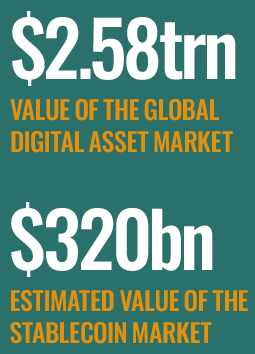
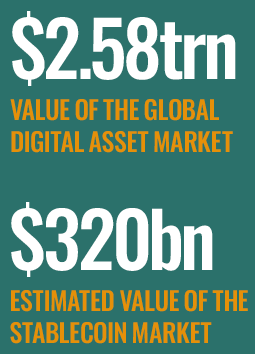
Yet to dismiss crypto as a failure would be to misunderstand what it has become. Far from disappearing, digital assets have evolved into a market worth roughly $2.58trn, increasingly functioning less as money and more as infrastructure. Cryptocurrency, rather than replacing the current system, has emerged as a form of financial infrastructure, most visible not at the centre of the global economy, but at its edges.
This has become particularly apparent in recent months with the evolving use of cryptocurrencies in geopolitically constrained environments. Amid the continuing fallout of the US–Israel ‘special operation,’ Iranian officials and state-linked industry representatives discussed proposals to collect a $1 per barrel tariff from tankers crossing the Strait of Hormuz, payable in bitcoin.
According to Hamid Hosseini, a spokesperson for Iran’s Oil, Gas and Petrochemical Products Exporters’ Union, “vessels are given a few seconds to pay in bitcoin, ensuring they can’t be traced or confiscated due to sanctions.”
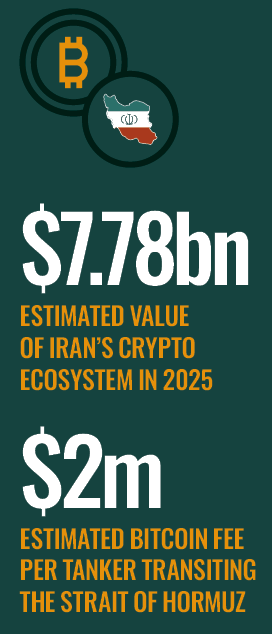
This equates to a $2m fee per tanker transiting the strait and effectively embeds digital assets into one of the world’s most strategically important trade routes. This is not a move based on the adoption of a new financial doctrine. It is far more pragmatic than that. It is a method that serves to bypass the dollar-based system and creates a payment channel that is difficult to monitor or block.

The failure of the currency thesis
Following the global financial crash of 2008, the overall sentiment towards banks was one of deep mistrust. It is out of this mistrust that cryptocurrency emerged; it was “a backlash against the failings of the conventional financial system,” writes Hyun Song Shin, economic adviser and head of research at the BIS, in a 2022 op-ed for the Financial Times. Cryptocurrency promised a self-sustaining peer-to-peer system that bypassed banks altogether.
In practice, however, cryptocurrency does use intermediaries: crypto exchanges such as Binance, Coinbase and Kraken. Shin goes on to say that while the banks are regulated, it is often “the founder and a small number of venture capital backers that are in charge” when it comes to the protocols governing cryptocurrency.
If bitcoin were a country, it would rank 23rd in terms of energy use
The jailing of Sam Bankman-Fried and subsequent collapse of his cryptocurrency exchange FTX is perhaps the most high-profile example of what can happen when there is a lack of governance and risk management. After a liquidity crisis at the exchange, it emerged that Bankman-Fried had defrauded customers at FTX to the tune of $8bn, taking their deposits and funnelling them to his trading firm, Alameda Research, for use on investments, loans, political donations and real estate.
The scale of the fraud also highlights the growth of cryptocurrency, something that simply would not be possible without the symbiotic relationship that these centralised intermediaries provide. They are the growth engine for the entire industry, so while a return to the original decentralised vision might be the ideal, it is fraught with problems. As Shin argues, “crypto would not have grown to its current size without these entities channelling funds into the sector.”

On a basic level, our financial system relies on money being a medium of exchange, a store of value and a unit of account. There is little evidence that crypto reliably performs any of these functions. As a medium of exchange, transactions are inefficient. Some of these bottlenecks are technical, with bitcoin transactions slow to confirm and transactions sometimes failing during contract execution. Other constraints are economic, with large fluctuations in price affecting real-time payments. This is before accounting for the substantial energy use and transaction costs involved. A 2025 report by Digiconomist found that if bitcoin were a country, it would rank 23rd in terms of energy use, with 204.44TWh (terawatt hours) per year.
As a store of value, cryptocurrency fails because its extreme volatility makes setting price difficult, with bitcoin price exacerbated by its typical four-year boom and bust cycles. In an article for Empirical Economics, Baur and Dimpfl write that “the volatility of Bitcoin prices is extreme and almost 10 times higher than the volatility of major exchange rates.” Finally, as a unit of account cryptocurrency never really escaped the gravitational pull of the dollar. Markets are priced in USD, and there is almost no real-world pricing in cryptocurrency.
Crypto on the edge
If crypto has failed as a basic form of currency, then where does it actually work? The answer lies at the fringes of the financial system. First and foremost, cryptocurrency is a way of getting around sanctions. Iran’s Strait of Hormuz bitcoin toll is a prime example. According to Virginia Pietromarchi in an article for Al Jazeera, “Iran’s crypto ecosystem was valued at more than $7.78bn last year, growing at a faster pace compared with 2024.”
The global financial order is becoming less universal and more regionalised
Its rapid growth in the country among citizens in recent years is due to higher inflation and a fading currency, but as Pietromarchi goes onto say, the IRGC have been prominent users of the in-country chain as well. “Harder to trace and easier to transfer than traditional bank payments, crypto offers a way to sell oil, buy weapons and commodities, circumventing sanctions.”
That is not to say that circumventing sanctions is all plain sailing though. A May 7th press release from the US Department of the Treasury states that the “treasury is aggressively advancing ‘Economic Fury’ and has disrupted billions in projected oil revenue, taken actions that have led to the freezing of nearly $500m in regime-linked cryptocurrency, and cracked down on Tehran’s shadow banking networks.”
Following Russia’s invasion of Ukraine in early 2022, sanctions rained down upon the country from all quarters, leading to Russia’s exit from mainstream correspondent banking and exclusion from SWIFT, cutting off their ability to make international money and securities transfers. According to crypto journalist and editor Phil Haunhorst, “Russia will legalise crypto payments in foreign trade on July 1, 2026. Exporters will gain a legal path to accept Bitcoin (BTC) and stablecoins from buyers cut off from Western banking.”
Crypto-facilitated international trade has allowed Russian exporters to pay their bills, notably to their largest trading partners China and India for the export of oil. In 2025, these transactions were responsible for roughly 1trn rubles ($11bn). Russia’s approach illustrates how crypto has evolved from a speculative retail phenomenon into a state-enabled settlement layer. Rather than replacing banking infrastructure outright, it supplements sanctioned economies that have lost access to conventional payment channels.
According to Gonzalo Saiz Erausquin, Research Fellow at defence and security thinktank, RUSI (Royal United Services Institute), “Crypto-enabled settlement is now embedded in Russia’s procurement model, linking diverted CHPI supply chains with alternative payment mechanisms designed to blunt the disruptive effects of sanctions.” Cryptocurrency has now evolved from the purview of cybercriminals into “a systemic, state-tolerated and in some cases state-enabled payment rail for military procurement.”
The implications of such systems are deeply ambiguous. The same networks that allow citizens to protect savings from inflation and capital controls can also facilitate sanctions evasion, illicit procurement, and opaque cross-border transfers. One of the problems with a decentralised financial system, no matter if the transactions are viewable to all on the blockchain ledger, is a lack of accountability. Where the balance lies is arguably in its retail use. For citizens residing in unstable economies where one might want to place assets beyond the control of local authorities, cryptocurrency is a handy alternative to bypass traditional banking restrictions.
One could argue that capital flight in heavily indebted countries isn’t particularly healthy, but as a 1989 Bank of England note observed, capital flight is often better understood as a symptom of weak domestic policy than a cause of economic deterioration in itself: “inappropriate policies, for example price controls, may well drive a significant wedge between the private returns to the investor and the social returns to the country at large.”
Financial plumbing
Bitcoin’s most enduring role has arguably been as a speculative asset, held less for utility than conviction. As a unit of account, as a store of value, as a medium of exchange, this investing philosophy sits at odds with its self-proclaimed status as a currency. In this sense, it cannot become money. But it can become infrastructure.
Traditionally, SWIFT, banks and settlement systems provide the infrastructure for transfers. Naturally, these are appropriately regulated and therefore relatively secure, but comparatively slow. SWIFT transfers can take between one and five days to complete, whereas blockchain provides direct peer-to-peer transfers and settlements are completed in seconds or minutes at most.
Stablecoins sit at the intersection of these two systems. Worth roughly $320bn and accounting for around 11.5 percent of total crypto market capitalisation, they function as a bridge between conventional finance and decentralised settlement. As the name suggests, they offer a more stable alternative to the dramatic price swings of crypto assets such as Bitcoin. But how exactly do they differ from cryptocurrency? According to a 2025 IMF article authored by Adrian, Miccoli and Sugimoto, “the main difference is that stablecoins are centralised (meaning they are run by a specific company) and are mostly backed by conventional and liquid financial assets, like cash or government securities. Most stablecoins are denominated in US dollars and are typically backed by US Treasury bonds.”
A digital asset backed by the dollar is essentially backing up the dollar, rather than competing with it, which helps to mitigate (but not wholly address) the central concern of governments, banks and financial institutions everywhere: losing control over capital flows. A decentralised financial system bypasses them altogether.
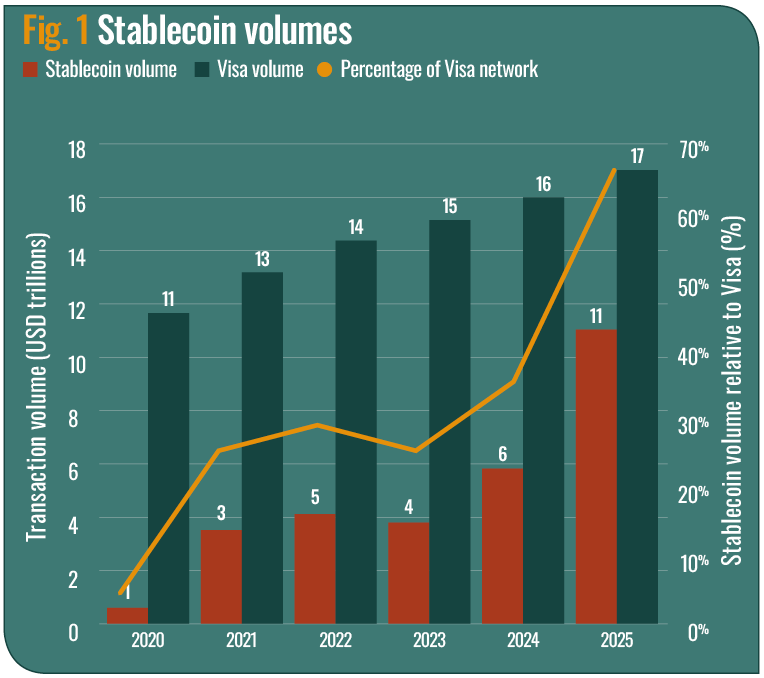
Stablecoins offer some management over this and their use has been steadily increasing in recent years (see Fig 1). According to the IMF, “the market capitalisation of the two largest stablecoins has tripled since 2023, reaching a combined $260bn. Trading volume has increased 90 percent, amounting to $23trn in 2024.”
The use of stablecoins has helped promote the idea of cryptocurrency as a sort of routing layer, where fiat is converted into crypto, transferred across borders and then converted back again. This is particularly evident in remittance markets and dollar-short economies. In countries where access to hard currency is limited or banking systems are unreliable, stablecoins increasingly function as synthetic digital dollars. In Argentina, businesses and households have used USDT to protect savings from peso devaluation. In parts of Africa and Southeast Asia, freelancers and exporters now receive payment in stablecoins to avoid correspondent banking delays and local currency volatility. Rather than replacing the dollar system, crypto in many cases extends it, allowing users to access dollar liquidity without touching the formal banking sector at all. Heavily at odds with the enduring Bitcoin whitepaper vision of eliminating trusted third parties such as banks in favour of direct online transfers, crypto is weaving itself into the gaps of the existing financial system, shoring up its weaker points.
What happens next?
The governmental response to crypto has been mixed at best. Initially, decentralised cryptocurrencies were dismissed by central banks as structurally disruptive, reducing the effectiveness of capital controls by allowing citizens to circumvent the system entirely. They have since been forced to walk back those statements, realising that cryptocurrency wasn’t going away and the technology behind it could be beneficial if adopted.
Central banks that initially dismissed crypto have increasingly moved toward experimentation themselves. Ecuador briefly trialled one of the earliest state-run digital currencies before shuttering it amid low adoption, while dozens of central banks are now exploring CBDCs of their own.
According to an article published by the IMF, “as of July 2022, there were nearly 100 CBDCs in research or development stages and two fully launched: the eNaira in Nigeria, unveiled in October 2021, and the Bahamian sand dollar, which made its debut in October 2020.” JAM-DEX (Jamaica Digital Exchange) became the third, launching in 2022.
There are currently 41 CBDC projects being piloted across global economies including Russia’s digital ruble, Brazil’s Drex, China’s e-CNY, India’s Digital Rupee and Europe’s Digital Euro. The defining mission behind each of the three operational CBDCs appears to primarily be a drive for financial inclusion, especially in the case of the sand dollar, where “the need to serve unbanked and under-banked populations across more than 30 of its inhabited islands” was a motivating factor, according to the IMF.
To put it kindly, the central banks have had to play catch-up. While there are several reasons behind the development of CBDCs, the most obvious one seems to be that it was necessary. The advent of cryptocurrency has forced them to upgrade their antiquated systems and bring them into a new technological era. Where crypto has its decentralised rails, governments are now building sovereign digital alternatives.
Stablecoins are also becoming more institutional; according to an LSE Business review article “the rapid growth of dollar-backed stablecoins is reshaping monetary dynamics,” expanding the reach of the dollar. While stablecoins do seem to reinforce dollar hegemony, increased stablecoin activity in any country that isn’t the US runs the risk of reducing its central bank’s control over domestic liquidity. It is not without a sense of irony that crypto’s greatest success may be extending the reach of the dollar rather than replacing it.
Global and central banks are also moving tokenisation projects from sandbox to pilot, with the BoE reporting that it is collaborating with private banks to explore DLT (digital ledger technology) to “facilitate faster, cheaper processes – with fewer intermediaries, shorter settlement windows and smart contracts automating routine processes.” In America, five US banks are moving onto an Ethereum-based tokenised deposit system in a shift towards a more modern payments industry. In Asia, the Hong Kong Monetary Authority (HKMA) has tier-one banks such as HSBC, Standard Chartered, and Bank of China piloting the execution of real-value, cross-bank transfers of tokenised deposits. Similarly, in Singapore, Standard Chartered is processing real-time global treasury operations on its blockchain.
An environment of global shocks
The timeline of recent years has been one of global shocks. These crises, whether they are health, geopolitical conflict or natural disaster-related, generally have a disastrous effect on supply chains, causing a knock-on effect in the price of essential commodities and a spike in inflation. As Forklog, a blockchain and digital currency magazine, points out; “in an environment of high inflation and strict capital movement controls, Bitcoin becomes a tool of financial freedom and a hedge against fiat devaluation, shedding its status as a purely speculative asset.”
In this sense then, cryptocurrency has been less of a revolutionary financial vehicle and more useful as a hedge against inflation and an enabler of capital mobility. It has acted as a pressure valve in unstable economies, perhaps most notably in Venezuela, where years of hyperinflation has resulted in citizens turning to bitcoin to protect their wealth, buy essential goods and receive money from relatives abroad. An article for Zenledger points out that “between August of 2014 and November of 2016, the amount of Bitcoin users in Venezuela skyrocketed from 450 to a staggering 85,000.”
The revolution promised by Bitcoin never fully arrived
Similar stories play out in other high-inflation countries, like Argentina, Turkey and Nigeria. Turkey boasts some of the highest crypto adoption rates in Europe and the Middle East, while Argentina and Nigeria have both turned to dollar-backed digital tokens for everyday transactions.
The future of crypto is now narrower than its past promises. As the IMF acknowledges, “Tokenisation and stablecoins are here to stay. But their future adoption and the outlook for this technology are still mostly unknown.” We must also acknowledge the continuing fragmentation of global finance into competing geopolitical blocs and take into account the volatile US tariff landscape, alongside a rising number of global sanctions – Russia and Iran topping the list, respectively.
Parallel systems
Crypto seems to be a good match for a fragmenting world, finding its place within blocs, where their underlying blockchain technology acts as a force for fragmentation in both the financial system and the technological landscape by creating siloed networks and encouraging divergent regulatory approaches.
The global financial order is becoming less universal and more regionalised. Sanctions, export controls, tariffs and technological decoupling have all increased the incentive to develop parallel systems for trade and settlement. Crypto is unlikely to become the foundation of a new monetary order, but it is increasingly useful within fractured ones. In that sense, digital assets resemble financial adaptation tools: not strong enough to replace sovereign currencies, but flexible enough to operate around the political constraints attached to them.
To be clear, crypto is not going to replace the dollar, it won’t dominate trade or become universal money, but it does have a place in the financial system. The revolution promised by Bitcoin never fully arrived. Yet in the spaces where traditional finance is weakest, slowest or politically constrained, crypto has quietly embedded itself into the machinery of global commerce.

