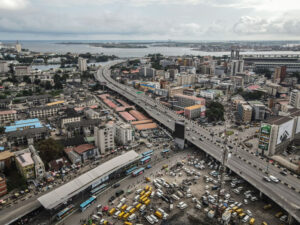
The biggest shock appointment of the year so far isn’t England manager Roy Hodgson, but an overlooked Nigerian who should have taken top job at the World Bank
Waging wars against oil subsidies to the middle classes, Nigeria’s central banker, Dr Lamido Sanusi, is not short of adversaries
Europe’s banks have relied on the ECB yet again. But will funds be distributed fairly?
Sourcing funds for investment in Russia remains a challenge even with positive underlying economic fundamentals. A disciplined approach could, however, provide potential for solid returns
Alpen Capital now works in a number of countries in an attempt to act as a local institution to clients in all its areas of operation
Vikram Pandit’s shock resignation as Citigroup CEO shook the industry. Now, an investigation will look into the departure. Did a boardroom coup force Pandit out of one of Wall Street’s top jobs?
When Gregor MacGregor made up a country in the early 19th century and proceeded to sell its non-existent land, investors were all too keen to be involved. Modern-day bond investors are perhaps not too different
As financial experts and economists argue about the true nature of the low-rate policy adopted by most Western central banks, its effects on clients’ asset allocation are a major challenge for private bankers
By assessing the size and ratio of the high-net-worth population globally, private banking companies are ascertaining specific operational components to selective scalability
European countries are scrambling to raise every last penny of funds through taxes. But some countries may have gone too far...
Though all business taxes in Belgium can be paid online with little effort and preparation, the rates are still sky-high at 57.7 percent, including a staggering 50.8 percent total rate on profits only in social security contributions.
In Belarus, a company spends up to 338 hours annually preparing for and paying ten different taxes and duties. The total tax rate has incredibly been lowered to 60.7 percent, from 117.5 percent in 2008.
A company in France pays seven different taxes and duties, the sum of which can amount to 65.7 percent of profits; though President François Hollande has announced a wave of business tax rate cuts coming up.
A business in Estonia pays 67.3 percent of profits in tax, 37.2 percent exclusively in social security contributions. The country has gone against the grain in Europe by raising businesses taxes from 48.6 percent in 2008 to the current rates.
While corporate income tax (IRES) in Italy is limited to 38 percent of taxable profit, a company operating in Italy can expect to pay 14 other taxes and duties, including social security contributions, bringing their total payable tax to 68.7 percent of profits, according to the World Bank.
Norway taxes motor fuels twice, with a road use tax and a CO2 emissions tax. Combined with strikes in the energy sector that have curbed output, the price of gas at a local pump has soared to $10.12 per gallon.
Though Turkey sits on the Suez Canal and neighbours many oil rich countries, the price of a gallon of average gas clocks in at $9.41 in Turkish pumps, because of a 60 percent share of taxes.
Like Turkey, Israel is surrounded by oil-rich neighbours, but drills very little itself. Gas prices are controlled by the government, so about half of the $9.28 per gallon goes to taxes.
There are few gas stations in Hong Kong, but the ones available charge up to 76 percent more per gallon than mainland China, where the government caps the cost of fuel. A gallon at the pumps will cost around $8.61 on the island.
Expensive labour costs make the Dutch petrol prices the dearest in Europe, at $8.26 per gallon; though the 57 percent tax add-ons don’t help.
8 February 2007
HSBC warns of subprime mortgage losses
2 April 2007
New Century goes bus
14 September 2007
Wholesale markets have dried up
17 March 2008
Rescue of Bear Stearns
7 September 2008
Rescue of Fannie Mae
15 September 2008
Lehman Brothers file for bankruptcy
3 October 2008
US congress approves $700bn bailout
14 February 2009
$787bn stimulus approved by congress
The effects of the current financial crisis are global and irrefutable. With the collapse of Lehman Brothers, the domino effect of irresponsible public monetary policies, huge levels of unsustainable debt, and a deregulated financial sector, has escalated to the point where no corner of the globe has been left untouched.
October 1973
Syria and Egypt launch an attack on Israel on Yom Kippur and set off a twenty day war;
1977
US President Carter creates Department of Energy, which develops the US strategic petroleum reserve
The Organisation of Petroleum Exporting Countries (OPEC) used their oil reserves as a weapon with the Arab Oil Embargo against those who supported Israel. By January 1974, world oil prices were four times higher than they were at the start of the crisis, especially in the US, and the shock led to a huge drop in the stock market with NYSE losing $97bn in just six weeks. The embargo lasted five months, and the effects are still seen today.
1922-1923
Hyperinflation
1923 – 1924
Stabilisation
The trouble began when Germany missed a repatriation payment, worth about one third of the German deficit in this period. Inflation was already high but by 1923 it was raging. Prices doubled within hours, and by late 1923, it cost 200bn marks to buy a single loaf of bread. People burned money as it was cheaper than buying firewood. Germany eventually regained control of its economy when it introduced the Rentenmark into circulation in 1923, and then the Reichmark in 1924.
1929-1933
The Great Crash
1934-1939
Recovery and Recession
After the decadence of the Roaring Twenties, the 1930s saw the biggest economic slump of all time. The stock market crashed on 29 October 1929, and optimism and decadent living tumbled along with the figures. The GDP fell from $103.6bn in 1929, to $66bn in 1934 and the subsequent years of recovery were the most dramatic in US history.
1907
Otto Heinze and his brother Augustus Heinze bought shares of United Copper.
The stock market was already cautious over the tight money supply, but the US was thrown into a depression after the stock market fell nearly 50 percent from its peak in 1906. The Heinze brothers thought they could influence market shares but ended up bankrupting lenders that provided the financing to buy the stock. A chain reaction left nine institutions bankrupt. By February 1908, the panic was over and the government created the Federal Reserve system, to prevent banks from exercising too much control over the economy.