


The road to regulatory reform

During the summer-long Conservative leadership election, many in the City were surprised to hear the successful candidate, the now replaced Liz Truss, talk about the need to reform Solvency II, the decade-old rules inherited from the European Union governing the matching of liabilities and investments of insurance companies. For the then Prime Minister these were symptomatic of the restrictive EU rules that are holding back the UK economy.

This view is shared widely across the sector, with the Association of British Insurers estimating that up to £95bn could be liberated from insurers’ funds to invest in infrastructure and the green recovery if the Solvency II rules are relaxed, especially giving more credit for less liquid long-term assets when matching assets with liabilities. The potential reforms go much further than just a re-jig of the solvency rules for insurers – it is a topic of heated debate in the EU too, where industry and regulators are at loggerheads over similar proposals to relax the current regime.

The role of financial regulators in the UK is also under intense scrutiny. The financial services sector has been pressing for several years for regulators – the Bank of England, the Prudential Regulation Authority and the Financial Conduct Authority – to be given a duty to promote the competitiveness of the sector. This means many different things depending on who you speak to. Most see it as a need to promote the sector against foreign competition, others as a duty to ensure competition within the market, especially by encouraging innovation in areas such as cryptocurrencies. These pleas were already finding a sympathetic ear in government before the abrupt departure of Boris Johnson.

Regulatory reform
The Financial Services and Markets Bill – a wide-ranging package of reforms – published in July contained a commitment to make promoting competitiveness a secondary objective of UK regulators, behind their primary objectives of financial stability and consumer protection. The Chancellor of the Exchequer at the time, Nadhim Zahawi, told a high-level City audience at the traditional Mansion House banquet that this was the right approach.

“We will give the FCA and PRA a new, secondary objective: to facilitate growth and competitiveness. I know that some people will say that making this a secondary objective, doesn’t go far enough. Others will say that having it as an objective at all, goes too far,” Zahawi said.

He argued that this “balanced approach” was the best solution. “But, by making it secondary, we’re giving the regulators an unambiguous hierarchy of objective with financial stability and consumer protection, prioritised,” he continued.

UK Finance, which represents a large part of the banking and finance sector, backed his approach: “We strongly welcome the new secondary objective for competitiveness and growth that the Bill assigns to the FCA and the Prudential Regulation Authority. This will demonstrate that the UK is open for business and will give firms the confidence to invest for the future. A thriving, internationally competitive financial services sector provides hundreds of thousands of high-quality, well-paid jobs, lends to help businesses grow and contributes tax revenue for the public services on which we all rely.”

However, some in the City are now hoping the government will go further and believe the new Chancellor, currently Jeremy Hunt after Kwasi Kwarteng’s brief stint, can be persuaded to make this a primary objective of the regulators. The promise in Kwarteng’s UK growth plan that “the government will bring forward an ambitious deregulatory package to unleash the potential of the UK FS Sector,” has encouraged this view. This was not dampened when the sector lobbied the new Treasury ministers at the recent Conservative Party conference, according to Graeme Trudgill, executive director of the British Insurance Brokers’ Association.

Ministers “appeared to accept our point that the new growth and competitiveness objective on the regulator needs to have more teeth and would be better suited as a ‘primary’ or ‘operational’ objective, not a ‘secondary’ one, which makes it effectively tertiary to their operations,” says Trudgill.

With the new Chancellor still supporting most of the headline supply side reforms, such as the low regulation enterprise zones, the sector is optimistic that the competitiveness objective will remain, although it is still seeking clarity on how the balance will be struck between promoting domestic and international competitiveness.

Separating bank and state
This will not be the only contentious issue the new Bill will raise. There has already been debate around the extent to which regulators can be held accountable to the government. This started with some sabre-rattling about limiting the Bank of England’s independence. While this threat seems to have slipped away, the extent to which the activities of the two main regulators – the PRA and FCA – should be subject to government scrutiny has not.

In the run-up to the publication of the Financial Services & Markets Bill, there was speculation that it would include powers for the Treasury to ‘call in’ decisions of the regulators that it wanted to review. In the end, it was left out but it is by no means clear that this debate is over, as Hunt may be tempted to grant such powers if he feels regulators are not fully on board with his agenda.

This would re-open the debate about the bank’s independence as the key regulators all operate under its remit, warns Professor Sarah Hall from the University of Nottingham: “There is a risk that should ministers be permitted to call in regulatory decisions made by the Bank of England, the position of the bank as an arm’s length regulator would be undermined.

This move risks re-politicising regulation which, in turn, could undermine the attractiveness of the UK as a location for financial services.” There has been talk of even wider changes. During her leadership campaign, Truss floated the idea of sweeping up Prudential Regulation Authority, the Financial Conduct Authority and the Payment Systems Regulator into a single new mega-regulator. Nothing has been said yet to discourage speculation that this is a serious proposition.

What goes around
We have been here before. Not once, but many times as it seems the life span of a financial services regulator nowadays is little more than a decade. The current arrangement with the PRA and FCA as the two lead regulators was only implemented in 2013 after the global financial crisis and the decision to break up the Financial Services Authority – a single regulator. The FSA itself was created in 1997 when the new Labour government decided to reform the fragmented system it inherited. Before that there was the Securities & Investments Board, the Personal Investment Authority and a plethora of other regulatory bodies.

Those who have seen many of these changes from the inside caution against creating another mega-regulator. Mick McAteer, co-director of the Financial Inclusion Centre and a former non-executive director of the FSA, who sat on the committee that oversaw the transition to the current regime, says it would be a retrograde step. “The break-up made sense. It was an impossible task for the FSA to cover everything. It really did make sense to split it up,” McAteer said. He warns that throwing those reforms into reverse now would have “a destabilising effect that would be considerable.”

The EU on bonfire watch
Brexit is one of the key drivers behind the broader supply side reforms, with the government promising a ‘bonfire’ of unwanted EU regulations. This has not gone unnoticed in the European Union. Pan-European regulator The European Insurance and Occupational Pensions Authority (EIOPA) moved with unusual speed and, at the end of July when the Bill was published, issued a consultation paper of its own on the use of governance arrangements in third countries, which is the status the UK now enjoys in relation to the EU.

There has already been debate around the extent to which regulators can be held accountable to the government

EIOPA says it is seeking views on “how to enhance the supervision and monitoring of insurance undertakings’ and intermediaries’ compliance with relevant EU legislation concerning governance arrangements in third countries.” Brexit is top of the list of the reasons why it has launched this consultation, which runs until the end of October: “These issues were initially identified in the context of the discussion on the risks arising from the UK withdrawal from the EU”, says the consultative paper.

And it does not mince its words when it highlights the potential risks it sees if third countries drift too far out of alignment with EU regulations: “These governance arrangements may impair risk management and effective decision making, and have the potential to pose financial, operational and reputational risk and ultimately impair policyholder protection.” What is not clear from the consultative paper is the potential responses EIOPA might adopt if it feels any third country steps too far away from its requirements and whether this could extend beyond the insurance and pensions markets it regulates.

A chance for change
The government will also have to win over the regulators themselves as Sam Woods, Deputy Governor for Prudential Regulation and CEO of the PRA made clear at a recent Bank of England webinar. “Brexit gives us an opportunity to rewrite the insurance regulations we inherited from the EU – and in doing so help drive further investment in the economy. But we need to be clear that this is not a free lunch. If changes simply loosen regulations which were over-cooked by the EU, without tackling other areas where regulations are too weak, then we are putting policyholders at risk”, said Woods.

He made it very clear that the PRA was in no mood to take risks with regulation just to satisfy the impatience of pro-Brexit ministers. “Following Brexit we have a once-in-a-generation opportunity to re-shape insurance regulation to work better for the UK. We can do this while loosening parts of the regime which were over-calibrated by the EU and making it easier for insurers to invest in a wider range of assets, but we also need to strengthen it … in order to avoid risks to the millions of current and future pensioners who rely on insurers for their retirement income. The combined effect of these changes should support the government’s objectives for competitiveness, growth and investment in the economy.”

The turmoil on the financial markets following Kwarteng’s ill-fated September 23 mini-budget, which forced the Bank of England to step in to stabilise bond markets because of the threat to pension funds, will reinforce the Bank’s determination not to be forced into what it sees as risky regulatory changes.
Reform is in the air but it is by no means clear how it will conclude.

How can the postal sector achieve long-term growth?

Despite postal services being essential for bridging the gaps between individuals, organisations, and governments around the world, the sector is currently facing its biggest obstacles yet: climate change and digital disruption. The sector, which possesses all the qualifications needed to tackle these challenges, needs to innovate, and become more sustainable to ensure it continues to compete and boost the world economy. The pandemic, the geopolitical instability caused by the war between Russia and Ukraine and soaring energy prices are causing companies to re-evaluate their existing corporate strategies and adopt more innovative, sustainable, and resilient business models.

To address the current crises and anticipate future ones, at Poste Italiane, we believe the postal sector needs a ‘green transition,’ where it implements strategies that emphasise digitalisation and follow a ‘platform’ model. This could involve a move towards a more inclusive business, where companies provide services and products capable of responding to the needs and interests of citizens everywhere. It is imperative to the success of this approach that companies combine their business plans with ambitious ESG goals. Both will add value and produce positive economic, environmental, and socially beneficial outcomes.

The green transition
As part of the journey towards the green transition, we need to integrate environmental concerns into company strategy and set clear objectives. The postal service relies heavily on shipping, which is carbon intensive. Around 940 million tonnes of CO2 are emitted by shipping each year, which accounts for approximately three percent of global greenhouse gas (GHG) emissions. Without intervention, the European Commission predicts that within a few decades, shipping might account for 10–13 percent of world emissions.

In addition, according to the World Economic Forum, the energy shift in the shipping sector has created an investment opportunity of $1trn–$1.4trn. In this regard, in line with the Paris Agreement, the recent 2021 Glasgow Climate Pact, and the European Green Deal, Poste Italiane has published an ambitious roadmap, aiming to achieve a 30 percent reduction in total CO2 emissions by 2025 and carbon neutrality by 2030.

A responsible and resilient model
There are numerous responsible and resilient initiatives that the postal sector can adopt to minimise their environmental impact and energy consumption. Companies should commit to a corporate fleet renewal plan, a path that envisions the complete replacement of the entire vehicle fleet with next-generation electric, hybrid and endothermic low-emission models. Poste Italiane, for example, aims to replace the entire corporate fleet with 27,800 next-generation green vehicles with reduced environmental impact, achieving a 40 percent reduction in emissions.

Green initiatives don’t need to be drastic to make a significant difference. An open goal for reducing emissions would be to ensure that the electricity powering company real estate comes from 100 percent renewable sources. Poste Italiane is coordinating more than 90 energy efficiency projects across Italy, including the use of photovoltaic panels on its own buildings throughout the country, which will not only have a noticeable impact on our carbon emissions, but reduce our long-term business expenses through a cheaper, sustainable energy supply.

One thing is certain: the postal sector is being positively disrupted by technological innovation, which is driving major growth in the market. Postal services need to accelerate the digitalisation of their products in order to remain competitive in an increasingly crowded market. With a history going back more than 150 years, Poste Italiane deftly brings traditional postal services to the cutting edge of digitalisation, through innovation and partnerships in the financial and insurance services as well as mobile communications.

According to the International Post Corporation (IPC), over 50 percent of users are willing to accept slower deliveries for less polluting alternatives, as consumers become increasingly aware of the environmental impact of delivery. According to the Green Postal Day, in response to the growing consumer demand for solutions with a low environmental impact, post offices are collectively aiming for a minimum of 50 percent of their fleet to be powered by alternative fuel vehicles (compared to 22 percent in 2020). In addition, post offices have reduced their yearly carbon emissions by over 30 percent as well as their electricity use by 30 percent

How artificial intelligence is changing the face of banking

Artificial intelligence is changing the dynamics of businesses and the banking system is no exception. From mobile banking to customised customer service, the role of AI technology is transformational. The hassle of standing for long hours to get banking services is slowly becoming a thing of the past for retail consumers. Consumers’ desire to reach banking services from the comfort of their homes has increased the demand for mobile banking. A recent study by Insider Intelligence showed that more than 45 percent of respondents considered mobile banking among the top three features that influence their selection of financial institutions.

The Big Tech billionaires of the world including Mark Zuckerberg, Elon Musk, and Bill Gates have given life to AI. They are using AI tools and apps in determining consumer preferences and are now influencing other businesses to adopt AI-based technologies. Consequently, banks are investing heavily in AI and predictive analytics to make better decisions and provide customised services.

Even banks that have been reluctant to use AI technology in their processes are using AI chatbots to handle customer queries. As predicted by Elon Musk, “there certainly will be job disruption because what is going to happen is robots will be able to do everything better than us.”

Risk management
Money laundering is an emerging issue for banks because these institutions, in most cases, are unintentionally facilitating such processes. The Financial Action Task Force (FATF) considers money laundering an international issue and stresses the importance of global cooperation. A study conducted by The United Nations Office on Drugs and Crime (UNODC) also highlighted this, stating that nearly 3.6 percent of global GDP, which is equal to $1.6trn, is being laundered each year. A recent report by Zippia showed that the US is dealing with money laundering worth $300bn each year. These figures are alarming for the banks and it is crucial that action is taken when the recessionary pressures on global economies are approaching 2008 levels.

Leading banks are using real-time AI risk management technologies to determine customer behaviours and transaction patterns to combat terrorist financing and money laundering. It closely monitors high-risk accounts by matching a customer’s expected monthly turnover with their actual monthly transactions to raise red flags. This ultimately assists banks in implementing controls to safeguard against losses, fraud and in turn enhances ROI for their consumers.

However, it is worth noting that implementing AI technologies is not the end of the story. AI processes will need optimised frameworks and hardware accelerators to manage AI assignments. Furthermore, financial institutions also need to prepare processes and effectively communicate them with staff to achieve their AI goals rapidly. “Artificial Intelligence technology invariably needs human beings,” says Simon Carter, Head of Deutsche Bank’s Data Innovation Group.

And, as pointed out by Deloitte’s survey, organisations that can communicate a bold vision with an AI strategy are approximately 1.7 times more likely to achieve high outcomes as compared to enterprises that do not. Thus, by using big and complex data sets, banks can create risk frameworks that can provide precise and timely analysis.

Consumer behaviour and AI
Banks offer services and products integrated with AI to customers based on their preferences and searches. One of the best features of AI in banks is its ability to learn. It matures and becomes more intelligent over time. Standard Chartered is using machine learning that helps the bank to decode complex data compilations and slim down the related information.

Banks are using these data analytics to develop their marketing strategies. “Ensuring transparency and explainability in AI-based decision-making is not just a competitive advantage for us, but also the right thing to do by our client,” says Standard Chartered’s Retail Banking Group Head, Vishu Ramachandran. In this way, they are identifying consumers’ preferences and offering targeted products and services, which has helped it to decrease costs and increase productivity.

However, data breaches are a continuing concern for banks that are using AI technology in their processes. Every bank records a large number of transactions daily. The collection of data is a never-ending task, one which raises considerable security issues. A recent data breach in Flagstar Bank, one of the largest banks in the US, has put its 1.5 million customers at risk.

Of course data protection remains a challenge for banks, but they cannot ignore the significance of AI in modern banking. Implementing robust data protection protocols is necessary to counter such threats. On the other hand, banking institutions need to lay the groundwork to support AI teams who can promise efficiency, consumer satisfaction, and improved ROI.

AI offers tantalising opportunities and modern banking must include accessible, secure, and consumer-driven data centres to accelerate data collection and analytics.

Is inflation here to stay?

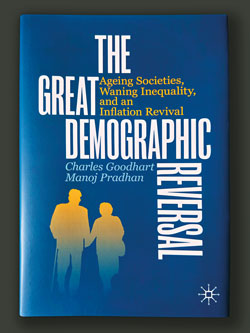
Charles Goodhart has seen it all: recessions, stagflation and boom years. In his book, The Great Demographic Reversal: Ageing Societies, Waning Inequality, and an Inflation Revival, co-authored with Manoj Pradhan, the former Bank of England adviser predicted the revival of a beast long thought dead by most economists: high inflation. It was cheap Chinese and Eastern European workers who kept inflation rates low over the last decades, rather than central bank policies, Goodhart argues, but the tide has now turned. Ageing populations will bring about higher inflation and interest rates, but also less inequality, he argues in an exclusive interview with World Finance’s Alex Katsomitros, while explaining how we can deal with climate change and musing over what central bankers and sheep have in common.

What prompted you to write the book?
When Manoj and I were working at Morgan Stanley, we were asking ourselves why inflation was running below target, despite the expansionary policies of central banks. We came round to the view that there was an underlying trend, caused by the weakness of labour markets and the sluggishness of wages. We put that down to demography and globalisation, notably the arrival of China and Eastern Europe into the world’s trading system.

As you predicted, inflation and interest rates have increased. Do you feel vindicated by recent events?
Yes and no. Mainstream economists still believe that current inflation is temporary. Central banks forecast that we will return to inflationary targets in two or three years, and interest rates will come down. We believe that COVID-19 was a trigger for a change to a more inflationary period from now to 2050.

Some put the blame on the war in Ukraine for rising inflation, others focus on the pandemic. What is your take?
We wrote the book in 2019. We thought that the momentum of weak labour and reduced trade union membership would carry on, although we also believed that demography and deglobalisation would change this. But we didn’t know when the shift would take place. COVID-19 and the war brought this change forward. What remains to be seen is whether inflationary pressures will persist when these temporary developments disappear.

The economist Michael Pettis recently told World Finance that China can only sustain current growth levels by increasing the household share of GDP and reducing government consumption. Do you think they can reform their economy?
They will have to. They are trying to move up the value chain by shifting from low-tech to high-tech products, and they will have to increase internal consumption. The rift with the US, which will not go away, means that the growth rate of exports will decline. Aggregate growth rates have been between six and eight percent in real terms, and with a declining workforce, they will be lucky if they have 2.5 percent growth. If your workforce is falling by 1.5 percent annually, you are lucky to have aggregate growth of 2.5 percent. That means that your productivity per worker rises by four percent, which is huge.

You argue that inflation will rise due to a shortage of workers. However, there’s still a big pool of cheap workers globally. In the book you discuss India and Africa, but what about Vietnam, Indonesia and Pakistan?
In Vietnam and Indonesia birth rates have already started declining. The areas where high birth rates remain are Africa, certain Muslim countries and perhaps India, although it is falling there too. The problem is how to use this workforce.

One possibility is massive migration, but this is politically unpopular, as we saw with the election of the far right in Italy. So if that is not an option, you have to take manufacturing to those countries. To do that, you need political stability, administrative competence and a well-educated workforce. It is possible and desirable that Africa may have these, plus a degree of unification, so perhaps Africa and parts of South Asia could become the next China. But it hasn’t happened yet.

What about automation?
We need all the robots we can get. As the proportion of the old increases, we will have more incapacitated people. The problem is not age itself, but incapacitating illnesses like Alzheimer’s, dementia, Parkinson’s, arthritis. Those suffering from these diseases cannot carry out ordinary activities. They need supportive care and human sympathy. Robots are not sufficient. They could help to get people into a wheelchair, but we need people.

Many youngsters believe that the postwar generation is enjoying undeserved privileges. Is this anger justified?
To some extent, yes. We, the old, have support in the form of care, medicine, NHS, and pensions, paid by the working-age population. There are relatively few of us and many younger people, which means they can support this fiscal generosity. But when they grow old, there will be fewer workers to support them. If the future old have the same level of benefits and retirement age, there will be a higher tax burden on younger generations and they will not like that. Tax rates will have to go up or support to the old go down. One reason why this has happened is that the old vote at higher proportions than the young. If the young voted for lower taxes and fewer benefits to the old, they would get somewhere, but the proportion of voting 20-year-olds is much lower than that of 60-year-olds.

Economists who espouse modern monetary theory believe that deficits and debts don’t matter. What do you think?
They say that deficits and debt are not so much a problem, but inflation is. Taxation will have to be raised to control inflation, if this goes out of hand. The problem is that rising deficits lead to unsustainable fiscal problems, which tend to cause inflationary pressure and require higher taxation.


Another issue you discuss in the book is central bank independence. Why do you think it is in danger?
The difficulties facing the UK recently {the week after the since U-turned mini-budget was announced} are instructive. The underlying problem is that we cannot bring back inflation to target without the fiscal position becoming more sustainable. If you try to deal with inflation solely by raising interest rates, you get two effects.

First, that reduces demand and output growth and increases unemployment, which brings a recession with rising expenditures on unemployment benefits and lower taxes. Higher interest rates also increase public debt immediately, particularly because of quantitative easing, which has effectively substituted long-dated government debt for overnight government debt. So with higher interest rates, you are making the government’s fiscal position worse.

And if people start thinking that public debt becomes unsustainable, they flee the government bond market, as happened in the UK. If the government bond market starts to collapse, the only thing that can be done, which the Bank of England did, is reverse course and go back to quantitative easing, which brings more inflation. You cannot defeat inflation in the long term, unless fiscal and monetary policies are sufficiently restrictive to make the public debt position seem sustainable. When you get policies such as those Truss and Kwarteng tried introducing, it is clearly not there.

You argue that labour will gain the upper hand due to a shortage of workers. Does that mean that we will see less populism?
It is very likely. I hesitate to make political forecasts, but I believe we will see less inequality. The massive increase in the availability of labour, particularly due to offshoring to China, will be reversed. In many countries, particularly the US, there has been little real income growth for unskilled workers. We now see a reversal, and with interest rates going up, we will see a decline in asset prices. Because of the shortage of workers, the unskilled will see relative growth in real wages and those with capital will do less well, so inequality within countries will decline.

Another issue that looms large over monetary policy is climate change. Is there some kind of balance between the economy and the environment?
Where I think there should be a balance is on how we pay the expensive effects of carbon usage reduction. Economists think that we should adopt a carbon usage tax. However, such a tax would make the carbon-intensive segments of industry, like steel and cement, very uncompetitive compared to countries where there is no such tax. Opposition from industries subject to heavy taxation would be sufficient to stop it. Also the net-zero activists do not support carbon taxes. I don’t know how they think we will finance the extra expenditures needed to move towards renewables.

In the book you approach an economic issue through a non-economic lens: demographics. Many people believe that economics has lost its way, that it’s too mathematical and just out of touch.
I am with the latter, as I am more of an economic historian rather than a pure economist. Our book has two defining features. The first is that macroeconomists tend to focus on their own country, which is too narrow. We have two chapters on Asian countries, Japan and China, but no chapter on the US, Europe or the UK, because we think that the rise of China has been the most important feature of the last 30 years. The second difference is that they focus on demand-side policies, whereas we focus on supply.

You own a sheep farm in Devon. Has farming taught you anything about economics?
Sometimes I make this analogy: central bankers and economists in some ways are like sheep. They tend to flock together. If you are in a position of power where what you do has important effects on everyone, you like being able to defend and protect yourself by saying ‘well, I am doing exactly what everyone else thinks is right.’ They have a flock mentality.

Nuclear’s new resurgence

Europe is bracing itself for a long, cold winter. Blackouts, gas shortages and unheated homes could well become a reality for millions across the continent in the months to come, as the ongoing energy crisis continues to escalate. Already grappling with skyrocketing bills, many families are fearful of what the winter will bring, while thousands of small businesses may be forced to close if they can’t keep up their energy payments.

By January, experts warn that two-thirds of UK households could be pushed into fuel poverty, with sustained higher prices set to impact families at all levels of the income spectrum. Despite a package of planned government interventions, the outlook appears bleak. The energy crisis – exacerbated by the ongoing conflict in Ukraine – shows no signs of abating as we head into the coldest months of the year. In the worst case scenario, the UK’s National Grid has cautioned that families could face daily three-hour blackouts, bringing back memories of the power cuts that plagued Britain in the early 1970s.

As political leaders across Europe look to deal with the immediate impacts of the crisis, it is becoming increasingly clear that there will be long-term ramifications from the events of the past year. The crisis has, in many ways, changed the continent’s energy landscape forever. Despite recent commitments to phasing out fossil fuels – including most notably at last year’s COP26 conference – Europe remains largely dependent on imported oil and gas. Russia, the largest supplier of natural gas and petroleum oils to the EU, has cut its exports of gas to Europe by 88 percent over the past year. Against this backdrop, energy security has suddenly rocketed up the political agenda.

After years of scepticism and apprehension, countries around the world are now reassessing their position on nuclear power – persuaded by its potential to provide an efficient and reliable domestic source of energy in the long term. Not everyone is convinced, however, with the catastrophic disasters in Chernobyl and Fukushima looming large in the public consciousness.

But with the Russia-Ukraine war exposing fundamental weaknesses in Europe’s energy supplies, is the tide set to turn on nuclear power?

Firing up
Few issues are guaranteed to generate as polarised a debate as the question of nuclear power. For those in favour of nuclear investment, it represents a clean and efficient form of energy, with a smaller carbon footprint than both solar and geothermal alternatives. Its opponents, meanwhile, argue that the risks simply outweigh the benefits: over 30 serious nuclear incidents have occurred at nuclear plants around the world since the early 1950s, with Japan’s 2011 Fukushima disaster stoking significant fears over safety.

Now, a decade on from the Fukushima accident, public reservations on nuclear power look unlikely to deter its expansion. For the first time since the 2011 disaster, the International Atomic Energy Agency (IAEA) has raised its projections for annual nuclear electricity generation, reflecting a significant shift on nuclear policy around the globe. Japan is unexpectedly at the very forefront of this nuclear revival, with Prime Minister Fumio Kishida announcing plans to restart a number of the country’s idled nuclear plants, and setting intentions to develop next-generation nuclear reactors.

Europe economies are following suit, with even staunch nuclear sceptics beginning to revise their policy position. Germany, which firmly turned away from nuclear following the Fukushima disaster in 2011, is now rethinking its approach, with plans to postpone the closure of its remaining nuclear plants. The country’s last three nuclear power stations were due to be permanently switched off in December, as part of plans to completely phase out nuclear energy by the end of 2022. Two of the three plants will now remain operational until at least mid-April, in order to provide an ‘emergency reserve’ this winter as the energy crisis rumbles on. While the German chancellor Olaf Scholz has insisted that he remains committed to the country’s nuclear phase-out, the decision to extend the lifespan of its last power stations marks a significant U-turn for the nuclear-adverse nation. It’s a similar story across the border in Belgium. The nation had previously committed to abandoning nuclear power entirely by 2025, but has since decided to extend the lives of its two newest reactors by at least another 10 years. Reversing a decision made in December 2021 to shut the plants, the extension will keep nuclear as a key component of the Belgian energy mix for years to come.

Britain, meanwhile, is taking inspiration from its pro-nuclear neighbour across the Channel. In September, outgoing Prime Minister Boris Johnson pledged £700m for the construction of the new Sizewell C power station in Suffolk, committing to nuclear as one of the final acts of his premiership. Calling on his successor to “go nuclear and go large,” Johnson’s million-pound pledge sent a clear message that nuclear power will undoubtedly be at the heart of the UK’s future energy strategy.

Too little, too late?
While there certainly appears to be renewed enthusiasm for nuclear energy – both in Europe and further afield – this recent change in direction may do little to resolve the current energy crisis. Keeping soon-to-close power stations on standby may be a reassuring back-up plan for countries facing energy shortages over the winter, but the strategy won’t create energy independence overnight.

One of the strongest arguments for investing in nuclear power is that it grants nations greater energy security and independence – with France standing out as an obvious success story. Deriving almost 70 percent of its electricity from nuclear power (see Fig 1), France boasts an energy independence rating of 53.4 percent – one of the highest rates in the EU. While this level of autonomy means that the nation is less exposed to Russian cuts to gas supplies, replicating the French model is not easily achieved.

Nuclear power stations are famously time-intensive to build, with the average construction time for reactors coming in at just under 10 years. Compared with renewable alternatives, nuclear power plants are also much more costly to both build and operate – and then there are the additional expenses of decommissioning and waste disposal to consider. For any country wanting to follow in France’s nuclear footprints, they will need to be prepared for high costs and slow progress.

It’s clear that nuclear isn’t a short-term solution. The immediacy of the current crisis requires swift action to keep bills down and keep lights on, and nuclear is anything but swift. Investing in nuclear power won’t solve this winter’s energy crisis – but it could stop the next crisis from hitting as hard. With the energy landscape so dramatically transformed by the events of the past year, energy security is understandably a long-term priority for the EU, and nuclear power could prove crucial to achieving this goal.

Finding balance
If the recent energy crisis has sparked a renewed interest in nuclear power worldwide, it has also exposed the dangers of nuclear over-reliance. Nuclear-dependent France is facing its very own energy predicament while the rest of Europe grapples with cuts to Russian gas supplies. This year, 57 percent of the country’s nuclear reactors have been shut down due to corrosion problems, technical issues and long-overdue maintenance works – with repairs outstanding from the multiple COVID-19 lockdowns. With so many plants offline, French power output has fallen to a 30-year low, making the country a net importer of energy for the first time since records began a decade ago.

After years of scepticism and apprehension, countries around the world are now reassessing their position on nuclear power

France’s recent nuclear strife illustrates the importance of creating and maintaining a diverse energy mix. Over-reliance on a single form of energy – whether that be domestic nuclear power or imported natural gas – can only leave a country exposed when unexpected setbacks occur. A hybrid energy system, combining cutting-edge renewables with nuclear power, may just be the future of the European energy landscape.

Achieving the ambitious targets established in the landmark Paris Agreement on climate change will require a dramatic transformation of the global energy system, and a pivot towards carbon-zero sources. Whether nuclear power can be classed as truly ‘clean’ remains hotly debated, given that each reactor generates not-insignificant quantities of long-lasting radioactive waste. However, it is true that it remains an efficient and reliable source of carbon-free electricity – and one that isn’t affected by meteorological fluctuations, as is the case with solar and wind power.

While 100 percent renewable energy may be the ultimate goal for climate-conscious countries around the world, a hybrid approach may be more readily achievable in the near term. Already, major economies such as Sweden have been able to completely decarbonise their power grids through a blended use of nuclear, hydropower and other renewables, demonstrating the potential of a hybrid system.

Nuclear isn’t a magical cure-all for the challenges of fossil fuel dependence and energy insecurity, but it could provide some welcome relief in the years to come. Long-sidelined and still met with opposition from many, nuclear’s new resurgence may not be popular but it may prove necessary – if Europe wishes to make this energy crisis its last.

The evolving digital landscape of banks

An All Party Parliamentary Group (APPG) has recently said the UK should widen its open banking model to speed up the growth of fintech as part of a broader evolution in financial services. The APPG has called on the UK government to start a new ‘big bang,’ imitating the deregulation of the financial markets in the 1980s. The group has said that by eliminating the shackles from fintechs, the government can make strides in levelling up the country by reducing economic imbalances between different parts.

Meanwhile, in the US, a new report from the cloud-based digital banking provider Alkami Technology, a leading cloud-based digital solutions provider for banks and credit unions, highlighted five trends banks and credit unions should be aware of during their digital evolution. One of them regards the possibility of partnerships with fintech companies, which may be the easiest and cheapest way to complete the digital journey.

This report showed that 73 percent of the population trusts financial institutions with their personal information, but fintech is not far behind, with 63 percent saying they trust the companies with their data. Around 50 percent of banks and 40 percent of credit unions have partnered with a fintech company within the past three years due to competitive pressure.

Sanat Rao, CEO of Infosys Finacle, a global banking software and platforms business, considers the digital journey as a way to create and deliver value to customers. “Digitisation enables banks to acquire more customers, build better products and services faster and at lower cost, manage risks well, and run operations efficiently. In other words, it’s the key to sustaining the business,” he said.

In the age of ecosystem-driven banking, a partnership is the natural order of things

Rao explained that over time, banks have realised that collaborating – rather than competing – with fintech usually creates value and synergy for both. While banks are looking to embed their services in the primary journeys of other providers, fintech will enable this transition, for instance, by helping banks to evolve marketplaces or insert their offerings in different consumer journeys.

“As long as the partnership is a net positive and not a zero-sum game, the price the partners have to pay is irrelevant. And there is so much room for growth and untapped opportunity that most partnerships end up increasing value for everyone. In the age of ecosystem-driven banking, a partnership is the natural order of things,” he said.

Rao claimed that every bank would work with several partners across the value chain to create and deliver products in ecosystem banking. While many partnerships will have no conflict of interest, in distribution partnerships, however, some conflicts may arise. “For example, if customers use Google Pay to open deposit accounts, banks will lose that part of the engagement. Banks need to ask whether they can deliver greater value to customers via these partnerships than by serving them independently. If the answer is yes, that is how the industry will go. Then the only option for banks is to stay in those partnerships, even if it means becoming embedded in other product journeys because that is what customers will want,” he added.

Silvia Davi, chief marketing officer of the fintech firm Symbiont, with its headquarters in New York, believes that the digital journey consists of moving from inefficient ‘paper’ or manual processes to benefit from the tools that digitised solutions bring to the table, such as smart contracts. “Via this technology, for example, we are enabling market participants globally to automate the reconciliation process, and there are multiple solutions that can be built on top of these high-quality data sources,” she said.

Davi highlighted that while in the short term there is a time and budget commitment – with inaction way more expensive in the long run – the long-term consequences are immensely positive, driven by the immutability, transparency, and apparent efficiencies that will result from utilising distributed ledger technologies.

“There may be some growing pains and tweaks needed to optimise the benefits of these relationships. From our experience, driven by our desire to constantly evolve and introduce new technology releases, we are committed to that process, and the banking sector is as well,” she added.

Working through conflicts
Likewise, Carol Hamilton, senior vice president of Provenir, a global leader in AI-powered risk decisioning software, sees the digital journey as “a non-stop set of continuous interactions between an organisation and their customers.” It starts from that first moment of contact, either a customer browsing a website online or applying for a product on a mobile device. Financial services providers want to maximise every digital interaction along the journey. To do that, they need to up their game for consumers who demand that digital interactions be quick and informative. This is why such organisations are utilising more data and more sophisticated technology to understand better who they’re doing business with and use that intelligence to optimise every component along the way.

“Embracing digital is very powerful; however, some organisations digitise processes on paper or legacy technology and move to more updated online systems. But true digital transformation shifts how that company is thinking and how it is interacting with customers to meet their needs for a more engaging and memorable digital banking experience,” she said. Nevertheless, Hamilton does not deny that there are a few other disadvantages of moving to complete digital transformation, especially as it gets even more intelligent.

“We are at a solid place in the industry where even organisations who weren’t historically operating in financial services can offer intelligent financing products through an app or other digital interactions. Successful digital transformation offers more intelligent products and services to the end customer. These are more valuable to that end customer and thus the organisation offering them,” she added.

Hamilton explained that to compete in such a busy market, the profile and needs of a customer need to be identified more quickly than ever, and data-driven actions need to follow in order to be successful. “For most customers, this is about embracing speed and optimised communication and products. For the minority, data-driven actions at speed also ensure the organisation is protected,” Hamilton said.

Also, in contrast with what Sanat Rao stated, she does not exclude a conflict of interest between the two businesses, highlighting that as traditional banks diversify, fintechs could soon do the same. “Data could be commoditised. It’s always about finding out that next layer of value and staying ahead to meet customer expectations. There will always be conflicts – it’s all about working through them,” she suggested.

However, there are plenty of options to accelerate this digital transformation. As Hamilton suggested, one of them is diversifying the business, for example, leading banks launching neobanks and targeting different parts of the market while diversifying their portfolio. Open banking has also been a groundbreaking development in the financial market. Regulation will also play a role in accelerating or decelerating digital transformation.

Adapt or die
Eric Bierry, CEO of the French fintech Sopra Banking Software, said that the digital journey is about more than meeting consumers’ changing expectations; it is also a reaction to shifting business models and industry regulations. “To take full advantage of these new business models, banks need to work with fintechs and avoid the mistake of trying to become them. This means providing fintechs with access to the core competencies that are part of banks’ DNA, like licensing, lending and security, freeing them up to focus on innovation and consumer experience. The result is a relationship where both parties can bring their strongest capabilities to consumers,” said Bierry.

He pointed out that banks are unequivocal about their decision to enter the digital ecosystem, and those unwilling to transform digitally will face extinction. “Fintechs are increasingly becoming the main point of contact for end-customers, from lending money to opening bank accounts and making payments. Banks will eventually be disintermediated from the value chain without digital infrastructures to enable partnerships with these companies. For banks that do leap to participate in the digital ecosystem, partnership opportunities in any industry, not just finance, are endless. Supporting fintechs and neobanks is the first and most obvious stop. Still, by offering their lending, security and compliance services to an auto manufacturer, banks can bring financing directly to consumers in any industry and cement their position in the industry for years to come,” Bierry added.

Undoubtedly, every bank in the world is working to transform. However, according to the Innovation in Retail Banking 2021 survey conducted by Infosys Finacle alongside Qorus, a non-profit organisation in the financial services industry, 14 percent of respondents said that their organisations had deployed digital transformation at scale and delivered as expected.

Sanat Rao explained that this result does not mean that other banks are not trying, but the reason for this low number is the constantly advancing goalpost of digital transformation (see Fig 1). “While banks are moving ahead, so is the transformation horizon, making it seem like banks aren’t going the distance. But that is not true,” he concluded.

The price of pageantry in a time of crisis

Many millions of people around the world watched at least some of the Queen’s funeral, with figures from the Broadcasters’ Audience Research Board (BARB) estimating over 26 million BBC viewers across the service in the UK alone. The global and streaming audiences would have been many times this amount. The eyes of the world were firmly fixed on the UK in what is thought to have been the biggest television event in history, but once the grandeur and ceremony were concluded, the headlines reverted to ever more desperate reports of fuel poverty, political crisis and economic woe. Summer was officially over and with the incoming chill of the weather, reality soon started to bite.

Almost all the mainstream UK media was sympathetic towards the royal family in the lead-up to the dazzling solemnity that was the state funeral. Regardless of political stripe, any one of us who has lost someone can recognise the pain of going through the motions while stunned with your own grief.

Brexit, Covid, and now the cost of living have all led the left and right to point fingers at each other, and meanwhile the climate is in literal meltdown

But far fewer of us will inherit vast wealth, property, and privilege as a result, and perhaps that’s where the sympathy runs out. The royal family’s finances are as complex as its relationship with the public, and opinions and estimations around these vary wildly. Whether or not you believe that ultimately they contribute more to the economy than they take out, now the country is back to humdrum, can the royals realistically expect to feel genuinely relevant, cushioned as they are from the financial woes facing the average citizen?

Within a week of the Queen’s funeral, the reshuffled Conservative government announced a raft of financial measures in a much-maligned ‘mini budget’ that included the intention to abolish the additional rate of income tax, disproportionately benefitting the highest earners. This in turn sparked days of fierce debate, with then PM Liz Truss and her then Chancellor Kwasi Kwarteng being called to defend the move everywhere from local radio to the Tory party conference.

The plan was eventually dropped just 10 days later, but not before close to 1,000 mortgage products had been withdrawn from the market, and international stock markets had been well and truly spooked.

Disunited Kingdom
At times like these it is hard for households to bear the financial strain of matters that are outside of their control. Spiralling prices of gas and electricity, the geopolitical instability caused by Russia’s war in Ukraine, and global climate breakdown all provide an overarching context that any government would find challenging to thrive in, but when such rash political moves as Kwarteng’s mini budget feel like a choice to make things harder for most, it adds insult to injury and sends a very clear message about Britain’s crumbling sense of unity. In the meantime, the new coin featuring Charles III’s face was unveiled, but otherwise, all was quiet from the palace, even beyond its extended period of private mourning.

Whether you lean in favour of the royal family or not, it is important to acknowledge the magnitude of the Queen’s passing. She was a constant, for good or ill, in a country that feels increasingly polarised with every passing crisis. Brexit, Covid, and now the cost of living have all led the left and right to point fingers at each other, and meanwhile the climate is in literal meltdown. At times like these, no wonder almost half the UK population tuned in to bid farewell to one of the world’s longest serving figureheads, and yes, perhaps for a little distraction as well. Like it or not, we will all remember where we were when we heard the news, however we felt upon hearing it.

The well-worn argument of the royal family being good for UK tourism (not to mention the media) may not hold much water if Charles III does as he is rumoured to want to do and slims down the operation, reducing the number of senior working royals who enthral the visitors and capture the imagination. Although no longer able to lean on parliament the way he has purportedly done while heir to the throne, it is well known that King Charles is extremely concerned about climate change.

Perhaps he could be the figurehead that presses forward with Britain’s environmental imperative. There’s something we can surely all unite behind.

Going against the stream

In 1997, so the story goes, Reed Hastings spent the best $40 of his life. At the time, he was frustrated. He had just returned a rented copy of Apollo 13 six weeks late and was slapped with a huge late fee. Why, he wondered, could the price of renting films not be more like a gym membership, where you pay a flat price to work out as much or as little as you want? At the time, DVDs were a new but untapped technology poised to explode in the US market. Not only were they a burgeoning market, but they were also perfectly sized for slipping into post boxes. Off the back of his fine, Boston-born Hastings dreamt up a business model for mail order movies. With one start-up already under his belt, he would go on to found DVD-by-post turned streaming behemoth Netflix within the year.

Twenty-five years on, Hastings’ origin story has become legend in the world of business. However much truth is in it, his success is undeniable. Netflix, which turned over nearly $30bn in 2021, has gone from plucky, cult-status start-up to Silicon Valley veteran. Hastings steered the ship through periods of choppy waters, but with questions over just how long he will remain at the helm and where he will take Netflix in the so-called ‘streaming wars,’ World Finance looks back on his legacy.

Don’t listen to the sceptics
While Netflix would be Hastings’ big lightbulb moment, it wasn’t his first spark of brilliance in the business world. After earning a mathematics degree from Bowdoin College – he “found the abstractions beautiful and engaging,” he later told The New York Times – Hastings went on to earn a master’s degree from Stanford in computer science. By 1991, at the age of 31, he had co-founded his first business, Pure Software, with Raymond Peck and Mark Box.

The business, which originally offered a debugging tool for engineers, was a success. Revenue doubled each year before it went public in 1995, Hastings told Inc. magazine, and it was soon snapped up by a competitor, Rational Software, for $750m. The deal wasn’t particularly well received by Wall Street, but Hastings didn’t worry about what others thought. “I was doing white-water kayaking at the time, and in kayaking if you stare and focus on the problem you are much more likely to hit danger,” he told The Times. “I focused on the safe water and what I wanted to happen. I didn’t listen to the sceptics.”

After inspiration for Netflix struck, Hastings wasted no time in making his idea a reality. In 1997, he launched the business with co-founder and entrepreneur Marc Randolph.

Winning the rental wars
In its first year, Netflix gained 239,000 subscribers, and it wasn’t long before its red DVD envelopes became ubiquitous in the United States – and beyond. Hastings made waves by situating the business at the cutting edge of entertainment and technology. While Netflix first offered a pay-per-rental model for each DVD, by 2000 it had a monthly flat fee in place, nixing the need for late fees and due dates. “It was still a dial-up, VHS world, and most video stores didn’t carry DVDs, so we were able to sign up early adopters,” he told Inc.

The business went from strength to strength in the run-up to its initial public offering in 2002, when it listed its stock at $15 per share.

The company posted its first profit the next year, earning $6.5m on revenue of $272m. By 2004, its profits had ballooned to $49m, and in 2005 it was sending out a million DVDs every day. But 2005 marked the time of peak DVD in the US market, with sales reaching a height of $16.3bn. For Hastings, the next goal was to move into video streaming. He told Inc. that same year: “We want to be ready when video-on-demand happens. That’s why the company is called Netflix, not DVD-by-mail.” But the transition wasn’t without its problems. In 2011, Hastings announced Netflix would divide its DVD and streaming businesses into separate subscriptions with separate fees – and names. The streaming service was to retain the name Netflix while the DVD side would be renamed Qwikster. Neither customers nor the markets were happy, and Netflix’s share price fell 75 percent by the end of 2011, according to Forbes. After initially doubling down, Hastings eventually cancelled plans for Qwikster.

Despite the missteps, Hastings was winning the film rental wars. In 2010, Blockbuster, which once had 9,000 video rental shops in the US, filed for bankruptcy after being crushed by nearly $1bn in debt and torn apart by internal disputes. Blockbuster’s demise occurred just a decade after Hastings and Randolph offered to sell their business to the video rental giant for a mere $50m. Following the meeting, which took place during the dot-com bubble, former Netflix CFO Barry McCarthy said Blockbuster executives had “laughed us out of their office.”

Throwing out the rulebook
At Netflix, Hastings is known for being a hands-off leader. “Incredible people don’t want to be micromanaged,” he once told Forbes. “We manage through setting context and letting people run.” Hastings currently shares responsibilities with co-CEO and chief content officer Ted Sarandos, who became joint head of the company in 2020, having worked at the business since 2000.

In 2020, Hastings published No Rules Rules: Netflix and the Culture of Reinvention with business school professor Erin Meyer. The book outlined his leadership philosophy and how it plays out at Netflix. “We wanted to make the case that it’s good business to run without rules – which is a surprising statement,” he told Variety. The key, he said, is “embracing managing on the edge of chaos. And as long as you are tolerant of managing on the edge of chaos, of course there’s going to be some mistakes” – take Qwikster, for example – “but there’s also going to be a lot of innovation.”

Netflix’s annual leave policies are one case study of the ‘no rules’ strategy. Hastings plays the long game with employees, encouraging them to take time off via unlimited vacation policies and unlimited parental leave, in the hopes that any loss in efficiency will be regained by employee loyalty and innovation. “We’re willing to take some inefficiency narrowly and in edge cases to create an environment that’s extremely flexible because we think that outperforms in the long term,” he told Entrepreneur. Hastings said he takes six weeks off per year, explaining at The New York Times DealBook Conference that the time away from work “hiking some mountain” or “reading something not connected to work,” helps him get a different perspective and provides inspiration.

But it’s not all positives with the ‘no rules’ philosophy, and Hastings admits it’s not a perfect strategy. Some of Netflix’s policies have been challenged for creating a culture of fear. The infamous ‘keeper test’ is a process where managers are told to consider if a person on their team were to quit whether they would try to get them to change their mind or whether they would accept the resignation, perhaps even with relief. If their answer is the latter, they may as well send them packing now and look for someone they would fight to keep, the ‘keeper test’ advises.

“Think of a great athlete,” Hastings told Variety. “You kind of know you could get injured, maybe even a career-ending injury, in every game. But if you think about that and if you obsess on it, it’s only going to hurt you. So we have to hire the psychological type that can put that aside and who aspires to work with great colleagues and that’s their real love, is the quality of their colleagues or the consistency of that, versus the job security.” If job security is your priority, Hastings said Netflix’s message is clear: “We’re not a good place to come. We don’t want people to feel debilitating fear; obviously that’s not productive.” But, he said, Netflix is looking for “a special kind of person who can ignore that fear.”

Hastings believes this strict approach to weeding out mediocrity is key to maintaining Netflix’s competitive edge and innovation. He saw the alternative at Pure Software. “We stopped being innovative. We were all about process. And then the market shifted, and we were unable to pivot and ended up selling to our largest competitor,” he told Variety. “So it ended up as a really good success financially, but it did not become an epic, world-changing company in the way we want to make Netflix.”

Changing tack
Flexibility and innovation are important to keeping Netflix’s offering fresh and its business model agile, but the business’s recent change in strategy regarding advertising is more akin to a U-turn. Hastings had long committed to keeping advertisements off the platform, with Netflix’s chief financial officer saying advertising was “not in our plan” as recently as March 2022. But in April, Netflix reported its first quarterly decline in subscriber numbers in more than a decade, and a tumbling stock price forced a swift rethink. Now, the streaming giant’s plan is to funnel in more subscribers through its cheaper, ad-supported service.

The television advertising industry was buoyant on the news, with Brian Wieser, president of business intelligence at WPP-owned GroupM telling the Financial Times that Netflix poses “a great untapped audience.” And the advertising world, which brings in more than $60bn a year, offers an equally large opportunity for Netflix. However, Netflix has to battle the perception that by offering an ad-supported service, it is compromising its brand. As Rich Greenfield, an analyst at LightShed Partners, told the Financial Times, “It is scary if the only way to reinvigorate growth is offering cheaper products that worsen the consumer experience, essentially making it more like the dying linear TV experience.”

Being an entrepreneur is about patience and persistence, not the quick buck

Hastings himself has admitted that advertising is no fast-track to growth. “Advertising looks easy until you get in it. Then you realise you have to rip that revenue away from other places because the total ad market isn’t growing, and in fact right now it’s shrinking,” he told Variety in 2020. And in a 2019 letter to investors, the business said, “We believe we will have a more valuable business in the long term by staying out of competing for ad revenue and instead entirely focusing on competing for viewer satisfaction.”

Market researcher Kantar noted in a July report that streaming growth was most significant in paid ad-supported streaming and free ad-supported streaming, while paid streaming without ads grew at a slower rate.“Value is increasingly important to retaining streamers as platforms are competing for screen time or risk being cancelled and replaced,” said Nicole Sangari, vice president of Entertainment on Demand at Kantar Worldpanel Division. “This upward trend of significant [paid and free ad-supported streaming] growth is correlated to high stacking [of multiple subscriptions]. As stacking reached new heights, consumers were willing to reduce their overall streaming costs for ads. Streaming has gone full circle, once being the destination to avoid cable TV ads, to increasingly relying on ads to drive growth.”

Of Netflix’s ad-supported tier, Sangari said the move was a “suitable strategy to combat losing subscribers due to its cost and value.” Offering an ad-supported tier “can help win back its lost subscribers,” she said, as customers who had planned to cancel their subscriptions can switch to a cheaper service instead. However, as the business fights password sharing, it is expected to lose customers. “Their strategies are having lingering effects on how loyal customers perceive its features and value.”

While Netflix teeters on the unknown, two of its rivals, HBO Max and Hulu, have seen growth. “The platforms have focused on cost-savings to prove value and created a content niche that over time they expanded: HBO Max with new releases and Hulu with next-day cable to Hulu TV series,” Sangari said. “Both started by offering something unique to the market, and with greater competition have focused on diversifying their offerings to drive engagement.”

Netflix’s Chief Content Officer, Ted Sarandos, and CEO, Reed Hastings

Changing the world for good
While Netflix’s shift to ad-supported advertising is welcomed by some industry experts, seeing Hastings’ commitment to ad-free viewing crumble overnight may cause investors to wonder if other commitments will be dropped. From live news and sports to gaming, there are a multitude of ways Netflix’s content offering could shift.

Speculation over when Hastings will leave Netflix is also emerging. With Sarantos sharing the position at the head of the business and making the big calls on Netflix’s content, Hastings appears to be putting the wheels of a succession plan in motion. In a recent earnings call he suggested he would be leaving the business by 2030. But he insists he’s committed to Netflix. “What I don’t want people to think is that I’m checking out,” he told Variety. “I guess it is the beginning of the end in the sense that eventually, I’ll be gone. At least for the next decade, I’m super-excited by what we’re doing and full-time, so it was a statement that it’s not a short-term situation.”

Outside of his work at Netflix, Hastings is known for his philanthropy and political contributions. Through Netflix, Hastings accumulated a substantial fortune. In 2017, he was added to Forbes’ 400 list of the richest people in America, with the group estimating his fortune sat at $5bn. Between 2001 and 2011, Hastings spent $8.1m on political donations in California, according to the Silicon Valley Business Journal. In 2020, he donated $1.4m to Joe Biden’s presidential campaign, Business Insider reported, having previously gifted $89,000 to Barack Obama’s 2012 re-election campaign.

Hastings and his wife, producer Patty Quillin, also joined a philanthropy pact founded by Bill Gates and Warren Buffett to give away the majority of their fortune. “It’s an honour to be able to try to help our community, our country and our planet through our philanthropy,” Hastings and Quillin said in a statement at the time. “We are thrilled to join with other fortunate people to pledge a majority of our assets to be invested in others. We hope through this community that we can learn as we go, and do our best to make a positive difference for many.”

Education has been a consistent theme in Hastings’ philanthropy, and he has made a pledge to spend $100m of his fortune reforming the US public school system. In 2020, he and Quillin gave $120m to fund scholarships for black students through a partnership with two historically black colleges in the US and the United Negro College Fund, and he also spent $20m building a training facility for teachers. “Being an entrepreneur is about patience and persistence, not the quick buck,” Hastings told Inc. in 2005. “If we can transform the movie business by making it easier for people to discover movies they will love and for producers and directors to find the right audience through Netflix, and can transform public education through charter schools, that’s enough for me.”

The streaming wars
Netflix has indeed transformed the movie industry. Not only the way films were delivered, but also through the content itself. In 2012, the business produced its first TV series, House of Cards, which went on to receive over 56 Emmy nominations, winning seven. Since launching the political thriller, a stream of critically acclaimed successes has flowed from Netflix’s original content production machine, including Stranger Things, The Crown, Bridgerton and Sex Education.

Netflix has proven it has significant strengths in the market, despite losing subscribers

Netflix’s streaming service has now expanded into 190 countries, and the business’s next aim is to become content king. In the second quarter of 2022, Netflix commissioned 160 film and TV show titles in total, with most of the originals being produced outside of the US. “What’s next is becoming a great Turkish developer of content, becoming a great Egyptian developer of content, and sharing that with the world,” Hastings told Variety. Indeed, content is one differentiator in the ongoing streaming wars. “Netflix has proven it has significant strengths in the market, despite losing subscribers. It has the content and easily navigable interface to keep subscribers engaged,” Kantar’s Sangari said.

The use of streaming services continues to grow. The proportion of US households with streaming services reached 88 percent as of June 2022, according to Kantar, with 113 million households accessing streaming products. According to the research, the average household has five subscriptions to streaming services. But Netflix’s competitors aren’t confined to its streaming peers, according to Hastings. In 2017, Hastings said Netflix’s biggest rival wasn’t Amazon or traditional broadcasters, but sleep. “You know, think about it, when you watch a show from Netflix and you get addicted to it, you stay up late at night,” he said. In 2019, he said video games were causing the business to lose more subscribers than rivals. “We earn consumer screen time, both mobile and television, away from a very broad set of competitors. We compete with (and lose to) Fortnite more than HBO – there are thousands of competitors in this highly fragmented market vying to entertain consumers.”

But Hastings isn’t afraid of a little competition, and he is confident of Netflix’s position, even as rivals like Disney+ make bigger gains in subscribers. In a recent letter to shareholders, the business effectively said it was winning the streaming wars: “Our competitors are investing heavily to drive subscribers and engagement, but building a large, successful streaming business is hard – we estimate they are all losing money, with combined 2022 operating losses well over $10bn, vs. Netflix’s $5bn to $6bn annual operating profit.”

Hastings said it himself: he isn’t in this for the quick money. He wants to build a “world-changing” company – one subscription at a time.

Attempting to save the planet

When, or if, the Earth stops heating up and the planet is saved, historians will probably look back to August 16, 2022 as the landmark date. For that was the day when the US President Joe Biden administration’s anti-climate change package, the Inflation Reduction Act (IRA), became law. The biggest and most far-reaching legislation of its kind by far, the IRA throws a guaranteed $479bn at all forms of energy that will reduce noxious emissions while experts predict that it will also trigger trillions of dollars of similar investments in the US and beyond.

“Legislation of this magnitude and duration lasting through the 2030s and beyond is likely to have profound and lasting impacts across US and global climate and energy systems, supply chains, industries,” summarises the Boston Consulting Group (BCG) in a detailed analysis of the impact of the IRA that echoes the views of other think tanks. “Trade and US legislation on climate and energy also have the potential to trigger policy actions from other nations, both large energy producers that compete across these value chains, and large energy consumers.”

The IRA is a cleverly designed package that wields both a carrot and a stick. Although US Congress pledged to spend this unprecedented sum between now and 2030, amounting to over $68bn a year, there will be a cascading effect through tax credits and incentive funding. As the BCG notes, these credits and incentives are intended to create investment multiplier effects that are certain to catalyse an avalanche of similar actions beyond America.

How will this happen? According to BCG, there will be a multi-pronged effect. First, the adoption of electric vehicles will accelerate, lowering the price of entry for passenger and heavy-duty vehicles. Further, incentive-style funding will materially reduce the costs of renewable and other carbon-free forms of energy, with up to 80 percent of electricity being carbon-free as early as 2030. Simultaneously, manufacturing, which is a hard-to-abate sector, will be encouraged to use manufacturing tax credits to embrace cleantech.

Nor, having set a new direction, is the Biden administration stopping with the IRA. In a surprise decision, given the Republicans’ blind eye to climate change during Trump’s fossil fuel-friendly term in office, the US senate has ratified the so-called Kigali amendment to the Montreal Protocol that aims to protect the much-damaged ozone layer through a rapid phase-down of climate-deadly hydrofluorocarbons (HFCs). According to scientists, HFCs are hundreds to thousands of times more powerful than CO2 in accelerating climate change.

And although the Biden White House is not hostile to Big Oil and has, in fact, passed measures that encourage the production of shale gas and drilling, government agencies have recently moved to keep the industry honest. Three separate hearings are under way into how Big Oil used deceptive advertising campaigns to purportedly mislead the public about the risks of climate change.

Also, the Environmental Protection Agency, which Trump tried to hamstring, is considering tougher rules for heavy trucks so more zero-emission haulers are put on the road. Almost every week, the White House and government agencies launch initiatives aimed squarely at climate change. Buildings, another hard-to-abate sector that covers everything from homes to schools and offices, will get more than $50bn to slash pollution. A $1.5bn programme will speed up electric vehicle-charging infrastructure over 75,000 miles of highways that will, promises Secretary of Energy Jennifer Granholm, “lessen our oversized reliance on fossil fuels.”

Nearly $50m will be poured into deep-water floating wind turbines. The energy efficiency of semiconductors – vital components in everything from air conditioners to smartphones – will be increased by a factor of 1,000 times within two decades. The Department of Energy (DoE), another agency targeted by Trump, has unveiled $7bn in funds to create clean hydrogen hubs, one of the biggest investments in the agency’s history. And looking further ahead, the DoE released a road map that has the US aviation industry running exclusively on sustainable fuel by 2050.

And now for the stick. Industry will have to foot some of the bills for cleaning up the climate, for instance in the form of a 15 percent tax on companies with profits over $1bn. And from 2024, oil and gas companies will pay a penalty of $900 a tonne for methane emissions, rising to $1,500 by 2026. Some exemptions will apply, notably for small producers, but otherwise the writing is on the wall.

Big targets
President Biden’s ambitions are nothing if not big. This avalanche of funds is intended to slash economy-wide greenhouse gas emission in the US by 40 percent as soon as 2030 compared with the levels pertaining in 2005 (see Fig 1). The power companies that make up the grid are expected to do even better by cutting emissions by around two thirds. Further out, the Holy Grail of a net-zero carbon economy is set for 2050. Biden’s attack on fossil fuel-induced pollution has come in the nick of time. “Climate change is accelerating rapidly, with a narrow possibility to escape its worst environmental and socioeconomic consequences,” warns the International Monetary Fund in a sobering recent analysis. “The global average surface temperature has already increased by about 1.1°C compared with the pre-industrial average during 1850–1900, amplifying the frequency and severity of climate shocks across the world.”

The numbers are turning against humanity. So far, 2022 is already the sixth hottest year ever on the planet, according to data from the US National Oceanic and Atmospheric Administration. All of the 10 warmest years recorded in the last 140 years have occurred in the past 17 years.

The IMF’s latest alarming assessment predicts that if greenhouse gas emissions continue growing at their current rate, global warming is projected to reach 4–6°C by 2100. That would trigger “an unprecedented shift with greater probability of larger and irreversible environmental changes unseen in millions of years that threaten devastation in swathes of the natural world and render many areas unliveable.”

Until the Inflation Reduction Act saw the light of day, much of the action was little more than rhetoric in many – or perhaps most – of the 189 countries that pledged to slash CO2 emission by 30 percent by 2030. In fact, global CO2 emissions have risen steadily since the 2015 Climate Accord. In the latest figures, in 2021 they had jumped by 2.3 percent to 36.3 billion metric tons, the highest level in history.

The long-term consequences are all too obvious, as the IMF study explains. Current projections assume sea levels will surge by two or three metres over the next 300 years and by five to seven metres if the warming of the planet isn’t slowed. At those levels entire countries in the South Pacific will find themselves below the oceans.

And that’s just water. Extreme heat waves, like the deadly ones that fried North America in the summer of 2021, are considered five times more likely to occur at the current rate of warming, which is about 1.3 percent. But at a rate of two percent, heat waves are 14 times more likely to occur. Similarly, severe droughts will happen two or three times more often in what climatologists call ‘weather whiplash’ – wild swings between dry and wet extremes.

Unless other countries follow Biden’s path, there’s worse to come in the long term. “The risk of extreme weather events, such as heat waves, wildfires, droughts, flooding, and severe storms, is projected to increase over the next century, as the global mean temperature continues to rise,” warns the IMF.

As the World Bank points out in a recent paper, the consequences of climate change aren’t always as dramatic as hurricanes and heat waves, but they are just as pernicious. Nigeria, for example, faces a collapse of about 30 percent in its GDP by 2050 because of “severe water stress” caused by climate change-induced droughts, the organisation warns. Although this is small change compared with the Inflation Reduction Act, the World Bank will pump $700m into projects in Nigeria that will at least slow down the effects of droughts by creating sustainable oases and wetlands. Highly active in climate-change initiatives, the World Bank will pump a record $31.7bn into projects in the 2022 fiscal year that mitigate the damage resulting from climate change.

Pipeline politics
The IRA arrives on the wider front of the war in Ukraine that has highlighted the critical importance of a fossil-free environment where nations’ energy security does not depend on oil and gas pipelines. As numerous studies point out, sanctions against Russia as well as the latter’s response by pumping dramatically smaller oil and gas volumes into Europe has unsettled global energy markets.

The price of crude oil has nearly doubled from an average of $68 per barrel in 2021 to $124 in 2022. Much worse, the price of natural gas in Europe jumped to a record high of €345 per megawatt-hour, a stratospheric increase that is the oil equivalent of $600 a barrel.

Other nations are watching closely the effects of the IRA and hoping for rapid results. According to the Democrats’ majority leader in the senate, Charles Schumer, the package adds up to the “strongest one-two punch against climate change that any Congress has ever taken.” But will other countries follow suit?

The dangerous growth of shadow banking

Until last September, few people beyond the close-knit world of pension asset managers had heard of ‘liability-driven investment’ (LDI), a trading strategy deployed by many pension funds. When the then UK Chancellor Kwasi Kwarteng announced a mini-budget that included unfunded tax cuts, markets went into a wild tailspin. The pound plunged into depths not seen since the global financial crisis of 2008, while the yield of gilts, as UK government bonds are known, shot up precipitously. LDI would become the fuse that would set markets on fire, eventually burning Kwarteng and Liz Truss’s government.

Beyond the political mayhem, the crisis highlighted the risks engulfing the so-called ‘shadow’ financial sector: non-bank institutions acting as lenders or intermediaries. These include institutional investors that are not prone to speculation, such as pension funds. It is risk aversion that forces pension funds to hold gilts. However, in a low interest rate environment, even institutional investors have been tempted to experiment with riskier ventures. Based on derivative hedging, LDI strategies have allowed pension funds to tap into the gilt market without necessarily holding the bonds, with some estimating that before the crisis around £500bn held by UK pension funds had been turned into over £1.5trn in investment.

When gilts started losing value the day Kwarteng announced his ill-fated budget, pension fund managers were forced into a massive sell-off to meet long-term liabilities. The result was a flurry of margin calls, as counterparties demanded more cash as collateral, creating a vicious circle of illiquidity.

Given that pension funds are the main buyers of long-dated gilts, this was an idiosyncratic demand shock. Effectively, the market had run out of buyers. It was only the £65bn intervention of the Bank of England (BoE) that saved the day by providing extra liquidity. “If the BoE had not intervened, a doom loop would have started with gilt and other asset prices crashing in an attempt to meet the margin calls,” says Professor David Blake, an expert on pensions who teaches at City, University of London.

This would have possibly spiralled out of control, affecting banks and insurance companies holding gilts, says Jonathan McMahon, chairman of UK wealth management firm Parallel Wealth Management and former Head of Financial Institutions at the Central Bank of Ireland: “They must have judged that the downstream consequences of not intervening would have led to a run on gilts, and possibly insolvency events in other areas.”

That 2008 feeling
A strict definition of ‘shadow banking’ includes only financial institutions that carry out credit intermediation, such as collective investment vehicles, broker-dealers and structured finance vehicles.

But once a broader set of ‘market-based finance’ intermediaries are included, the sector becomes a broad church that encompasses all non-bank financial institutions involved in lending: insurance firms, mutual funds, hedge funds, payday lending services, pension funds, currency exchanges and microloan organisations. Many finance practitioners avoid the term altogether, dismissing its dark connotations that echo the credit crunch in 2008. Non-bank lending played an important role in the global financial crisis, with insurance providers and mortgage associations like the US government-sponsored enterprise Fannie Mae being at the centre of the subprime mortgage storm. However, it was the traditional banking sector that attracted the attention of regulators and the ire of protesters; there was no ‘Occupy Wall Street’ movement for little-known hedge funds and insurance providers. The sector escaped the crisis relatively unscathed, while regulators imposed higher capital requirements on banks, restricting their ability to lend.

As the banks retreated, shadow banks filled the gap by offering riskier credit options, while facing little supervision and enjoying low-interest rate liquidity through quantitative easing in Europe and the US. Since the crisis, non-bank lending has almost doubled in size. Currently, it accounts for almost half of the global financial sector, according to the Bank for International Settlements (BIS), up from 42 percent in 2008, controlling $226.6trn by 2021. Across the EU, shadow banking institutions hold the majority of total assets, while non-bank institutions in the US match traditional banks in lending numbers. In the UK, ‘market-based’ finance accounts for almost half of all lending activities.

“This time round the search for yield was fuelled by persistent overreliance on monetary policy to stimulate economic recovery,” says Sir Paul Tucker, a veteran banker who served as deputy governor of the Bank of England in the aftermath of the global financial crisis (GFC), adding: “Post-GFC reregulation of banking incentivised that to happen outside of de jure banks. There is no surprise in the regulatory arbitrage, which is why the G20 agreed a decade ago to develop policies to contain the problem.”

One reason for that precipitous growth has been the idle, growing savings of the Western middle classes, seeking profitable investment opportunities, says Matthias Thiemann, a political economist and expert on shadow banking who teaches at Sciences Po, Paris. “These savings lead to large cash pools, which in turn seek to invest in profitable opportunities.” The post-crisis withdrawal of banks also provided ample opportunity for non-deposit taking lenders who rushed to deliver customer-orientated solutions, with managers promising quick lending decisions in towns where high street banks were shutting down branches, says Andy Copsey, non-executive director at ABL Business, a UK commercial finance consultancy: “Gone are the days that SMEs could only trot along, cap in hand, to their local bank manager when they wanted a loan.” One reason why micro-lending in particular has skyrocketed is the increasing number of people who find it difficult to get larger loans, says Tommy Gallagher, founder of Top Mobile Banks, a UK website dedicated to digital banking.

Proponents of shadow banking highlight its advantages, notably the fact that it offers borrowers a wide range of options. This also means that risks are more spread out; few non-bank institutions are too big to fail, like banks back in 2008. The smaller ones, like peer-to-peer lenders and fintech firms, offer financial services to those traditionally excluded from the mainstream banking system. “It would be very difficult for capitalism to work in the 2020s if banks were the only source of capital,” McMahon says, adding: “Banks are very good at one thing, which is typically lending to property, but not at providing cash flow-based financing to businesses.”

The flip side is that the non-bank sector has increased in complexity, making it harder to discern the nature and scale of risk embedded in the system. High leverage can cause uncontrollable ripple effects. Unlike banks, which have to meet capital requirements set by regulators, shadow banks hold collateral set by their counterparties, which thus creates a complex network of interconnected parties. The system worked well in the pre-pandemic era of historically low interest rates and unlimited liquidity, but now many non-bank institutions need to have access to substantial collateral, as shown during the LDI crisis. Flexibility and innovation prowess are two of the greatest advantages of non-bank financial intermediaries (NBFI), but they can also turn into disadvantages when markets turn south, says Professor Barbara Casu, Director of the Centre for Banking Research at Bayes Business School: “These structures are inherently fragile and they lack an official backstop, such as a central bank. Regulators intervene because of the interconnectedness between banks and the NBFI and the potential risk of spillovers to the banking sector.”

More worryingly, the sector shows signs reminiscent of the credit crunch, as low interest rates have encouraged asset managers to beef up portfolios with leverage. Critics claim that non-banks are not prepared to deal with tighter credit conditions, a problem that will be further exposed by higher interest rates. “The shadow banking system is an unstable system of leverage, asset bubbles and crashes, and then the regulator and the central bank have to step in to prevent the whole financial system – and after that the economy – from collapsing,” says Blake from City University.

Since the crisis, non-bank lending has almost doubled in size

The lack of transparency makes it more difficult to identify potential sources of systemic risk in the non-bank sector, although finance linked to real estate seems to be in a particularly perilous state in the advanced economies. In the US, rising interest rates have already shaken mortgage lenders, which have seen refinancing activity plummet.

Mortgages could also be a problem for many UK households that borrowed at low interest rates, according to Blake: “As these fixed rate deals are coming to an end, mortgage rates are rising rapidly and house prices are falling – so we could get a doom loop developing as people are forced to sell their houses because they cannot pay higher mortgage rates.”

China’s message to the world
For those raising the alarm about the perils of unbridled shadow banking, one case study stands out: the world’s largest economy. Following the global financial crisis, the Chinese government fuelled growth through fiscal stimulus and easy credit, largely channelled to the economy through shadow banks that in many cases were associated with traditional banks. In 2009, the non-bank sector accounted for eight percent of the country’s financial sector; by 2016 this had grown to a third (see Fig 1). The Chinese government tacitly abetted, and for some even encouraged this trend. “Shadow banking expanded rapidly based on a combination of regulatory arbitrage by banks trying to channel credit to restricted sectors, along with a widespread perception that government guarantees at some level, central or local, would ultimately backstop any losses,” says Logan Wright, Director of China Markets Research at Rhodium Group, a research firm.

As the system built leverage, problematic loans were gradually burdening Chinese financial markets with dangerously high levels of credit risk, while many inexperienced retail investors were entering the local stock market. Its crash in 2015, which caused major shares to lose up to a third of their value within a month, convinced the authorities that the non-bank sector’s growth posed a threat to financial stability. In response, regulators implemented reforms constraining the lending abilities of shadow banks, mainly by cutting down the interest rates they could charge. As a result, the country’s shadow banking assets dropped from over 100 percent of GDP to around 80 percent, shrinking by RMB11.5trn ($1.6trn) from 2017 to 2020.

Although the reforms were successful in reducing the size of the sector and limiting risks on the liability side, they also had negative side effects. “The result was that credit risk rose sharply on the asset side of the balance sheet as more defaults occurred, because many institutions were cut off from financing,” says Wright. Effectively, the crackdown reversed the deepening of the financial system that had benefitted underserviced borrowers, such as lower-income households, while undermining the government’s plan to build a more equitable growth model, known as ‘common prosperity.’ SMEs, traditionally shunned by banks that prefer to lend to large state-run firms, were particularly hit, although their reliance on shadow banks increased during the pandemic.

The shadow banking system is an unstable system of leverage, asset bubbles and crashes

One sector that has also been hit hard is real estate, as some of the main users of shadow banking channels are property developers. Currently, the sector, which represents up to 30 percent of the country’s economy, is embroiled in an acute crisis, with some of China’s largest property developers facing the possibility of bankruptcy. “The deleveraging campaign contributed to the property market crisis by encouraging property developers to rely more heavily on pre-construction sales as a primary mode of financing,” says Wright, adding: “Presales effectively became a substitute form of credit for shadow financing channels, which were contracting under the deleveraging campaign. This process also produced a significant expansion of housing supply and new construction at a time when fundamental demand among owner-occupiers was slowing.”

The crisis is now coming back to bite the financial sector, as falling property sales test the solvency of many non-bank institutions. Chinese trusts defaulted on roughly $9bn in financial products linked to real estate in the second half of 2022, according to data provider Use Trust. One possible response would be further deepening of the country’s bond and stock markets, according to professor Sara Hsu, an expert on China’s shadow banking system who teaches at the University of Tennessee. Although the West doesn’t have an exact parallel to China’s shadow banking system, there are lessons to be learned, Hsu says: “The Chinese shadow banking system underscores the need to provide finance to SMEs and early regulation, as well as the need for market-based solutions.”

Shadows all over the world
Shadow banking has rapidly grown in many other emerging economies where small businesses remain unbanked. A case in point is Mexico, where the banking sector’s small size and limited trust in SMEs has fuelled their appetite for alternative funding sources. The bubble burst last winter, with loan provider AlphaCredit defaulting first, followed by Credito Real and Unifin. Since then, contagion has shaken many other non-banks, currently funding themselves at increasingly high interest rates. Overall, the three bankrupt companies had lent about $6bn, on top of issuing around $4bn of unsecured bonds and foreign bank debt. The crisis has spilled over into the real economy, as thousands of smaller businesses face the prospect of running out of credit. “Contagion has already set in, and it is very difficult for all remaining players to obtain funding and refinance maturities,” says Victor Herrera, Partner at Miranda Ratings Advisory, a Mexican financial services firm, and former CEO of S&P Global Ratings in Mexico.

Default on shadow bank bonds has a broader impact on the country’s economy. “Normal Chapter 11 procedures have not been followed and bond holders feel they have been mistreated because of Mexican debt restructuring practices,” Herrera says, adding: “All bond issuers in Mexico, regardless of the sector they are in, will suffer the reputational effect.” The overarching problem, according to Herrera, is the lack of regulation and supervision. “One questions why a $100 deposit in the bank benefits from ample regulatory supervision, but if a doctor or teacher buys a $100 bond, no government body monitors the risk the retail investor is undertaking, many times without knowing it.”

Is decentralised finance a systemic risk?

Of all the increasingly complex niches of non-bank lending, one has captured the imagination of both tech visionaries and more pragmatic finance practitioners: decentralised finance, widely known as DeFi. Based on the blockchain, the technology that underpins Bitcoin, DeFi applications use pre-programmed algorithms to provide credit in crypto without a central authority. Like many other technology trends, DeFi’s appeal rests on the elimination of intermediaries, such as banks and financial advisors. Although the market was born just a few years ago, it has grown exponentially with the total amount of funds handled by DeFi firms hitting $13.6bn by 2022, according to the market research firm Grand View Research.

The sector’s abrupt growth has focused minds on its disruptive potential. Last December, the BIS expressed concerns over its global expansion. The authors of the report argued that DeFi applications can become a threat to financial stability if they expand into mainstream financial activities, partly because the sector lacks any significant shock absorbers, such as a central bank. The collapse of the crypto exchange FTX last November, widely seen as a lender of last resort that had previously bailed out problematic DeFi firms, seems to confirm these fears. What makes DeFi particularly vulnerable to crises, according to the report’s authors, is its perilous structure and lack of supervision: “There is a ‘decentralisation illusion’ in DeFi since the need for governance makes some level of centralisation inevitable and structural aspects of the system lead to a concentration of power.”

For the time being, most analysts believe that the sector is too small to cause any systemic risks. Although there are examples of failure, there is nothing inherently riskier about the DeFi market compared to traditional finance, says Campbell Harvey, an expert on decentralised finance teaching at Fuqua School of Business, Duke University: “At some point all finance – centralised and decentralised, poses some systemic risks.” He added: “Importantly, in DeFi all loans are fully collateralised or they are closed out.”

However, many regulators have already taken action, fearing that such an untested market could cause problems that could spiral out of control in an already febrile economic environment. In the UK, the regulator has banned the sale of cryptocurrency-related ‘derivatives.’ The European Union’s ‘Markets in Crypto Assets’ law is also expected to tackle this issue, including establishing a watchdog to supervise the sector. For its part, the BIS suggests that policymakers should focus on the founders and managers of DeFi platforms.

“{There is} no reason why DeFi should be less prone to excessive leverage and liquidity risks,” says Tucker, adding: “Technology can alter the details of finance, but not its functions and pathologies. To think otherwise is delusional, and maybe worse.”

The next crisis
As dark clouds gather over the global financial system, many analysts fear that regulators will soon find out that they have even less control and understanding of the non-bank financial sector than they thought. “The problem with ‘shadows’ is that they do not foster transparency – so the size of the correction is difficult to predict,” says Copsey from ABL Business. Higher interest rates may shrink asset valuations that were previously inflated due to cheap debt, leading to liquidity challenges and even insolvencies. The energy crisis and the war in Ukraine also pose problems for the financial sector, but perhaps the biggest one is complexity, McMahon from Parallel Wealth Management says: “We just don’t know what the trigger event will be.”

Capital-based pension funds are a major reason why we are in this mess

One particular problem is the lack of co-ordination between regulators. In the case of the LDI crisis, the pensions regulator was monitoring individual pension funds, but not systemic risks across the sector, while the central bank lost sight of pension funds altogether. “Capital-based pension funds are a major reason why we are in this mess: they invest a lot in shadow banking. We need to go back to a pay-as-you-go system,” says Thiemann from Sciences Po. Other proposed solutions include conducting rigorous stress tests for non-banks and setting up special regulators, or expanding the remit of existing ones, such as the US Financial Stability Oversight Council, to monitor the shadow banking system and detect potential threats.

“Where they can, the authorities should quietly be encouraging very careful deleveraging in some places,” says Sir Paul Tucker, adding: “They should be much less reluctant to use their powers to get providers of leverage, including clearing houses, to set higher minimum margin and excess collateral (haircut) requirements. That might have been done from around 2016-17, if not earlier.”

Optimists believe that the financial sector is better prepared to face a crisis, compared to its pre-2008 naivety. Data coverage of the shadow banking sector has dramatically improved since the crisis, according to Martin Hodula, Head of the Financial Research Coordination Unit at the Czech central bank. One way forward, he suggests, is broadening the regulatory framework covering traditional banking to encompass the shadow banking sector on a global scale, and thus create a level playing field: “A unified global regulatory framework seems vital because local financial regulation is subject to the prisoner’s dilemma and cross-country regulatory arbitrage.” Alternatively, policymakers and regulators could completely separate traditional and shadow banking, while pledging that they will never bail out a non-bank institution. “The real solution would probably lie somewhere in between,” Hodula says. If a crisis does erupt, however, governments across the world may have to face the same dilemmas that haunted them during previous financial crises, McMahon believes: “Ultimately governments will have to stand behind the banking sector and corporations, but with government balance sheets under stress, how is all that going to be financed?”

‘Financial inclusion in Nigeria requires a lot of fintech’ – Bank of Industry CEO

Bank of Industry is Nigeria’s oldest, largest, and most successful development finance institution. Over the last six years it has provided financing to over four million enterprises, helping create more than seven million jobs, and diversifying Nigeria’s economy beyond dependence on the volatile oil and gas industry. BOI’s managing director and CEO is Olukayode Pitan – he explains the role that Bank of Industry can play in improving financial inclusion, how the bank supports women and young entrepreneurs, and the role that home-grown fintech is playing in the bank’s transformational mission. You can also watch the first half of this interview, where he discusses that mission in more detail.

World Finance: I want to talk to you about financial inclusion, which continues to be a challenge in Nigeria; what role do development finance institutions like BOI play in addressing this issue?

Olukayode Pitan: The Central Bank of Nigeria, one of the things they want to do is to ensure we have over 90 percent inclusion. Financial inclusion in Nigeria requires a lot of fintech. But BOI has been able to develop a platform that leverages technology, big data, biometrics, and having physical agents on the ground.

The government uses that platform to distribute NGN 75 billion – about $160-170bn, through BOI, to about 1.2 million people. That same platform is what is being used now for the World Bank programme to alleviate poverty caused by the coronavirus. Thirty of 36 states in Nigeria are using us. We have reached millions of people; in fact that platform won an award recently. So that is what we are doing to promote financial inclusion.

World Finance: You have products specifically targeting under-served groups – women and young people, for example. Talk me through the work that BOI is doing here.

Olukayode Pitan: Most of the small businesses that we have in Nigeria are actually owned by women.

What we have done in Bank of Industry is to create a gender group, catered to women and women-owned businesses. Because most lenders, they didn’t want to lend to the women. But lending money to women is good business! Because one, when you look at the ratio of repayment – women versus men – women do much better. And then when you give money to the women, the whole family benefits.

Also, Nigeria has a lot of youth. Many of them don’t have collateral, because they’re just leaving school. So we take risks on these young ones, who have the entrepreneurship spirit. We can look at what they want to do, they can borrow money at single digits from the bank. So we are being innovative in financing the areas where there’s need.

World Finance: The bank has become an official signatory to the UN Principles for Responsible Banking; how are you incorporating this firm commitment to sustainability into your operations?

Olukayode Pitan: One of the first things that we did is to ensure that our staff are trained, so that we can actually do what we have signed up to do.

For new customers that approach the bank, we want to ensure that what we are financing is responsible, we’re not going to create more problems for the environment.

We’re also going to help customers that we have already financed to have that transition to ensure that they are going to reduce carbon emissions.

World Finance: As industry is becoming increasingly automated or digital-first, how are you staying on top of technology trends to ensure that you can continue delivering this vital work into the future?

Olukayode Pitan: Most of the things that we do are digital. For instance, we raised $1bn in March 2020, and €1bn in December 2020: all done virtually and online.

So the platforms are there. They’re good. But you need good people too. And that’s now a problem! Because their skills are required all over the world.

So we have designed a product to invest in fintech, putting $18m in of our own resources. It’s going to be a fintech fund of $75m. We are also building tech hubs. We have built 10 as part of our corporate social responsibility. There are four that are ongoing. But the target is that every state in the country, we have a tech hub donated by Bank of Industry.

In Nigeria today there are some companies who have become unicorns. They were small Nigerian companies that now are playing in the world sector, and they are worth over $1bn. There are many more smart Nigerians who can create businesses that can become the unicorns in the future. We are part of that dream.

World Finance: Mr Pitan, thank you very much.

Olukayode Pitan: Thank you very much.

How Bank of Industry is transforming and diversifying Nigeria’s economy

Bank of Industry is Nigeria’s oldest, largest, and most successful development finance institution. Over the last six years it has provided financing to over four million enterprises, helping create more than seven million jobs, and diversifying Nigeria’s economy beyond dependence on the volatile oil and gas industry. BOI’s managing director and CEO is Olukayode Pitan – he explains why the bank’s funding model is so important to Nigeria, and how the bank’s focus on sustainability and responsible banking is ensuring it can have a lasting impact on Nigeria’s industries. You can also watch the second half of this interview, here he talks in more detail about how the bank supports businesses, particularly those led by women and young entrepreneurs.

World Finance: Olukayode, tell me more about those four million enterprises. Who are you helping, and why is it so important that Nigerian businesses get access to the kinds of financing you provide?

Olukayode Pitan: Thank you very much. Like you said, Bank of Industry is Nigeria’s oldest DFI. Our mandate is to transform the industrial sector, you know, for the economic development of our country. And we do that in many ways.

We provide advisory services and funding to micro, small, medium and large enterprises. We have access to long term financing; so, we’re able to give loans for up to 80 years. We’re able to give them cheaper costs of funding – most of our loans are priced at less than 10 percent. Today in Nigeria inflation is slightly over 20 percent. So you are getting a good deal when you actually come to Bank of Industry!

And then we focus also on the areas that government has interest in. Because that is one of the reasons why this bank was set up. For instance, the creative sector. Now it’s popular; but initially we were the bank that went in there to basically de-risk that environment. And so many other areas: agro, manufacturing, IT. Basically we finance virtually everywhere.

World Finance: Why does Nigeria’s industry need to be transformed? And how will you know if your work is ever done?

Olukayode Pitan: When you look at Nigeria, most of the things that we use now are imported. That’s a drain on the foreign reserves of the country.

Many of those things could be manufactured and produced locally. Because one: we actually make use of our local raw materials, we increase capacity of the companies we have locally, we reduce the pressure on the foreign exchange of the country. And then of course, massive employment.

In Nigeria there are about 41 million SMEs. They provide about 80 percent of employment. That’s why Bank of Industry is very important.

World Finance: And how is this important work made possible? Talk me through your own financing.

Olukayode Pitan: In the last five years we have been quite successful in raising funds. Either we raise through syndications or the bond market. We approached the Eurobond market for the first time this year, and it was quite successful.

All these funds are in foreign exchange. Now the question is, how do you protect the bank from foreign currency rate risk? So we normally swap all of these monies into naira, through the Central Bank of Nigeria. And they have helped us tremendously by providing guarantees. So that’s where the funding has come from for the activities that we have been doing.

World Finance: World Finance of course is proud to call Bank of Industry our Most Sustainable Bank in Nigeria for 2022; what does this recognition mean to you?

Olukayode Pitan: Well, for us it means that our efforts have been recognised. We subscribe to responsible banking. That means that we are in alignment with the global SDG goals, and the Paris climate agreement, to ensure that the business we are doing is such that it’s fair to everybody, and it takes into account the future.

So we are proud, and we are happy. If you do responsible banking in Nigeria, it helps not only Nigeria but the whole world.

Egypt’s economic woes

Egypt has desperately been looking up for white smoke. In better times, the country is often a political and economic powerhouse in the Middle East and North Africa (MENA) region. This year, however, the tides have shifted. Egypt has sunk into a deep economic crisis that is not only putting the country on edge but has also diminished its influence in MENA.

Openly and loudly, there are no echoes of the 2011 Arab Spring. Thanks to President Abdel Fattah El Sisi’s iron fist rule, his boisterous tendency of chest thumping and repeated rhetoric that his government has the wherewithal to pull the country out of the current economic crisis, Egyptians have remained largely subdued amid widespread suffering, widening inequality and deepening poverty.

“President El Sisi is an autocrat who wants all the power but does not want to take responsibility for the economic mess,” says Timothy Kaldas, Policy Fellow at the US-based Tahrir Institute for Middle East Policy. He adds that Egypt’s economic fundamentals have been weak for quite some time due to mismanagement. Though the impacts of Russia’s invasion of Ukraine on the country’s economic plunge cannot be downplayed, they have only served to expose the underlying rot. “Egypt needs significant change in how the economy is run and a dramatic reduction in the predatory political interventions,” he notes.

The need to change the management of the economy is already having casualties, the biggest so far being Tarek Amer. The former Central Bank of Egypt governor unceremoniously resigned in August, causing pandemonium in the monetary sphere. Despite being widely praised for sound monetary policies, Amer had endured a torrid year. Most of his interventions geared towards arresting the deteriorating economic woes, including policy tightening, largely came to naught. Amer, who was appointed as a presidential advisor, was replaced by Hassan Abdalla in an acting capacity. Though the reasons behind Amer’s resignation remain unclear, Kaldas believes his replacement was aimed at offering a signal to the International Monetary Fund (IMF) and the international market actors that Egypt’s government is prepared to move away from the surreptitious manipulation of the Egyptian pound that Amer oversaw during his tenure. “For years Amer insisted that the Egyptian pound was freely floating while everyone knew it wasn’t,” he avers.

Destructive dependencies
By all accounts, MENA’s most populous nation is going through a tough period. Notably, the government maintains the crisis has not ravaged the economy substantially. Its data show that in the 2021–22 fiscal year, gross domestic product (GDP) expanded by 6.2 percent and is projected to grow at 5.5 percent in the 2022–23 financial year (see Fig 1). The IMF forecasts a lower growth of 4.8 percent after reducing its projection from an earlier forecast of five percent. GDP for Egypt is measured by fiscal year from July to June.

The numbers, however, do not tell the story of Egypt’s economic malaise. The country, which in 2020 was among the few that escaped recession due to the pandemic, has emerged as one of the biggest casualties of the conflict in Russia and Ukraine. As a net importer of both fuel and food commodities and with huge dependence on tourists from Eastern Europe, the country has been forced to bear the brunt of the conflict.

Overall, Egypt imports 62 percent of its wheat needs. Of these, 82 percent come from both Russia and Ukraine. In 2021, Eastern Europe contributed the largest chunk of tourists to Egypt, accounting for half of the eight million tourists who visited the country according to government data. Rising crude prices due to the invasion have also hit Egypt hard. With an average of 120 million barrels of crude imports annually, the import bill has more than doubled to $15bn. The surge has wiped benefits accrued from exports of natural gas and liquefied natural gas, thus failing to close the wide balance of the payment gap. The country raked in $8bn for the 2021–22 fiscal year from gas exports.

“Egypt’s economy is one of the most vulnerable to the war in Ukraine given its position as a net commodity importer. This has left the country more at risk of the large swings in commodity prices and has exacerbated strains in the balance of payments that were already present following the pandemic,” explains James Swanston, MENA Economist at the UK-based Capital Economics.

Egypt’s economy is one of the most vulnerable to the war in Ukraine given its position as a net commodity importer

Disruptions occasioned by what is shaping up as President Vladimir Putin’s ‘forever war’ is having devastating impacts on Egypt. Apart from instigating a food crisis, the country has witnessed a surge in inflation, a local currency in free fall, widening trade and budget deficits, dwindling foreign reserves, worsening burden of public debt, rising poverty and weakening private sector competitiveness, among other challenges.

In August, annual inflation stood at 15.3 percent compared to six percent in the same month last year. Following a 50 percent devaluation of the Egyptian pound in 2016, officials have maintained a tight grip on the local currency. However, since March, the Egyptian pound has depreciated by about 20 percent. “Egypt has long needed to adopt a more flexible and weaker exchange rate regime to absorb external strains and avoid rebuilding external imbalances,” explains Swanston.

A population in poverty
Apart from ripple effects emanating from a weakening currency, poverty is on the rise. Roughly a third of Egypt’s 104 million population live in poverty. The country’s plight is worsened by debt, a huge chunk of which Kaldas contends has been accumulated by borrowing to finance unnecessary vanity projects as well as excessive arms imports. “The government needs to be much more prudent about its spending priorities and subject any new project to a credible and well-studied cost benefit analysis that shows such spending is worthwhile,” he notes.

With foreign debt currently standing at $157.8bn, Egypt is spending nearly half of all state revenue to service debt. The problem is worsened by the low tax to GDP ratio while the weaker currency is also pushing up the cost of servicing the debt that is denominated in foreign currency. Capital economists estimate the decline in the value of the local currency has pushed up the debt-to-GDP ratio by three to four percent of GDP. Further weakening of the pound will only add to the upwards pressure.

The economic woes have been exacerbated by a largely struggling private sector. Purchasing Manager Index (PMI) surveys show that Egypt’s non-oil and gas private sector has been in contraction for 63 of the past 72 months, well before the pandemic. In September 2022, the S&P Global Egypt PMI stood at 47.6, unchanged from August’s seven-month high. Still, it was the 22nd consecutive month of contraction in the non-oil private sector.

A weak private sector is the last thing Egypt needs, not when the country is witnessing an unprecedented surge in birth rate. In February 2020, the country’s population crossed the 100 million mark. Since then, Egypt has been adding a million people to its population every 240 days on average. The government, including President El Sisi, has admitted the growing population is fast becoming a burden on the national economy. Measures are being put in place to cut the growth including support for family planning. Being a largely Islamic nation, some of these measures are facing opposition.

Finding a way out
For Egypt, coming out of the current economic malady is a matter of urgency. Going by events witnessed a decade ago, the current state of forbearance can easily mutate to an uprising. For that reason, the government is pursuing and implementing strategies to get the country out of the crisis. Top on the list is pursuit of an IMF bailout. Egypt is optimistic the IMF will soon approve a financing package of about $5bn to $6bn. The optimism has been heightened by an assurance by IMF Managing Director Kristalina Georgieva in early October that a deal was imminent.

Egypt is optimistic the IMF will soon approve a financing package of about $5bn to $6bn

Egypt would have hoped for more considering the package covers roughly 10 percent of its financing needs in the coming year. However, previous financing packages mean that Egypt has already borrowed from the IMF to the tune of 223 percent of its quota. IMF sets an upper limit of borrowing at 435 percent of a country’s quota. In the current situation, any amount would be welcome. Apart from providing some respite to the country’s financing needs, an IMF deal would greatly help restore investor confidence and affirm the backing of policymaking.

Besides, it would restore the country’s creditworthiness and allay fears of near-term default particularly after rating agency Moody’s cut its outlook on Egypt’s credit rating to negative in May.

Another strategy the government is implementing to get the economy out of a hole is privatisation. The country hopes to raise $10bn by disposing of stakes in government-owned companies annually over the next four years. Investment by MENA partners has kick-started the programme. In August, Saudi Arabia’s Public Investment Fund committed $1.3bn to acquire stakes in four state-owned companies.

Over the next four year period, Egypt is also keen to attract significant foreign direct investment (FDI) inflows with a target of drawing $10bn annually. With net FDIs increasing by 183 percent in the first quarter of 2022 to reach $4.1bn compared to $1.4bn in the same period of 2021, the country believes that FDIs can be an essential driver of economic recovery.

The prediction trick

Prediction is often compared to a kind of magic. Indeed, it is a key component of many magic shows. It also plays an important role in science: as the physicist Richard Feynman once said, “The test of science is its ability to predict.” Economists have a more complicated stance. In fact, the great prediction of mainstream economists is that they cannot predict. Economist John Cochrane, for example, wrote in 2011 of the Great Financial Crisis that, “It is fun to say that we did not see the crisis coming, but the central empirical prediction of the efficient markets hypothesis is precisely that nobody can tell where markets are going” (it wasn’t that fun).

Still, just as ancient mathematicians constructed elaborate machines of the cosmos to make astrological prediction, so economists enjoy building elaborate mechanistic models of the economy. An example is the dynamic stochastic general equilibrium (DSGE) models – the so-called workhorses of macroeconomics – that are used to simulate the economy and predict the effect of things like policy interventions.

Crystal ball
These models, whose development goes back to the 1960s, represent producers and consumers using a handful of representative agents, who act to maximise their utility by trading some representative good. These agents are assumed to know how the economy works, and how to react if something changes. Among other talents, these imaginary inhabitants of the DSGE economy live forever, are perfectly rational, have a perfect model of the economy in their head, and – like World Finance readers – have access to all relevant information.

The net result of their enlightened actions, channelled through the forces of supply and demand, is to drive prices to their unique and optimal equilibrium point.

The model therefore treats something like a crash or recession not as the result of the economy’s internal dynamics, but as an unfortunate event imposed from outside.

More recent versions of these models do account for so-called frictions, which refer to things like the difficulty some firms have in raising funds, or the possibility that not everyone is perfectly rational. But a financial crisis is not the result of friction – instead it is the opposite of friction, when something suddenly snaps or gives way.

After the 2008 crisis, which was not characterised by equilibrium, economists of course tried to distance themselves from the whole business of prediction, which made sense given how bad they obviously were at it. As one group of scholars protested, “We are not astrologers, nor priests to the market gods.” Economists seem to want to have it both ways – they want to be seen as serious scientists, but when it comes to prediction all they have is that the economy can’t be predicted (which is convenient, since it means that their theories can’t be falsified). So given the poor predictive track record of economists, why are their soothsaying services so much in demand? And why have their DSGE crystal orbs not been shattered into a million pieces?

Peace is restored
The reason is that as with any kind of magic, prediction is all about the story. People don’t go to fortune-tellers or astrologers expecting a perfectly accurate prediction about the future; instead what they are looking for is a story that helps to make sense of their lives and justify a decision. In the same way, models don’t need to be accurate, they just need to produce something that gives a feeling of meaning and closure – which, in economics, is supplied by the notion of a stable and optimal equilibrium.

Another perennial favourite in magic shows is the restoration trick. This involves the destruction of an object, which is then miraculously restored to its original state – as when a watch is smashed and then restored, or an assistant is sawn in half before being returned to life. The trick plays with our fear of damage, our desire to turn back time and make things right again, as well as with our need to attain closure and restore order. The same narrative appears also in fiction, and in politics, in the image of the hero who brings order to chaos.

The real masters of the restoration trick, though, are economists: even after something like the 2008 crisis, they are always ready with a trite explanation about how the forces of supply and demand will soon bring the economy back to a state of peace and balance. After all, it’s there in the models.

As heterodox economist Steve Keen observes, “This image of a self-regulating market system that always returns to equilibrium after an ‘exogenous shock’ is a powerful emotional anchor for mainstream economists.” And their audiences.

But as the world seems to tilt ever further away from the cosy notion of a stable equilibrium, the magic is wearing off, the story is looking old, and the onlookers are losing interest.

Time for mainstream economists to develop some new tricks – or learn them from more entertaining sources such as systems dynamics, complexity theory, and quantum economics.

What happens when a country runs out of money?

Picture the scene: ordinary people splash in Sri Lanka’s presidential pool while another dozen or so pump iron in the presidential palace gym. Hundreds more enthusiastically wave the national flag in gilded offices, atop balconies, and on manicured lawns. Others loudly sing the national anthem, raising homemade banners and linking arms.

Though this is no celebration – it’s a snapshot of a country turned upside down and the culmination of a months-long struggle against rampant corruption and crashing living standards. Worse, there is more to come, not just for Sri Lanka but for many other low and middle-income markets saddled with heavy and increasingly expensive sovereign debt.

They are exhausted
The island nation with a population of 22 million is no stranger to turmoil. This is a country still reeling from a civil war in which up to 100,000 lives were lost. Its economic fallout was severe. And still, the economic crisis unfolding today is the country’s worst – worse even than the crisis borne by a quarter-century-long war.

Budget and current account deficits, hyperinflation, a devalued currency, and a huge sovereign debt that it can no longer pay, Sri Lanka’s economy could hardly be in worse shape. The reality for people on the ground is stark. As recently as October, inflation reached a fresh record of 73.7 percent from just a year ago (see Fig 1). Transport costs were up 150.4 percent, food prices 94.9 percent.

“These days, we don’t have a proper meal but eat only rice and gravy,” one woman told the World Food Programme (WFP). But at these rates, even staples like rice are becoming unaffordable. The average monthly cost of a nutritious diet has soared 156 percent since 2018. The causes pre-date 2018, some say by decades, though it was only this year that the consequences crept into the wider public consciousness. In June the government ordered employees to work from home to reduce the rush on public transport. Then in July sales of fuel for private vehicles were banned against a backdrop of nationwide school closures and prolonged power cuts.

The signs aren’t just in the workplace, but in homes too. According to the World Food Programme (WFP), over a third of people are facing moderate to severe hunger. “They are exhausted,” says the organisation’s Country Director for Sri Lanka, Abdur Rahim Siddiqui. “More than 60 percent of families are eating less, and eating cheaper, less nutritious food.”

This is in a country that, until recently, was a leader in South Asia on many important indicators, including health and education. By all accounts it was a middle-income country. Its GDP was on par with South Africa’s. But Sri Lanka relies on imports for essentials like fuel, food and medicine. Essentials that, as of today, it simply cannot afford. So when in May it failed to make an interest payment on its foreign debt for the first time in history, its people took to the streets en masse.

First hundreds and then thousands rallied outside parliament, staging sit-ins and sticking placards in the faces of their wildly unpopular government. It wasn’t just students either. By May, people of all stripes had joined a collage of peaceful protestors.

Over a 100-day period, the protests forced president Gotabaya Rajapaksa and prime minister Mahinda Rajapaksa – both brothers – to resign

United as they were, the protests were unusual in that they were mostly apolitical – not so much concerned with installing a rival party per se, but calling rather for the removal of one President Gotabaya Rajapaksa and the wider Rajapaksa regime. This, by the way, is an oversimplification of their demands, but it was the one that really cut through.

They were successful – to a point. Over a 100-day period, the protests forced president Gotabaya Rajapaksa and prime minister Mahinda Rajapaksa – both brothers – to resign. Eventually the president was forced to flee the country to escape the uprising. A third brother, former Finance Minister Basil Rajapaksa, also resigned. But three is hardly a clean sweep for the powerful Rajapaksa clan. All said, the Rajapaksa brothers are believed to have placed more than 40 relatives in influential positions during their respective tenures as president.

The big three are gone, but to underline the difficulty protestors will have in forcing a meaningful change of government, just seven weeks after his dramatic exit Gotabaya returned to Colombo – this time with a beefed up security team. Billboards appeared in the city proclaiming “I’m back.” This is a man whose approval rate fell to 10 percent.

His power is diminished, clearly. But his reappearance shows the resilience of not just the Rajapaksas, but of the precarious political machinery that landed Sri Lanka in this crisis. After all, his is a family that has presided over Sri Lankan politics for over two decades. The problem is, theirs is a rule beset with nepotism, corruption, and total mismanagement.

The making of a crisis
When the civil war finally ended in 2009, then President Mahinda Rajapaksa took out massive foreign loans to pay for war expenses and, tellingly, fund flashy expensive infrastructure projects to attract tourism and reward his pals. Take for example, ‘the world’s emptiest international airport,’ as it was named by Forbes. Dubbed – unsurprisingly – the Mattala Rajapaksa International Airport (HRI) when the ribbon was cut in 2013, it cost a cool $209m. The majority ($190m) came in the form of high-interest loans courtesy of the Chinese government.

This is not a crisis created by a few recent external and internal factors, it has been decades in the making

It was a sign of things to come. By 2018 the airport was almost completely abandoned, with only a vanishingly small number of flights scheduled. The international press luxuriated in their descriptions of empty runways and eerily abandoned kiosks. The 12,000 square metre ‘ghost airport,’ said one newspaper. It was a disaster, and it was only one of many projects that failed to generate the revenue it so urgently needed to pay off Sri Lanka’s expensive loans.

Without the foreign reserves to fund these kinds of projects, and there were many, the government was forced to rely on foreign lenders like China to help service its debts, sparking a vicious and faintly familiar cycle (more on that later). Instead of focusing on economic reforms that might increase those reserves, the Rajapaksas introduced sweeping tax cuts to shore up political support and free up disposable incomes – with very limited success. The snazzy headline change was a reduction in VAT to eight percent from 15 percent. Seven other taxes were abolished altogether. In all, the cuts are thought to have cost the government more than $1.4bn and extended the budgetary deficit. Compounding the issue is the fact that income from exports has stayed low, while at the same time Sri Lanka’s import bill has ballooned. Today, the country imports $3bn more than it exports every year, while its foreign reserves have dwindled to essentially nothing. And at what cost?

According to Jayati Ghosh, professor of economics at University of Massachusetts Amherst, writing in The Guardian, “this is not a crisis created by a few recent external and internal factors, it has been decades in the making.” She continues, “ever since its ‘open economic policy’ was adopted in the late 1970s, Sri Lanka has been Asia’s poster boy for neoliberal reform, much like Chile in Latin America.”

In practice, this means that in Sri Lanka – as in other emerging markets – the strategy has been to make exports the basis for economic growth and lean on foreign capital inflows for support. So when inflows are curtailed by the likes of COVID-19 or the war in Ukraine, earnings fall and the price of essential imports like food and fuel skyrocket. In other words, ordinary people pay the price.

For its part, the WFP has launched a $60m emergency appeal for food and nutrition to assist three million of the most at-risk Sri Lankans. But without an immediate and massive package to account for the country’s shortfall, the situation looks dire.

There was some solace to be found in September when the IMF tentatively offered Sri Lanka a $2.9bn loan. Because, if nothing else, the loan will provide some breathing space. Though the country needs to strike deals with international banks and asset managers, who hold the bulk of its $19bn in sovereign bonds. Gotabaya Rajapaksa may have resigned, but his legacy, and more importantly, a long legacy of sovereign debt remains.

What’s the cost?
As of today, Sri Lanka owes about $51bn in overseas debt to international bondholders and international creditors including China, Japan and India. Its favourite airport partner holds about 10 percent of Sri Lanka’s debt, and China has been reluctant – if not totally unwilling – to forgive any of Sri Lanka’s debt so far. Many commentators have framed this as a kind of cautionary tale about the dangers of doing business with China. But the reality is far more complicated.

By far the largest share of Sri Lanka’s debt is held by commercial institutions. Over the last 20 years, its debt has shifted away from the kinds of low interest rate loans granted by the likes of the World Bank or Asian Development Bank and towards mostly commercial loans from private banks.

In 2019, 56 percent of Sri Lanka’s debt was held by commercial lenders, versus 2.5 percent in 2004. As you well know, these loans carry much higher interest rates. When, as with the Mattala Rajapaksa International Airport, infrastructure projects failed to yield the requisite returns, it wasn’t just the public finances but the public at large who began to feel the bite. Now we have a situation where a destabilised government must restructure billions in loans while ordinary Sri Lankans are in dire need of food and fuel. Again, at what cost?

According to the War on Want, “Many Sri Lankans fear that the IMF and World Bank will enforce the same ‘solutions’ that caused and fuelled the current crisis: further deregulation, cuts to public services, privatisation and poverty wages pushed even lower.”

Typically, a country’s debt repayments must be prioritised over social security schemes or investments in public services. In recent years over 40 percent of government spending was spent on paying off interest on foreign debts. Can Sri Lanka – or more accurately, Sri Lanka’s people – afford more of the same? “Sri Lanka’s collapse should be a wake-up call to other countries, highlighting the perils of sovereign debt in an era of geopolitical competition,” according to the US Institute of Peace.

On the same day Gotabaya fled Colombo, Pakistan reached the final stages of an IMF deal to put its finances on a firmer footing. The jury’s out on whether this will be so, or whether the debt upon debt approach will prevent the likes of Sri Lanka and Pakistan from pursuing the kinds of policies that benefit ordinary people. This is not just a Sri Lanka/Pakistan problem. Around 60 percent of low-income countries and 25 percent of emerging markets are in debt distress or at high risk of it. Couple this with rising interest rates and the strengthening of the dollar and it makes for quite the cocktail. A stronger dollar makes repayments even more expensive while at the same time borrowing costs for debt distressed countries have skyrocketed.

“The protests will again erupt – there’s no question about it,” says Jayadeva Uyangoda, professor emeritus of political science at the University of Colombo. “We can expect a situation with a lot of tension in the coming months.” Tension, because people on the streets are concerned about debt-driven concessions. But in a much more real sense, they’re concerned about a newfound determination to clamp down – and hard – on their protestations.

A familiar feeling
While protestors scored a minor victory in July with Rajapaksa’s resignation, his successor, Ranil Wickremesinghe, has shown a worryingly authoritarian streak. More authoritarian even than his predecessor. Most concerning is his new government’s use – or abuse – of emergency powers to contain protests. On September 23, it gave sweeping powers to authorities with the Official Secrets Act and the creation of ‘high security zones’ in central Colombo. Protestors now require written permission from police before they can legally organise any public gathering. Without it, police have wide-ranging authority to arrest anyone inside these zones. Only the High Court can grant bail.

Sri Lanka’s collapse should be a wake-up call to other countries, highlighting the perils of sovereign debt in an era of geopolitical competition

“In the wake of an unprecedented economic crisis in which families sometimes have to choose between food and medicine, these repressive measures further close avenues for dialogue and maintain a political climate prone to an escalation of tensions,” according to UN experts.

“Limitations to the right to freely assemble must be applied only in exceptional circumstances and strictly according to the law. National security cannot be used as a pretext to shut down expressions of dissent, and detention purely due to peaceful exercise of rights is arbitrary.”

Even outside of Colombo, authorities have responded to protests with excessive or unnecessary force, using teargas, water cannons and even live ammunition. The police and the military together have already arrested an array of what appear to be protest organisers. They’ve also raided the homes and the offices of protestors and – worryingly – opposition political parties. The latter suggests that they’re not only concerned about public opposition, but political opposition too. The step up in rhetoric and action has some organisations worried.

“The Sri Lankan authorities have repeatedly and unrelentingly stifled the voice of the people,” says Yamini Mishra, Amnesty International’s South Asia Regional Director.

“The new government in Sri Lanka has continued resorting to the unlawful use of force, intimidation and harassment to subdue protestors, sending a chilling message to the people of Sri Lanka that there is no room for dissent. The right to freedom of peaceful assembly is a keystone of any rights respecting society. It must be respected and protected,” Mishra said.

What next?
The protests have been muted, sure, but there are voices still on the streets calling for change. Their hope: that Sri Lanka will hold new elections within the year and establish a new constitution to empower its people and reduce the president’s executive powers. Chances of success are slim – and get slimmer by the day. People calling peacefully for reforms and greater accountability now face a very real risk of violence and arrest. But hope has not faded.

“We will continue our fight till we achieve our goal for a complete change of the system,” said one leading activist, Father Jeewantha Peiris. “This is a freedom struggle.”

As for the country’s spiralling debt crisis, history tells us that there is only real and systematic debt relief when there is the will to do something. Sri Lanka’s inclusion in global news outlets let a lot of people know that there is a crisis unfolding. Whether there is a willingness to step in…we shall see.

But as the headline-grabbing pictures of protestors storming the presidential building fade from memory, the international community may forget Sri Lanka’s plight. And by extension, that of other low and middle-income countries like it. Time, sadly, may be running out.
