


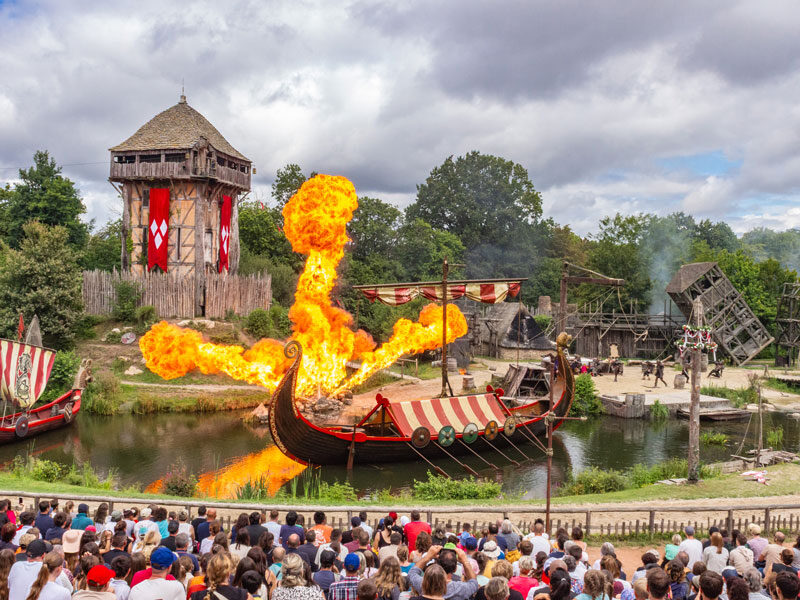
Almost 50 years ago, Philippe de Villiers gathered together hundreds of volunteers to create Cinéscénie, a live-action re-enactment of history and folklore from his part of France, a region called the Vendée. Quite unlike the ‘liberté, égalité, fraternité’ motto that accompanies the revolution in a lot of France, in the Vendée region it was received with little enthusiasm, and in the process of uprising its inhabitants died in their thousands. De Villiers wants this recognised, which is partly what led him to create a large-scale performance, to ensure the story was told to future generations. Not a typical start to a fantastical theme park.
From its founding in the 1970s, that single re-enactment has grown into ‘the world’s biggest night-time show,’ and its home park a provider of dozens of eye-popping performances – world class in every sense of the word. Its name is Puy du Fou.
A leader in performance, spectacle and indeed customer experience, Puy du Fou is second only to Disneyland Paris as the biggest theme park attraction in France. It is a multi-million-pound business and tourism model, and it is currently under consultation to come to the UK.
There are two Puy du Fou parks already: the one in France founded in 1978, and a newer one in Spain since 2021. Both provide immersive, multi-award-winning, genuinely world-class shows telling famous historical legends and stories of the local area and beyond. When I say world-class, I mean it – Puy du Fou productions have won international awards for best shows; not best theme park shows, best shows. Their technical prowess and spectacle are preposterously good. The scale of them is life size or bigger – think exploding Viking ships and life-size castles appearing from nowhere. Visiting a Puy du Fou is a whistle-stop tour through famous and not-so-famous events in history, presented to spectacular effect.
Know your audience
The UK Puy du Fou consultation is being run with Cherwell Council in Oxfordshire, inviting perspectives from local people and businesses. Naturally there are objectors, but it would seem unlikely that the council will turn down the level of investment on offer, not only financially speaking but also in terms of regenerating the local environment. It sounds surprising but Puy du Fou evidence an improvement to the local environments of their parks in terms of site choice, tree planting, and biodiversity, delivering a net gain to the local environment. It is a pretty watertight and persuasive consultation package, having had 50 years of learning from their existing two parks, but the reality is that the council will only approve the park if it is felt to be financially and politically viable to develop this sort of attraction in their part of the UK.
It is a multi-million-pound business and tourism model
Interestingly, the proposed Cherwell site is within easy reach of Bicester Village, the second biggest tourist destination in the UK (after Buckingham Palace) for wealthy Chinese tourists. Indeed, the massive designer outlet hosts some seven million visitors every year and the Chinese represent the biggest demographic.
Marketed strongly in Mandarin online, particularly on Weibo, it has easy rail access from London and it is also close to the Cotswolds, which in turn has millions of tourists visiting every year. Make no mistake, there is already an abundance of disposable income in this area. A Puy du Fou, with its niche offering of historical and mythological re-enactments specific to its host country yet a quintessentially British experience, should appeal to international tourists but crucially, British ones as well.
Bringing Hollywood home
Those with a keen eye on the UK tourism industry will also be aware of the public consultation for a proposed Universal Studios to open in nearby Bedfordshire. The consultation website for this park states that a Special Development Order has been granted by the local authority, which ‘represents an important milestone for the project.’
The website itself states that 94 percent of the consultation responses have been in favour of the park; the UK tourism industry has arguably not had such a globally recognised attraction brand launching here since the opening of Warner Bros. Studio Tour London – The Making of Harry Potter, in 2012.
Much more of a classic theme park experience, with rides, rollercoasters, and movie set immersions, Universal Studios is a truly global brand with significant resources and experience that will know its UK market well. It is surely the better known of the two parks in the UK – indeed, Puy du Fou, while being the second-biggest attraction in France, somehow also manages to feel like a very well-kept secret. With the Universal name comes a global reputation it will need to live up to; with multiple stablemates in locations like California, Japan, and Singapore, the Orlando, Florida park is the largest (comprising three separate parks) and has long ranked among the world’s most popular tourist attractions. Attendance numbers have typically shown steady growth, peaking in 2019. The following year, however, brought an abrupt shift as the park faced months of closure and widespread travel lockdowns due to Covid, leading to a sharp decline in visitor numbers from which it has still not fully recovered.
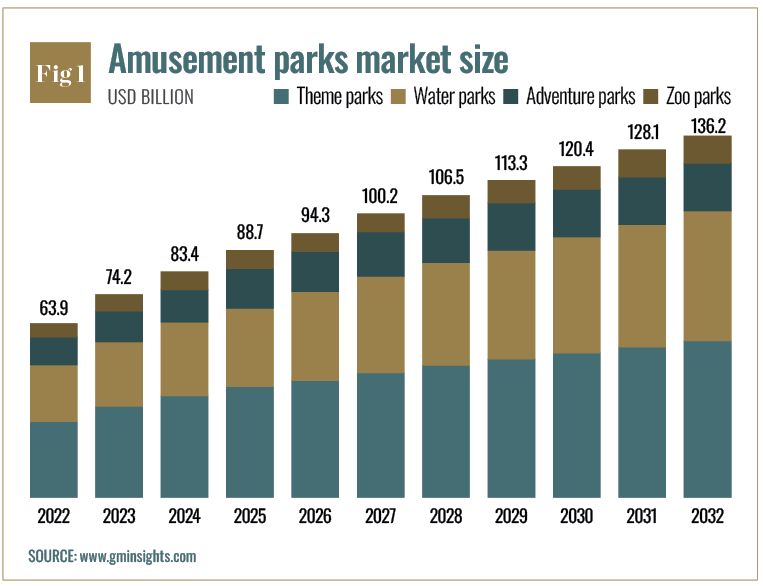
That said, Forbes reports that over a million people from the UK alone visited Florida in 2024 – that figure is still nowhere near pre-pandemic levels, but if a proportion of those visitors could be tempted to stay at home and still have the theme park experience here in the UK, the number may fall further still. Amusement parks are big business and that trend is predicted to continue in the coming years (see Fig 1).
Tradition or ambition?
But what of the quintessentially British experience? Does the UK actually want gigantic theme parks? Perhaps one of the characteristics that makes the UK so attractive to tourists is the typical understated charm of so many of our offerings. Certainly that is what drives many to visit the Cotswolds and places like Devon, Dorset and Cornwall. That olde-worlde British charm feels much harder to come by in the peak of summer, however, and one has only to recollect the frenzied staycations of the lockdown years and the genuinely serious issues with flytipping and mess left behind in overrun beauty spots that simply could not cope with such an influx, to recognise some of the concerns that respondents to the theme parks’ consultations are expressing online.
Social and environmental concerns are being carefully considered and planned for in both consultations, and the parent companies are engaging with local government, community groups, and businesses to assuage fears around everything from firework noise to local employment offers. There are detailed plans for the build phases, the customer experience during visiting hours, and longer term once anticipated peak guest numbers have been reached after opening.
Any large enterprise like a theme park requires enormous numbers of staff, both front of house and behind the scenes, onstage and in the back office. Excitingly, both parks also use actors and performers to enhance the visitor experience. With Puy du Fou especially, this is a central part of their brand, and they have specific career enhancement pathways that enable people to join, say, hospitality, but receive on-the-job training and development to join the ranks of highly skilled performers that make the shows so breathtaking and unique to watch.
Harry Potter Studios, Bicester and Bedford – you can drive from any one of these sites to another in about an hour. That is more than doable from a holiday perspective. When families from the UK visit Florida, it is common to plan entire holidays around the various parks. Big-ticket theme parks here in the UK such as Universal Studios and Puy du Fou could offer UK tourism a complete portfolio of visitor experiences that are well-connected (and hopefully, well thought out) and that could take the UK offering beyond the realms of quaint Britishness and into truly global tourism.
International tourists will keep coming to the UK, but whether the country’s own public has a sustainable appetite for this remains to be seen. With the cost of living continuing to bite more with every passing year, disposable income is not abundant for most UK working families, but perhaps this is in fact a reason for people to get behind projects like Universal Studios and Puy du Fou. Why spend hundreds of pounds on unreliable flights abroad that might never take off given global instability, when you can simply staycation closer to home? Added to the already impressive combination of luxury retail experiences, historical wonders like Stonehenge, and classic British attractions like Buckingham Palace, parks like Puy du Fou and Universal Studios could mean the feeling of being transported to another world might soon happen right on your doorstep.

