


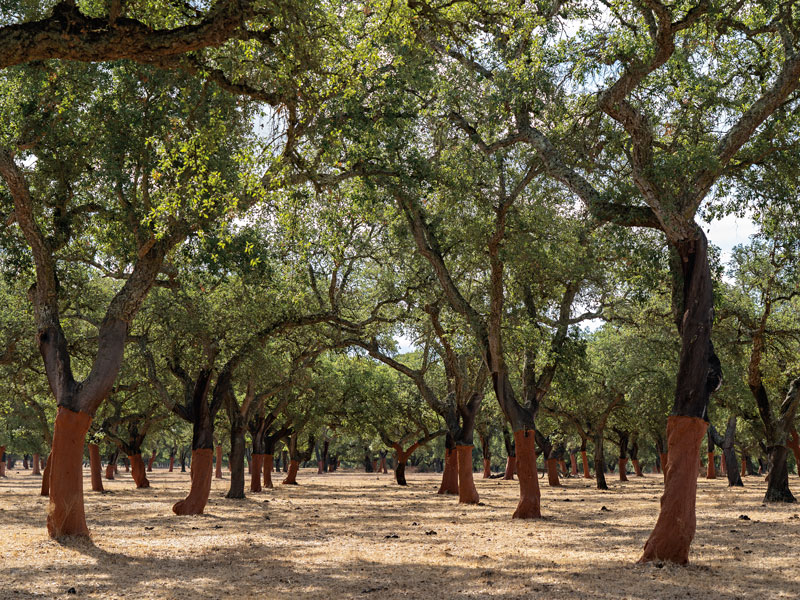
Whether in its most traditional roles or in more unexpected contexts, cork continues to demonstrate outstanding performance across a broad spectrum of industries. In sectors as diverse as winemaking and aerospace, cork can be integrated into a wide and growing range of applications, supporting lower-impact solutions across multiple fields.
The story of cork is closely intertwined with the history of wine, two worlds that are inseparably linked. Over the centuries, this relationship has evolved into a true symbiosis, in which the natural cork stopper protects, preserves and elevates a product that is itself alive. Dating back to ancient civilisations and later shaped by the influence of Dom Pérignon in the 17th century, who established the enduring connection between glass and cork, the stopper has become an essential part of the wine experience.
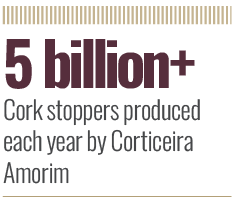
At the heart of this experience is Corticeira Amorim, the world’s leading producer and exporter of cork products, recognised for its long-standing focus on renewable, bio-based materials and life cycle-based sustainability assessment. Founded in Portugal in 1870, Corticeira Amorim has grown from a family business into a global leader, with sales in more than 100 countries. While its portfolio now extends from flooring to aerospace-grade composites, it remains best known for its high-performance cork stoppers, producing over five billion each year.
Why cork?
There are multiple reasons why cork stoppers are widely regarded as the preferred closure for wine bottles, covering technical, sensory and environmental dimensions, with environmental performance supported by peer-reviewed life cycle assessment studies and product carbon footprint analyses.
Corticeira Amorim is the world’s leading producer and exporter of cork products
Aligned with the ISO 14067 standard, greenhouse gases – carbon footprint of products, Amorim Cork has conducted studies to quantify the carbon footprint of its cork stoppers using a cradle-to-gate approach. To date, these studies cover around 60 percent of the product portfolio and have been independently verified by APCER – Portuguese Association of Certification – ensuring robust, credible and transparent information consistent with EU regulatory expectations for environmental disclosures.
The results confirm that all analysed cork stoppers present a negative carbon footprint within the defined system boundaries, highlighting cork’s environmental value as a packaging solution for the wine sector. Depending on the product typology, values range from –28.72 g CO₂e for each Spark Top II stopper, in the sparkling wine segment, to –56.4 g CO₂e for each Naturity cork stopper.
Rooted in the cork oak, giving back
At the core of cork’s exceptional environmental qualities is the cork oak tree. Native to the Mediterranean and central to Portugal’s distinctive Montado (cork oak forest), it is the only tree species whose bark regenerates after harvesting. Cork oak forests function as carbon sinks and as long-term carbon stores, since these trees have an average lifespan of around 200 years.
According to a study cited by APCOR – Portuguese Cork Association, cork oak forests can sequester up to 73 tonnes of CO₂ for every tonne of cork harvested. This makes cork a nature-based system with significant long-term carbon storage potential, while also contributing to other ecosystem services.
Beyond cork production, this ecosystem supports high levels of biodiversity, including endangered species such as the Iberian lynx and the Spanish imperial eagle. The Quercus suber, more commonly known as the cork oak, plays an essential role in maintaining soil quality, storing carbon and preventing desertification. Unlike monoculture plantations, the cork oak forest represents a model of land use where environmental protection and economic productivity coexist.
In addition, the long-term resilience of the cork oak forests depends on responsible forest management and the maintenance of healthy, economically viable cork value chains – helping to keep this multifunctional landscape standing and managed over generations.

