


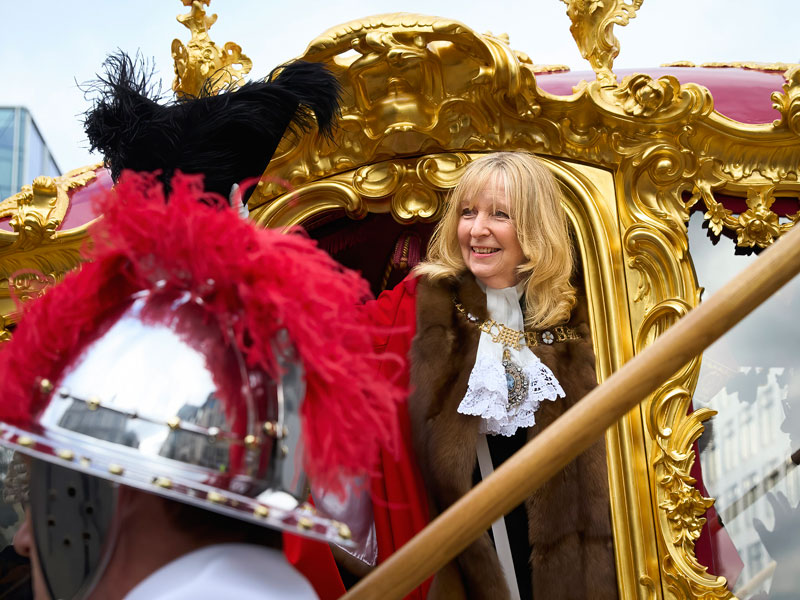
Changing perceptions of an 800-year-old institution steeped in tradition is no easy task, but that is what Dame Susan Langley is on course to achieve in her year as the first citizen of the City of London, usually known as the Lord Mayor. She is the 497th holder of that office since it was established in 1189 and only the third woman to hold the position, but the first to style herself Lady Mayor of London. That decision alone has made a huge impact, as well as raising the eyes of traditionalists, but it shouldn’t have come as a surprise.
When she was elected to the Court of Aldermen in 2018, part of the City’s governance structure, she quickly realised she wasn’t happy with a gender-specific title: “I was the first to take the title Alderwoman. I wasn’t trying to make a point but what triggered it was when someone said ‘Alderman Langley’ everyone shook my husband’s hand. I got fed up with that.
“Changing that was hard. There were papers written about whether it could be done but the nice thing is now that it is done all of the women who come after me have a choice.”
When it came to the Mayoralty, the potential legal obstacles were non-existent because all the relevant legislation just refers to the position as Mayor. Lord Mayor is the title that has been used by convention. This didn’t stop her having to work to justify the adoption of Lady Mayor as her title, but her approach was always gentle persuasion, as she recounts one encounter with someone reluctant to accept the change:
Challenging perceptions
“I get that view that since 1189, it has been the convention, I said, but that is because it has been men. Fine. That was the way it started. I said, well, let’s turn it round. Let’s say since 1189, it has been women, and the title is Lady Mayor, and there has always been Lady Mayor. How would you feel if I addressed you as my Right Honourable, the Lady Mayor? And he said, oh, I see what you mean.”
Now that it is done all of the women who come after me have a choice
From that decision flowed the re-titling of the annual parade through the City of London every November that marks the formal installation of the new Mayor from the Lord Mayor’s Show to the Lady Mayor’s Show. This made the world sit up and take notice as it was broadcast live on BBC and widely covered in the national press in the UK:“It made far more of an impact than I ever imagined. It made people feel they belonged because they could see themselves.”The changes she has pursued go far beyond the change of title.She has christened her year in office as the start of the ‘Modern Mayoralty,’ and plenty is happening to embed that in the way the office operates now and in the future.
A legacy that lasts
Traditionally, Lord Mayors have set a theme for their year in office, many very worthy but rarely enjoying a life beyond that Mayor’s year. Working with the City authorities, Dame Susan has already moved the dial on that front. Unusually, the powers that be have been willing to be clearer on who will succeed Dame Susan, with Timothy Hailes, a lawyer, lined up for 2026–27, and Bronek Masojada, former CEO of Hiscox Insurance, succeeding him.
This change has been backed by the creation of an Advisory Board that will ‘fill in gaps in the Mayor’s skillset’ and ‘ensure all three of us operate within set tramlines to give more consistency and impact.’ It is being chaired by former UK Cabinet Secretary Mark Sedwell, who has a clear brief to deliver continuity. And impact is what Dame Susan is focused on. She wants to get the message across to the wider world that the City of London is a place to do business, as well as ensuring the UK government focuses on policies that help the City thrive. Pushing for speedier delivery of the promised captive insurance regime for the City has been at the top of her agenda.
As with all holders of the office she has joined ministerial visits to China, India and America – to name just a few – and has been able to use her experience as a UK trade envoy to put the City’s case effectively.
Bridging markets
“For centuries, the City has been a place where deals are made and honoured, contracts enforced, disputes resolved. In other words, a place where trust thrives. Despite current headwinds, the UK remains the second most attractive destination for global investment. The City continues not only as a centre for capital, but as a gateway connecting investment to markets around the world.
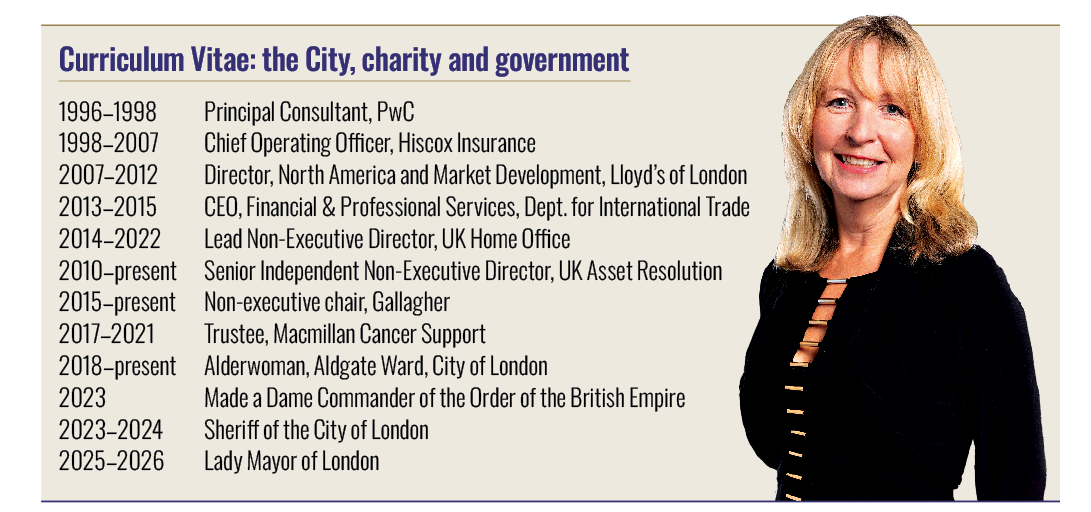
“Our partnerships are thriving and that is something to celebrate and build upon.” When she recently welcomed the British Foreign Secretary and senior foreign diplomats to Mansion House – where the Mayor lives and works for their year in office – she took the opportunity to reinforce this message.
“This is an age defined by volatility, by insecurity, competition and, at times, fragmentation. But despair is not an option. Because, when the world feels most fragile, that is precisely when togetherness matters most. None of us can navigate this moment alone. Not one nation, not one economy, not one system, the future won’t be built in isolation. It will be built through partnerships grounded in shared values, interest and objectives.
“So, as this storm rages on, the question before us is whether we choose to strengthen these connections or allow them to be swept away. I believe we must strengthen them and the UK – and the City – must play its part.”
For those messages to land, however, she says there needs to be a significant change in perception of what the Lord or Lady Mayor does. For her, the day-to-day reality of the role is very clear: “It is probably 10 percent ceremonial, 20 percent philanthropic and then 70 percent business.”But this is not how the world traditionally sees the role.
The Lord/Lady Mayor: history and role
The Lord or Lady Mayor of London is the first citizen of the City of London and heads up the City of London Corporation, which is the local authority for what is known as the Square Mile. Within the City, the Lord Mayor is accorded precedence over everyone except the King. It is one of the world’s oldest continuously elected civic offices. It was instituted in 1189, the first holder being Henry Fitz-Ailwin de Londonestone. The most famous holder of the office was Dick Whittington, who was Mayor three times between 1397 and 1420. It is entirely separate from the directly elected Mayor of London, a political office that covers the much larger area of Greater London and is currently held by Sir Sadiq Khan.
“I stand behind tourist groups outside Mansion House and hear them talking about the Mayoralty and the show and ceremony and I actually want to go: no, that is not it. But I don’t seize their flags from them. The aim, over time, is that when someone stops you in the street and asks what the Mayoralty does they will say they are an ambassador for the financial and professional services sectors and when they say, what does Mansion House do? I want them to say it is the FPS Embassy for the City of London.”
She has changed the signs on her office to say ‘Ambassador for Financial and Professional Services’ and one of the signs that greets visitors as they enter the splendour of Mansion House now says ‘Embassy for Financial and Professional Services.’
Changing signs is easy: changing perceptions is much harder, but the message is getting through. On a recent trip to Texas, Dame Susan asked if they would like her to explain what the Lady Mayor’s role is but her host turned round and said: “That’s OK we know you are the Ambassador for Financial and Professional Services in the City of London.”
While that must have given her a glow of pride, she was less prepared for some of the more general perceptions Americans and others seem to have of London. It started with an American firm saying a senior female colleague was coming to London but wouldn’t be wearing her watch and jewellery because of fear of crime. This she dismissed but realised there is a serious problem with misinformation when a senior American asked her what it was like living in an Islamic capital under Sharia Law. This must have made her despair, but she is too diplomatic to condemn those taken in by far-right conspiratorial misinformation, instead responding with a plea for London businesses and authorities to work together to counter such lies, putting the positive case forward for London.
London calling
She believes in London, having been born and brought up in London’s East End.She remembers watching the Lord Mayor’s Show on her father’s shoulders, never imagining she would one day be leading that historic parade. She says that began to change about 15 years ago when some of the more far-sighted City grandees said to her that they were concerned that too few women were in senior positions in the City of London’s governance structures.
When the world feels most fragile, that is precisely when togetherness matters most
“At the time I thought I didn’t have time to do it and, secondly, I had the wrong perceptions. I thought it was too ceremonial as that is the part that I saw. I didn’t think I could make a difference, and I am the kind of person who likes to make a difference. But as I became closer to the City, I saw the impact it could have and got to know some of the Lord Mayors, some of the business agenda, the philanthropic agenda and saw the impact you could have.”
The tipping point came in 2018 when she was persuaded at the very last minute to stand for a vacant Alderman’s seat. She won and the next few years saw her race through the preliminaries to becoming Mayor, including a year as a Sheriff of the City of London. Few Mayors are remembered for long after they have left office but perhaps like another outsider – Dick Whittington – who famously held this office three times from 1397, Dame Susan will have left a mark on the City that will be her legacy for years to come.

