



On October 1, Nigeria celebrated 65 years of independence. President Bola Ahmed Tinubu, who has presided over a period of remarkable economic recovery anchored on fundamental reforms in recent times, acknowledged the country is making progress in the right direction. Though out of the woods, Nigeria is “racing against time” in guaranteeing long-term economic transformation, the President observed. He went on to cite the need to invest in roads, rail, energy, schools, hospitals and other critical infrastructures for sustainable development.
Tinubu’s clarion call echoes the very existence of Coronation Merchant Bank (Coronation MB). In operation for more than three decades, Coronation MB is driven by a vision of wanting to see a continent transformed and a mission of providing transformational solutions for Africa’s challenges. In pursuit of these goals, the bank has grown to become one of Nigeria’s leading financial institutions offering services across investment banking, corporate finance and wealth management, among others.
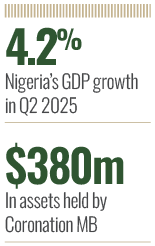
In 2024, Coronation MB’s shareholder funds stood at ₦45bn ($30.6m) with gross earnings of ₦70bn ($47.5m) and ₦12.2bn ($8.2m) in profit after tax. With assets in excess of ₦558.6bn ($380.2m), the bank’s growth has come by owing to strong governance, disciplined risk management, unlocking value for clients, deepening stakeholder trust and delivering sustainable returns. Besides, Coronation MB is one of the most highly rated financial institutions in Nigeria. This includes a ‘BBB’ rating from Agusto & Co and a Fitch rating of B- with a ‘stable outlook,’ all of which reflect the bank’s consistent asset quality and strong capitalisation.
Banking’s beating heart
For Coronation MB, the investment banking division is the heartbeat of the bank’s central role in Nigeria’s socio-economic development journey. This it does through its full suite of services cutting across capital raising, mergers & acquisitions, advisory to project and structured finance. The services, coupled with strong principles of strategic transformation, governance and professionalism, and a culture that blends innovation with execution discipline, have catapulted the bank to becoming a trusted partner for both private and public sector clients.
Nigeria prides itself on being one of the most vibrant and liquid capital markets in Africa
Granted, Nigeria is witnessing an economic renaissance. In the second quarter of this year, the country recorded an impressive 4.2 percent gross domestic product (GDP) growth rate, the highest in four years. Inflation is on a downward trajectory, declining to 18 percent in September from over 30 percent in 2024. Foreign reserves are booming, surpassing $42bn, while the public debt is projected to decline from 42.9 percent in 2024 to 39.8 percent this year.
The improving macroeconomic fundamentals are giving Nigeria ample headroom to be creative and innovative on strategies that will see one of Africa’s biggest economies realise its infrastructure sovereignty through domestic capital mobilisation. This is critical. Nigeria’s infrastructure deficit, estimated at over $100bn annually, remains one of the biggest constraints to economic growth and competitiveness. National Integrated Infrastructure Master Plan and African Development Bank data show the country’s infrastructure stock currently stands at only about 35 percent of GDP compared to an international benchmark of 70 percent. The gap cuts across energy, transport, housing, utilities and social infrastructure.
One primary cause of the huge gap is the fact that public funding alone cannot meet the scale of the investments required. Also, reliance on short-term, foreign-currency denominated loans from commercial banks as well as multilateral partners have proved to be largely unsustainable, often due to pains that come with maturity and exchange-rate mismatches. For this reason, mobilising long-term domestic capital becomes the ideal strategy for financing infrastructure projects.
Evidently, resources are available domestically. Currently, capital markets and institutional investors such as pension funds, insurance companies, high-net-worth investors and the Nigeria Sovereign Investment Authority collectively manage over ₦42trn ($28bn) in long-term assets. This, in essence, is a significant financial pool, which, if properly harnessed, can easily finance infrastructure needs sustainably.
For this to happen, developing transparent, well-structured instruments like infrastructure debt funds, project bonds and unit trust structures among others is critical. To make them attractive, the instruments must not only be long-term but should also be local currency denominated.
At the forefront
Coronation MB is at the forefront of mobilising domestic capital for infrastructure financing through the structuring of innovative equity and debt instruments. One such instrument is the Coronation Infrastructure Fund (Coronation IF) that is specifically designed to address one of Nigeria’s most critical challenges – lack of long-tenor, local currency financing for infrastructure. Through the ₦200bn ($133.3m) close-ended, naira-denominated fund, the bank, through its affiliate, Coronation Asset Management, is facilitating the channelling of domestic savings into viable infrastructure projects in sectors such as telecoms, real estate, utilities, social, transport, and energy. Notably, the focus is on projects that provide essential services including power generation and distribution, housing, waste management, data centres, and social amenities such as hospitals and education facilities.
Going by the success of the fund, there is no doubt investors covet instruments that generate predictable returns. Under Series I, the fund issued about 88 million units at ₦100 per unit, successfully raising ₦8.8bn ($5.9m). This was the largest amount ever raised for a maiden infrastructure fund in Nigeria. Coronation MB intends to ensure the fund continues to be a catalyst for economic growth by improving investor confidence and creating a consistent pipeline of bankable infrastructure projects.
Coronation IF is among the many solutions the bank has provided in the infrastructure financing space. Others include hedging arrangements, financial modelling, trade finance, private markets, public private partnerships (PPPs), and many more. Boasting a rich basket of clients cutting across governments (both federal and states), corporate, financial institutions and ultra-high net worth individuals, the bank has been involved in a growing list of landmark infrastructure financing deals.
In one such deal over the past 12 months, Coronation MB was the joint issuing house and bookrunner on the ₦32.5bn ($21.6m) 20-year Craneburg EKSG Motorway infrastructure bond. Backed by InfraCredit’s AAA guarantee, the transaction was initiated for financing the construction of a 17.84-kilometre phase of the Ado-Ekiti toll road. The bank was also involved in the ₦35bn ($23.8m) seven-year fixed rate bond for Cross River State the proceeds of which are earmarked for the acquisition of aircrafts and the dualisation of highways in the state. In both transactions, Coronation MB showcased its expertise in mobilising domestic capital for financing infrastructure projects that are critical for economic development.
While Coronation MB has become a powerhouse in bond issuances, the bank is also actively involved in PPPs. With governments being under pressure due to squeezed resources, PPPs are powerful mechanisms that are unlocking private investments for public good. By deploying its financial advisory expertise, structuring capabilities, capital markets access and private market, Coronation MB can bridge the gap between governments, project sponsors and institutional investors, thus making PPPs bankable and investable. In one facet, the bank seeks to collaborate with development finance institutions and specialised financial institutions to provide credit enhancements and blended finance solutions for PPP transactions. The strategy makes transactions more attractive to private capital, thereby enabling projects to achieve investment-grade status.
Closing the gap
Nigeria understands that having many tributaries makes it possible to mobilise domestic resources to close the infrastructure financing gap. Islamic finance is another stream, one that is particularly popular for the federal government. In recent years, the federal government has cumulatively raised ₦1.3trn ($928m) through eight Sukuk issuances. The most recent was in May when the government raised ₦300bn ($200m). The proceeds have financed over 4,000 kilometres of roads and bridges across the country, directly linking Islamic finance to tangible national development.
Coronation MB is at the forefront of mobilising domestic capital for infrastructure financing
Coronation MB considers Islamic finance an increasingly vital pillar of Nigeria’s capital market and infrastructure financing ecosystem. In this space, the bank played a pioneering role as the first arranger of TrustBanc’s NICP programme under FMDQ’s revised wakalah framework, enabling corporates to issue Shariah-compliant short-term instruments. The innovation underscored the bank’s commitment to supporting both public and private sector entities in accessing non-interest capital. The ultimate goal is not only supporting the country’s sustainable economic development but also deepening the capital markets and expanding financial inclusion. Nigeria prides itself on being one of the most vibrant and liquid capital markets in Africa. However, the market is still developing with a focus on increasing depth, structure, and the range of instruments available for long-term infrastructure financing.
As a leading investment bank, sustainability is at the core of Coronation MB’s operations. The bank is cognisant of the fact that long-term projects have deep environmental and social footprints. For that reason, environmental, social and governance (ESG) integration is not just a compliance requirement for the bank. Rather, ESG is a strategic imperative for delivering lasting value to clients, investors, and the communities. This understanding has ensured that sustainability is embedded throughout its advisory and arrangement processes for infrastructure financing, including environmental feasibility studies for projects.
Coronation MB is also a leading house in facilitating the issuance of green bonds and other sustainability-linked instruments for its clients. One such transaction was the Craneburg EKSG Motorway infrastructure bond in which the bank acted as joint issuing house. The ₦32.5bn ($22m) bond is a classic indication of the bank’s strong commitment to ESG integration in infrastructure financing. Apart from environmental studies, the project promoted local content participation, job creation, and community engagement throughout its execution.

