


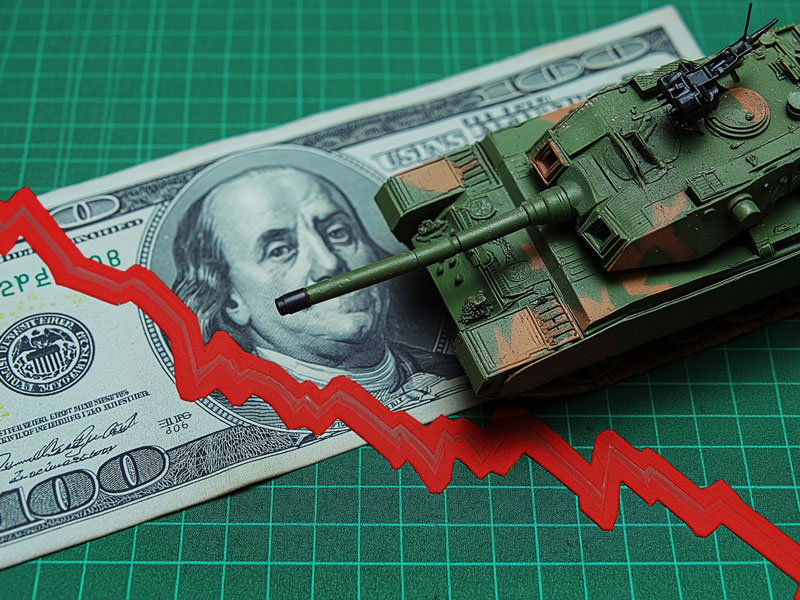
In the space of just a few weeks, the throttling of shipping traffic through the Strait of Hormuz has revealed the true nature of the US-Israeli war with Iran. This is no regional conflict, because the entire world is being invoiced. While the size of the bill remains to be determined, it is already obvious that the belligerents won’t be the only ones paying the tab. War is typically framed in terms of national security, territorial integrity, humanitarianism, or even civilisational struggle. But such rationales obscure an unsettling truth: war is one of the most mispriced of human activities. Those who initiate it rarely bear the full costs, which tend to be displaced across borders, markets and time. Beyond the physical destruction, war generates massive negative externalities. The price paid by the perpetrator reflects only a small fraction of the social cost.
Of course, the intuition that war imposes downstream costs on others is deeply embedded in the political-economy literature, running from Adam Smith and David Ricardo to John Maynard Keynes and Karl Polanyi. But globalisation has transformed the effect into a structural feature of the modern economy.
Economic growth diminishing
Consider the arithmetic of the current Iran conflict. Beyond the loss of life, direct US military spending may run into the tens or even hundreds of billions of dollars. Yet the broader economic cost – transmitted through energy, food and financial markets – runs far higher. The International Monetary Fund warns that the war is already diminishing many economies’ growth prospects, as energy shocks ripple outward and inflationary pressures intensify.
The transmission mechanism is brutally simple. When oil and gas prices rise, transportation and electricity become more expensive. When fertiliser costs increase, so do food prices. Central banks may respond by assuming a tighter monetary-policy stance. Ultimately, growth slows. Yet this domino effect is missing from the actual war ledger. Efforts to measure the true costs of war have consistently found that they lie beyond the battlefield. In their work on the Iraq war, Joseph Stiglitz and Linda Bilmes tallied a catalogue of costs in the trillions of dollars once macroeconomic effects were included. Similarly, both the IMF and the World Bank have found that violent conflict depresses growth in economies far removed from it.
Even under conservative assumptions, the US may bear only a modest share of the total global economic damage (much as the negative spillovers of the war in Ukraine far exceed the direct cost to Russia). As European Central Bank President Christine Lagarde recently cautioned, the rest is diffused across the system, absorbed by energy importers, emerging markets and households worldwide. War, in this sense, is globally subsidised.
Three mechanisms make this possible. The first is spatial. Modern economies are deeply interconnected. When war disrupts one node (particularly an energy chokepoint), the effects cascade outward. The Strait of Hormuz is not simply a geographic passage but a structural vulnerability in the global economy.
The second mechanism is temporal. War typically requires the present to borrow from the future. Governments finance conflict through debt, deferring its cost to generations not yet politically represented. The fiscal consequences of past wars continue to unfold decades later, showing up in public debt, constrained policy options, and obligations that outlast the politics that created them.
The third mechanism is distributive. War concentrates decision-making while dispersing the costs. Those who decide are not the ones who pay. This last insight lies at the heart of modern conflict economics. The Oxford University economist Paul Collier has shown that wars persist not because they are collectively rational, but because they are privately beneficial. Small groups capture the gains as the broader population absorbs the losses. Today’s networked economy amplifies this asymmetry.
When the world pays the price
As Edward Fishman of the Centre on Global Energy Policy argues in his book Chokepoints, power today flows through global systems such as energy routes, financial networks and supply chains. But conflict turns these into channels for economic contagion. The result is a peculiar inversion. War appears expensive in theory but affordable in practice, because much of the bill is paid by others. This mispricing has predictable consequences. When goods are subsidised, we get more of them. When their price is too low, we get oversupply: too much pollution, too much risk and too much war.
The policy challenge is therefore familiar, even if the politics are not: to discourage war, its costs must be internalised. Those who initiate conflict must bear a greater share (or, even better, the entirety) of its true costs. Ensuring that outcome requires an effective global institution that can align the private and social costs of conflict more effectively than global markets can. Until the world can come up with such an institution, the incentives will remain perverse, because one of the most destructive activities imaginable seems so affordable to those who undertake it.

