


Art that hung on walls and wine that sat in cellars is now competing for space in portfolios. After two years of correction, the market is finding its footing, but the numbers still demand careful reading. In spring 2022, as public equity markets stumbled and central banks signalled the end of cheap money, auction rooms told a different story. Sotheby’s reported record results. Rare whisky indices hit levels that would have seemed fanciful five years earlier. Tangible assets, long dismissed by mainstream wealth managers as indulgences of the very rich, were attracting serious institutional scrutiny for the first time.
Passion investing, encompassing fine watches, contemporary and classic art, vintage wine, rare whisky and high-end accessories, has spent a decade trying to shed its image as a plaything of the wealthy. In some corners of wealth management, it is succeeding. In others, scepticism remains deep and justified. The gap between those positions reveals something important about how investors think about value and risk.
For most of the 20th century the value of art, wine and watches was partly financial but mostly cultural, expressions of taste and inheritance rather than deliberate capital allocation. What changed was the infrastructure that grew up around them. Index providers began tracking price movements and platforms emerged to authenticate and trade collectibles. A prolonged period of low interest rates left investors hunting returns in unfamiliar places.
The long-run numbers remain striking. The Knight Frank Luxury Investment Index (KFLII) showed that $1m invested in 2005 would have grown to approximately $5.4m by end-2024. Individual categories performed even more dramatically at their peaks: rare whisky appreciated 191.7 percent over a decade and watches 125.1 percent.
Liam Bailey, Global Head of Research at Knight Frank, says: “Luxury collectibles have delivered for investors over the long term.” Wealth managers, particularly those serving ultra-high-net-worth clients, have begun to formalise what many already knew: that significant client wealth was sitting in collectibles, whether or not those assets appeared on any investment statement.
The performance reality check
The long-term figures are compelling. The recent ones are a useful corrective. The KFLII recorded a marginal –0.4 percent decline in 2025, signalling stabilisation after two years of broad correction across several collectible categories. That follows falls of one percent in 2023 and 3.3 percent in 2024. Even after three consecutive years of correction, the index remains 40 percent above its 2020 baseline, showing a market settling after a boom, not one in distress.
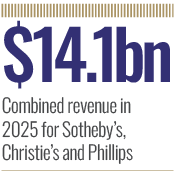
The auction houses tell a similar story of tentative recovery. Sotheby’s, Christie’s and Phillips reported combined projected revenue of $14.1bn for 2025, up roughly 10 percent from 2024. Sotheby’s alone reported total sales of $7bn, a 17 percent increase over 2024, with fine art up 15 percent to $4.3bn. That compares with auction sales of $4.1bn across the big three in 2024, itself nearly half the 2022 peak. Impressionist sales surged 80.4 percent, modern art advanced 19.4 percent, and Old Masters registered a 68.7 percent uplift.
We see a lot of interest driven by the tangibility and the emotional factor
Christie’s CEO Bonnie Brennan said: “The energy has returned to the saleroom, online and across the market. We have seen renewed confidence worldwide.” The recovery, though, followed a pattern familiar to anyone who has watched asset markets closely: a pandemic-era surge driven by liquidity and newly wealthy buyers, followed by a reversion as rates rose. Assets that held up best were handbags, jewellery and coins and tended to be those with genuine scarcity and cultural resonance. Those that fell hardest had attracted the most speculative attention. The fine wine market posted a decline of 2.5 percent in 2025, with total losses approaching 25 percent since the 2022 peak. Whisky, the standout performer of the previous decade, has still not recovered its pre-correction highs.
The lesson is not that luxury assets are poor investments. It is that they are uneven and cyclical. Returns cluster around quality and timing in ways that reward expertise and punish trend-chasing. The investor who bought a Patek Philippe Nautilus watch at the height of the pandemic premium paid a very different price to one who bought the same watch in 2018. Same object, three years apart, entirely different financial story.
What is driving demand?
Despite the correction cycle, the structural forces behind long-term growth remain intact. Inflation has revived interest in tangible stores of value. Geopolitical uncertainty has reinforced the appeal of portable, internationally recognised assets. The value of 1959 Macallan whisky, for example, is legible to collectors from Shanghai to Geneva.
Liam Bailey, Global Head of Research at Knight Frank , speaking on the 2026 Wealth Report, said: “After a cycle defined by extraordinary highs followed by rapid readjustment, the luxury investment market is now entering a more rational and more discerning phase. Collectors are increasingly prioritising rarity and cultural resonance and younger generations are reshaping ownership models through digital and fractional platforms.” Demographics are shifting the buyer base in ways that will define the category’s next decade. At Sotheby’s, buyers under 40 made up 17 percent of global fine art bidders and just under 30 percent in luxury categories in 2025, while first-time bidders accounted for 35 percent of all participants. Where older collectors gravitated toward old masters and grand cru Bordeaux, younger buyers are drawn to contemporary art, street-wear, sneakers and independent watchmakers. For this cohort, the line between cultural consumption and financial investment has all but disappeared. “As people become wealthier, their preferences evolve beyond mass-produced luxury items to seek more unique and exclusive pieces. There is a desire for items that reflect authenticity, craftsmanship, heritage and skill,” Bailey adds. Serious participation in luxury collectible markets once required three things in short supply: significant capital, specialist knowledge and the right relationships.
Digital platforms and fractional ownership models have begun to change that, though not without complications. Phillips Auction House reported that 70 percent of works sold in the first half of 2024 were purchased via online bidding. For newer categories, rare sneakers, vintage haute couture, even natural history specimens, the internet has created new markets. A 66-million-year-old Edmontosaurus skull, sold via a fractional platform, delivered a 22.4 percent return in just eight and a half months, according to Knight Frank.
Leonardo De Keersmaeker, Asset and Partnerships Manager at Timeless Investments, explains the appeal: “We see a lot of interest driven by the tangibility and the emotional factor. It is about diversification of assets, with a fun story to tell.” The tension in all of this is real. The exclusivity underpinning the value of luxury collectibles is foundational to their appeal. Eran Peer, Co-Founder and CEO of fractional platform Konvi, cautions that: “the most valuable asset in the luxury investment space is knowledge” and that investors must “move beyond the hype and avoid simply following trends.” He believes success requires deep knowledge rather than simply following market hype.
Any serious discussion of luxury as an asset class must reckon with characteristics that sharply distinguish it from traditional investments. The most significant is liquidity, or the consistent lack of it. There is no exchange on which to sell vintage cognac at a moment’s notice. Auction timelines run to months. Private sales require the right buyer at the right moment, and the right buyer is never obligated to appear.
Valuation presents a related problem. Without a central pricing mechanism, the true market value of a collectible is largely unknowable until the moment of sale. Indices provide orientation, but they track categories, not individual items, and the spread between an exceptional piece and an average one can be enormous. Physical risks are unique to this category too: improper storage, contested provenance, or an accident that insurance may cover but the market will not forget. Authentication in the watch market, where sophisticated counterfeits are increasingly hard to detect, has become a cost of entry.
Success requires deep knowledge rather than simply following market hype
The broad consensus among wealth managers is that luxury belongs at the margins, a satellite position rather than a core holding, sized appropriately for its illiquidity and the expertise required. Some advisers suggest allocations of up to 20 percent in alternatives broadly defined, with collectibles representing a portion of that, not the whole.
The more important shift is in how the question is being framed. For most of the 20th century, passion purchases were kept separate from investment portfolios by convention. That convention is dissolving. As trend forecaster Martin Raymond observed in Knight Frank’s 2026 Wealth Report: “Collecting is not conspicuous consumption – it is conspicuous taste.” The generation that normalised cryptocurrency as a portfolio asset sees no reason to treat a limited-edition watch differently from any other store of value, and wealth managers who treat the categories as entirely separate risk losing the conversation.
Passion with discipline
Knight Frank frames the current moment as a market characterised by buyers who are highly disciplined, not afraid to spend, but unwilling to pay above fair value. The froth has cleared. The question now is what endures underneath it and which investors are patient and knowledgeable enough to find out.
The most successful long-term participants in luxury collectible markets have consistently been those who understood both dimensions: who bought what they genuinely valued, held through volatility without panic and sold with as much discipline as they brought to acquisition. In the end, the best investors in luxury may be those who understand both the market and its meaning and never mistake one for the other.

