


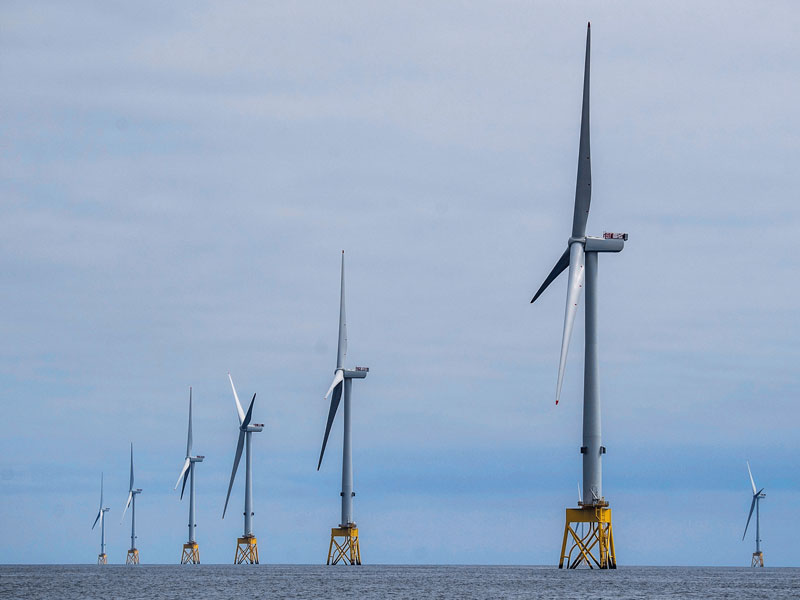
The signing of the Hamburg Declaration in January 2026 was intended to be a steady, decades-long roadmap toward transforming the North Sea into a 100 GW offshore wind hub. However, history rarely follows a linear path. The sudden and violent closure of the Strait of Hormuz shortly after the declaration has acted as a brutal catalyst, shifting the project from a long-term climate goal to an immediate matter of national survival.
As governments fast-track auctions and private capital scrambles to keep pace, the financial world is facing a stark reality: the current regulatory and financial architecture is being stress-tested by a ‘war-time’ deployment pace it was never designed to handle. For years, the North Sea wind expansion was discussed in the sterile lexicon of ‘Net Zero 2050.’ The Hormuz crisis changed the conversation overnight. Energy security has now surpassed decarbonisation as the primary driver of infrastructure investment. Arif Gasilov, partner at ESG and sustainability consulting firm Gasilov Group, captures the urgency: “The financing architecture we are examining is not a 2050 planning exercise. Governments are fast-tracking auctions now, and private capital needs to follow at a pace the current regulatory patchwork simply isn’t designed for.”
François Le Scornet, President and Senior Consultant at Carbonexit Consulting, argues that the crisis confirms offshore wind is no longer just a “light-hearted climate story” but a core industrial security plan. “Imported fossil fuels are a strategic weakness from a European perspective,” Le Scornet explains. “North Sea electricity is definitely a strategic asset from a geopolitical standpoint.”
The acceleration is visible in the numbers. Germany announced an additional 12 GW of auction volumes in direct response to the supply shock, while the UK brought forward its AR8 offshore auction to July 2026. This ‘Hormuz premium’ is forcing fund managers to re-evaluate risk-return profiles for assets deployed in months rather than years.
The revenue stability gap
While the 100 GW target is ambitious, the financial mechanisms to reach it remain under debate. Le Scornet warns that the target is credible only if governments stop pretending that private capital will shoulder the burden alone. To reach the goal, Europe needs approximately 15 GW per year from 2031 to 2040. “To ensure stable income for developers, at least 10 GW per year will require two-way price guarantee contracts (known as Contracts for Difference or CfDs),” Le Scornet asserts. These contracts fix a set price, protecting developers from market dips and consumers from overpaying during price spikes. “This ensures revenue stability for the developer and protects consumers when market prices are high. PPAs (Power Purchase Agreements) alone will not carry such an increase.”
North Sea electricity is definitely a strategic asset from a geopolitical standpoint
This creates a particular challenge for ‘hybrid’ assets like LionLink, connecting the UK and the Netherlands. Because the UK sits outside the EU’s internal energy market, investors face a dual layer of complexity: navigating different subsidy regimes and market coupling rules while managing significant currency risk.
“Developers are forced to structure PPAs across a GBP/EUR split,” Gasilov explains. “In agreements lasting 15 to 25 years, hedging costs eat into the already thin profit margins of offshore wind.” The lack of standardised contract templates for hybrid-specific risks remains a barrier, leaving institutional investors to manage 25-year currency volatility on a project-by-project basis.
According to Le Scornet, the real bottleneck is not just the capital, but the allocation of risk – specifically concerning grid investment, congestion, curtailment and price gap compensation. Furthermore, policy divergence between the UK and EU remains a primary concern for investors.
In this context, public de-risking becomes the ‘make-or-break’ factor. The roles of the European Investment Bank (EIB) and the UK National Wealth Fund are critical. “Without such public de-risking, the 100 GW target may seem very bullish,” Le Scornet warns. The public sector must act as the primary guarantor to make early-stage, high-risk projects bankable for the private market.
The ‘greenium’ mystery
The final pillar of the North Sea Hub is the capital itself, largely raised through green bonds. However, the pricing of these instruments reveals a complex landscape. Hilda Afeku-Amenyo, a researcher at Montclair State University, points to the concept of the ‘greenium’ – the slightly lower interest rate (or yield discount) investors accept in exchange for a green label. Academic literature, including recent findings by Panizza et al, suggests that the greenium for supranational bonds in advanced economies is approximately two basis points. Interestingly, research by Fatica et al found that the supranational greenium was once several times higher than the corporate one.
“This asymmetry in bond pricing provides one possible reason why institutions like the EIB have chosen to offer loans to North Sea countries rather than establishing dedicated, joint green bond programmes for the region,” Afeku-Amenyo explains. Demand, rather than climate impact alone, continues to drive the corporate green premium, which currently sits between three and eight basis points. A significant hurdle for the formal implementation of the Hamburg Declaration is Taxonomy alignment. According to a 2025 Bruegel policy brief, only nine percent of EU green bonds currently meet the strict criteria of the EU Taxonomy.
More concerning is the sectoral concentration: 79 percent of corporate green bonds that meet these criteria come from utility companies, despite utilities representing only five percent of the EU’s economic output. While this concentration helps offshore wind developers and Transmission System Operators (TSOs) in the short term, the ability of the Taxonomy to accommodate the sheer scale of Hamburg Declaration projects remains an open question.
Evidence from the first year
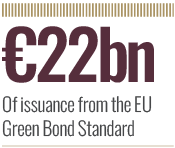
The first year of the EU Green Bond Standard (EuGBS) has seen approximately €22bn in issuance. However, data from ABN AMRO and IEEFA reveal a surprising trend: there is no measurable pricing advantage for bonds labelled under the EuGBS as opposed to those aligned with the older ICMA standards. Despite this, major players are moving forward. TenneT Germany launched its inaugural Green Finance Framework under the EuGBS in late 2025, and Eurogrid issued a €1.1bn EuGBS-aligned bond in October 2025. Denmark also issued its first sovereign EuGBS late last year.
“These developments indicate a shift towards the adoption of a common green bond standard across the region, rather than towards the development of a common issuing authority,” notes Afeku-Amenyo. The standard is moving faster than the pooling of bonds, leaving the prospect of a unified ‘North Sea Green Bond’ as one of the most intriguing unresolved questions in European finance.
Even with the capital secured, the legal vacuum in the high seas remains a ‘structural heart attack.’ Without a supranational regulatory authority, a project spanning multiple waters requires separate permitting processes and conflicting Environmental Impact Assessments (EIAs). “If a country changes its consenting rules mid-construction, counterparties are left with state-to-state legal disputes (arbitration) at best,” says Gasilov. This policy uncertainty is a significant deterrent for the ‘patient capital’ provided by pension funds. Moreover, biodiversity has moved from an ESG metric to a material financial risk. As wind density increases, the impact on migratory corridors creates permitting delays. However, the industry is fighting back with data. During the recent WindEurope Annual Event 2026 in Madrid, Sofia Ferreira (DHI A/S) presented a framework to quantify environmental vulnerability across 86,000 km², identifying conflict zones before upfront investment costs (CAPEX) are committed.
Policy divergence between the UK and EU remains a primary concern for investors
Operators like TenneT are also proving that infrastructure can act as a catalyst for nature. Saskia Jaarsma reported that High Voltage Offshore Substations (OHVS) are acting as biodiversity hotspots, hosting species like the harbour seal. For the finance community, this eco-friendly infrastructure (Nature-Inclusive Design) is about permitting speed – the faster a project proves ‘Nature Positive’ credentials, the faster it clears the regulatory hurdles of a post-Hormuz world.
The path to an energy union
The 100 GW North Sea Hub is a masterpiece of engineering, but its financial and legal foundations are still under construction. The Hormuz crisis has provided the political will to accelerate, but as Gasilov and the experts in Madrid have highlighted, ‘will’ is not enough to de-risk a trillion-euro investment.
To succeed, the North Sea requires three structural shifts: a unified authority to handle consenting and dispute resolution across all EEZs; a template for cross-border contracts that mitigates the GBP/EUR split and price gap risk (the risk that prices between the UK and EU will not align as expected); and a basin-wide methodology for pricing biodiversity, turning environmental protection into a predictable financial metric. The North Sea has the wind, the technology, and now the geopolitical urgency. If the finance ministers in London and Brussels can match the ambition of the engineers, the North Sea Hub will not only be Europe’s ‘Green Powerhouse’ but also the blueprint for a new era of supranational financial cooperation.

