


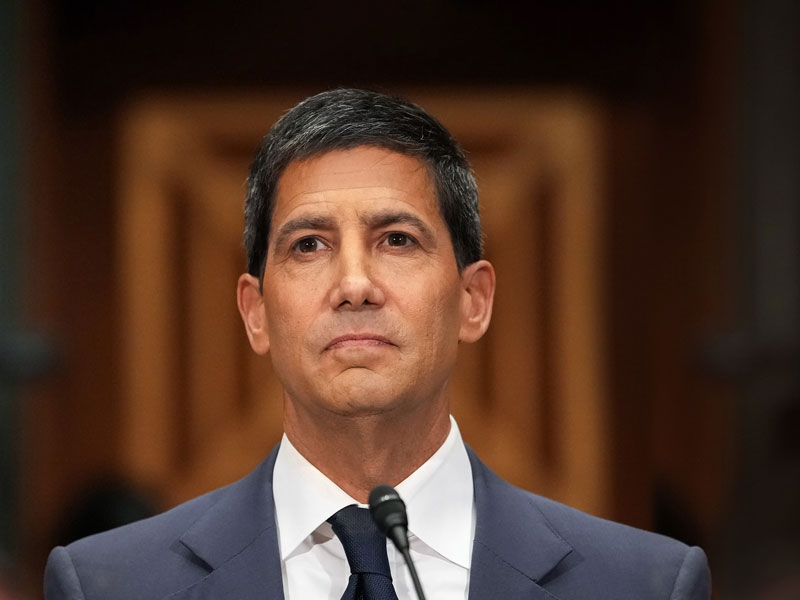
When Donald Trump turned his fire on Jerome Powell last year, it barely registered as unusual. The President had criticised the Federal Reserve chair before. This time, however, the threat felt sharper. “If I want him out, he’ll be out of there real fast,” he said – sounding less like a head of state than the host of The Apprentice, casually dismissing a contestant.
At first, it seemed like another off-the-cuff remark. But what followed was something more sustained: a steady, public campaign against the Fed chair. Trump repeatedly attacked Powell for refusing to cut interest rates, even calling him a “moron,” despite having appointed him. The message was blunt. Monetary policy should align with political priorities. Relief, the US President suggested, would come soon enough: rates would fall “when Kevin gets in.”
We need to talk about Kevin
Kevin Warsh, now installed as Fed chair, arrives with the kind of CV that reassures markets. A former governor who served from 2006 to 2011, he is widely seen as a seasoned operator in financial circles. He is also the wealthiest Fed chair in history, with assets worth at least $130m, accumulated through his role at the Duquesne family office. His confirmation, however, was anything but routine. Senators pressed him hard over more than $100m in ‘undisclosed’ assets, turning hearings into a confrontation. Republican senator Thom Tillis lent his support only after the Department of Justice dropped a criminal probe into Powell, widely perceived as a strategy to nudge Powell to step down. For his part, Powell has pledged to stay on the Fed board as governor to provide continuity, even though he had previously considered stepping down.
Warsh’s proximity to the administration has become a focal point. Critics worry that his alignment with Trump could blur the line between political power and monetary policy. In the run-up to his appointment, he softened his hawkish stance on inflation, a shift some see as calculated. His ties run deep: his father-in-law, Ronald Lauder, is a long-time Trump ally and donor. Supporters counter that Fed chairs may be political appointees, but their professionalism prevails once in office. Warsh has sought to calm fears during his Senate hearing, dismissing speculation that he would overhaul regional Fed leadership with loyalists. And his term runs until 2030, long enough to outlast the current administration.
The Fed’s structure itself offers some protection. Policy is shaped collectively by the Federal Open Market Committee (FOMC). Decisions – especially the most consequential ones on interest rates – require consensus or at least a majority. As chair, Warsh still casts only one vote and will have to convince other committee members. Historically, governors have been cautious about open dissent, preferring to project unity. But if they perceive an encroachment on independence, they may assert themselves forcefully through votes or even public statements.
Yet leadership still matters. The chair sets the tone, shapes communication and influences the internal culture. A chair perceived as politically aligned could shift expectations about how decisions on monetary policy are made. Over time, that perception can become self-reinforcing, affecting everything from bond yields to currency valuations. “Once he is sitting in the Chair’s seat he will be beholden to his fellow FOMC participants and markets, who will be closely watching for signs about his vigilance in keeping inflation expectations well-anchored,” says Christopher Hodge, chief economist of the US at the investment bank Natixis CIB Americas, who formerly held senior roles at the Federal Reserve Bank of New York and the US Treasury.
Under pressure
For much of its history, the Fed has occupied a delicate space – created by politicians, yet expected to stand apart from them. Its independence has never been absolute. Congress created the institution, and elected politicians have always sought to influence it, particularly before elections. Yet over time, a norm has emerged: while politicians might criticise its decisions, they ultimately respect the Fed’s autonomy. Its institutional gravitas rests on the premise that monetary policy is insulated from day-to-day politics, a tradition based less on formal rules than on shared norms. Once that mutual restraint between governors and politicians erodes, rebuilding it can be difficult.
Warsh is widely seen as a seasoned operator in financial circles
That understanding is beginning to fray. Trump’s attempts to reshape the Fed – its leadership and direction – have raised concerns that go beyond personalities. Last August, he sought to ‘fire’ governor Lisa Cook, defying legal protections that shield board members from dismissal. The move failed, but the signal was clear. If politicians can dictate the board’s composition, the boundary between fiscal and monetary authority begins to blur. At the same time, the administration has moved to exert more formal control. An Executive Order signed by Trump asserted that “officials who wield vast executive power must be supervised and controlled by the people’s elected President,” requiring independent agencies to submit regulatory proposals for White House review. The Fed’s monetary policy was spared. Much else was not.
To some historians, the shift in public rhetoric is without precedent. “Trump’s assault on both Jay Powell and Fed independence is the strongest such assault in the Fed’s 112-year history,” says Richard Sylla, an expert on the history of US financial institutions who teaches at the NYU Stern School of Business. The closest parallel, he argues, dates back to the post-war clash between the Treasury and the Fed over the latter’s interest rate policy, aimed at reducing inflation, which ultimately led to an accord restoring its monetary independence. Ironically, current pressure may strengthen the institution, Sylla argues. “Trump’s pressure on Powell, and Powell’s successful resistance to that pressure will actually result in increasing the Fed’s reputation for policy independence and strengthening the overall case for central-bank independence.”
Regime change
Warsh has made it clear that he does not intend to preserve the status quo. He has described US monetary policy as “broken for quite a long time” and has promised a “policy regime change.” Part of that shift will be philosophical. Unlike Powell, Warsh favours a narrower interpretation of the Fed’s mandate. He has signalled a retreat from policies that blur the line between monetary and fiscal intervention, particularly large-scale purchases of mortgage-backed securities. Under his watch, monetary policy is expected to be depoliticised, steering clear of non-monetary issues like climate change and social justice.
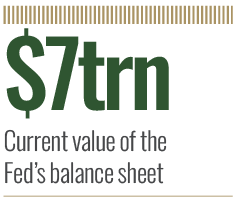
Above all, Warsh has his sights set on the Fed’s ballooning $7trn balance sheet. Immediately scaling it back would mark a decisive break from recent policy, reversing the Fed’s decision to halt quantitative tightening, under which its bond holdings were allowed to mature. Higher Treasury yields might force Fed interest rate policy into difficult trade-offs between supporting growth and containing inflation. And those trade-offs will not occur in a vacuum, given Donald Trump’s obsession with lower interest rates. “With what appears to be a persistent energy shock, there will be inflation and reason to raise interest rates,” says Barry Eichengreen, an economic historian at the University of California, Berkeley (the full interview with Professor Eichengreen is on pages 98–99 in this issue of World Finance). “But there will be political pressure from the White House to reduce interest rates. That will not be an easy circle to square.”
Calls for the Fed to keep interest rates low are not unprecedented. But the phenomenon is gradually evolving into a systemic feature of US politics due to the country’s precarious fiscal position. Higher debt levels increase pressure on the Fed to keep rates low and buy Treasurys, helping to erode the real value of US debt. The risks are obvious if recent economic history is a guideline. In the 1970s, government influence pushed the central bank to hold rates down, fuelling a surge in inflation. It took the shock therapy of aggressive rate hikes under Paul Volcker’s Fed leadership – and a deep recession – to restore confidence. Even then, it took years to fully re-anchor expectations. “That could happen again, undermining Fed independence, the value of the US dollar and confidence in US public debt management,” Sylla warns, pointing to the risks of sustained political interference that could undermine the Fed’s effort to anchor inflation expectations. “If political interference pushes inflation to sustained levels above two percent, the Fed would lose credibility. No matter what it does, it is likely to become a scapegoat for the likely negative results of fiscal irresponsibility.”
The Fed’s global reach under strain
What happens at the Fed rarely stays in Washington. As the anchor of the global financial system, the Fed’s credibility extends far beyond US borders. Its decisions shape capital flows, currency stability and the availability of dollar funding worldwide. For many countries, access to dollars is a cornerstone of financial stability. Foreign central banks are more comfortable with banks and firms under their jurisdiction using dollars if they can access them from the Fed through currency swaps in times of need, says Eichengreen. “If we have a nationalistic US President who insists on nationalistic behaviour by the central bank, things will be different.”
Warsh has made it clear that he does not intend to preserve the status quo
There are already signs of that shift in thinking. Stephen Moran, a temporary Trump appointee to the Fed board, has argued that the US should reconsider its role as a global lender of last resort, or demand compensation for it. Similar criticisms have surfaced before, including during congressional hearings after the 2008 financial crisis. A more inward-looking Fed aligned more closely with short-term domestic political objectives would reshape global finance, increasing global scepticism about its credibility.
“If financial markets and international partners perceive undue political interference in the central bank, we will see the ‘ABUSA’ – ‘Anywhere But The US’ – sentiment soar, and to the detriment of the US economy,” says Yerbol Orynbayev, a former World Bank governor and ex-deputy Prime Minister of Kazakhstan who played a key role in the country’s response to the 2008 financial crisis. “The US Treasury market is already on the verge of rioting – yields are fickle and are often rising. If the Fed is compromised, the US economy could face huge losses.”

