


In the run-up to this year’s International Monetary Fund and World Bank Spring Meetings, the one story that cut through the noise was that the World Bank had embraced industrial policy after decades of advising against it. But while much of the ensuing debate focused on whether this ‘U-turn’ is good or bad, overdue or dangerous, few pondered the fundamental question: What has actually changed?
The World Bank has merely affirmed what many of us have long argued: the framework it has promoted since 1993 – when its East Asian Miracle report cautioned against industrial-policy tools – has not served developing countries well. Such advice, World Bank Chief Economist Indermit Gill recently observed, “has the practical value of a floppy disk today.” Yet in his defence of the report, he also made clear how limited the shift remains. Industrial policy, he argued, should be “targeted and temporary,” an exception to a market-led model, rather than a tool for driving broader economic transformations.
The World Bank’s latest work confirms that industrial policy is more replicable across income levels and institutional contexts than the old consensus admitted, with a toolkit that extends beyond tariffs and subsidies. Public support for private actors, the bank now argues, should come with carrots and sticks, including withdrawal of finance from firms that underperform. This new position aligns with arguments we made in the ‘Entrepreneurial State’ and through more recent work on the role of missions and conditionalities.
But new conclusions do not automatically produce new economics. The World Bank still treats the state as a mere fixer of market failures, rather than as a market creator and shaper. The question is not whether governments should intervene after markets have failed. It is what kind of economy we want to build in the first place. Which public purposes should guide investment, and how can institutions govern the public–private bargain so that value is created collectively and shared fairly?
Viewed in these terms, the bank still falls short, because it treats fiscal-policy space as a fixed constraint within which to optimise, rather than as a set of institutional capacities that can be developed. As a result, the bank would still organise industrial policy only around specific sectors and considerations of comparative advantage. But the energy transition, water and food security, public health, and economic resilience are not sectoral issues. They call for economy-wide missions.
From market fixer to market shaper
Nor is the World Bank an isolated case. The IMF’s own economists have similarly documented how austerity and liberalisation fail to deliver. Yet these findings have yet to translate consistently into new operational practices. That needs to change. The IMF and the World Bank sit at the centre of an international order whose default advice still reflects an economics not supported by real-world evidence. What they model, measure and recommend shapes how development and macroeconomic policy are done around the world. They help determine who has access to liquidity, and on what terms; whose debt is treated as sustainable; whose public investment is seen as credible; and whose policy autonomy is constrained.
The wealthy countries that fund and control these institutions are not exempt from the consequences of the same economics. For decades, the same flawed assumptions shaped policy in Europe and the US, suppressing public investment, weakening public services, treating wages as costs rather than as fuel for aggregate demand and leaving households exposed to shocks that markets failed to manage. The resulting affordability crisis has now become a political one. The economics that constrained development policy abroad – hollowing out public capacity and narrowing what governments can do – helped fuel the far right at home.
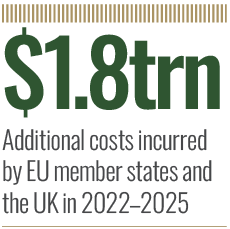
Europe’s response to the 2022 energy shock shows what is at stake. From 2022 to 2025, EU member states and the UK incurred $1.8trn in additional costs, much of it absorbed by households and public budgets, while the shareholders of firms charging higher prices benefited. Spain points to an alternative. Having invested in energy security as a mission, rather than as a subsidy category, it now generates more than half of its electricity from renewables, leaving it more insulated than its neighbours from the latest energy shock.
Consistent framework required
Making such resilience the default, rather than the exception, requires an economic framework that governments can apply consistently. The Global Progressive Mobilisation, convened by Spanish Prime Minister Pedro Sánchez, recently brought together progressive governments from around the world to start shaping a new economic consensus.
Its foundations are clear. We need public institutions with the capacity to invest, coordinate, and govern markets in the public interest. We need finance designed around missions, not leverage ratios, and policy frameworks that treat fiscal space not as a market-determined ceiling, but as something built by productive investment. And we need measures of value orientated around the common good. The argument for a new economics is being won. Now we must show what comes next.

