



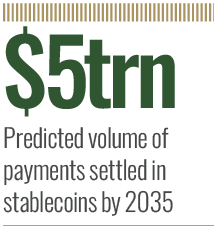
The painfully slow process of moving money across borders has stalled businesses for decades. The TradFi route is not fit for purpose but has been tolerated until recent years because no credible alternative existed at scale. According to Oliver Wyman, businesses collectively pay $120bn a year to move money across borders. Until the creation of stablecoins, moving money internationally meant waiting days for settlement, losing margin to FX spreads you cannot see or predict, and routing payments through intermediaries that add cost and time at every step. Now, Juniper Research is forecasting that cross-border B2B payments settled in stablecoins will reach $5trn by 2035.
This is less a prediction than a consequence of a broken cross-border banking system. At first glance, $5trn seems an extraordinary figure, but it reflects how enterprise demand is finally being met by infrastructure and regulation. The advantages of stablecoin payments over traditional cross-border rails are tangible. Payments move 24 hours a day, rather than on banking schedules, and settlement takes seconds rather than days. Payment terms can also be programmed and automated.
For businesses already on stablecoin rails, the efficiency gains are measurable – EY-Parthenon’s research also shows that there is further demand for wider industry support as 81 percent of corporates say bank support for stablecoins is critical or important. Juniper Research’s near 400x projected growth for the industry makes a lot of sense when you consider that the market is still at its earliest institutional stage. A sharp increase in the value of cross-border payments will naturally follow high demand and the right conditions for adoption.
The bottleneck was never demand
While stablecoins seem new and shiny to some, enterprise interest has existed for years – but the industry was missing the infrastructure and regulatory certainty that is necessary for commitment. Across the US and Europe, regulation is either progressing or falling into place. Last year, we saw the GENIUS Act pass in the US and, right now, the CLARITY Act is being debated in the Senate. The Markets in Crypto-Assets Regulation (MiCA) is live in Europe – over 40 Crypto-Asset Service Providers have been licensed as of March 2026.
If demand did not exist, financial institutions would not be investing
The market has crossed a commercial threshold. Landmark moves by major players have also signalled the shift from speculative use toward institutional payment infrastructure: Klarna recently built its own dollar-pegged stablecoin and Western Union committed to launching a stablecoin on Solana. Juniper predicts that 85 percent of all stablecoin transaction value in 2035 will come from international business-to-business activity. The direction of travel is clear – if demand did not exist, financial institutions would not be investing.
How to get adoption to skyrocket
For businesses with serious cross-border payment operations, the question has evolved from whether to implement stablecoin rails to which provider they trust to run them. The decision is harder than it sounds. In Europe, the MiCA grandfathering deadline of July 1, 2026 will mean providers without full authorisation must cease European operations from that date, with no grace period. But regulatory status is a baseline, not a differentiator. What separates credible infrastructure from everything else is whether it has been built to perform at enterprise scale: high transaction volumes, multiple jurisdictions, compliance across regulatory frameworks and integration with existing financial operations.
Confirmo Limited is authorised from the Central Bank of Ireland under both MiCA and as a Payment Institution under the Payment Services Regulations 2018 (PSR), covering the full stablecoin payment transaction lifecycle within a single regulated entity. More than half of enterprise non-users expect to adopt stablecoins within six to 12 months according to EY-Parthenon, and the providers ready to meet that demand are the ones who built the infrastructure before the forecasts made it look obvious.
The cross-border payments system has been extracting cost and time from businesses for decades. Stablecoins are not disrupting a system that works – they are replacing one that doesn’t. With regulatory frameworks now live across the US and Europe and the institutional capital flowing into payments infrastructure, the conditions for adoption at scale have finally arrived. The businesses that move now, while infrastructure is being built and competitive positions are still being established, will define what cross-border payments look like for the next decade.

