As CRO at GR8 Tech, a B2B platform provider for iGaming operators, I have seen how quickly the market has changed. In online gaming, the old business model was relatively straightforward: launch fast, offer enough content and use strong acquisition to build traction.
That approach is much harder to sustain today. But the shift is not unique to iGaming. Across digital industries, competition is heavier, customer acquisition is more expensive, and users expect speed, personalisation and smooth service as a baseline. Businesses are no longer judged only by what they offer, but by how well every part of the experience works together. In such an environment, technology becomes a key factor in sustainable growth.
What the market now demands
By that, I mean excluding super-innovative technology that looks impressive in a pitch deck but has few use cases. I mean technology that adds value when peak traffic arrives, when a new market demands faster localisation, when regulatory requirements shift, when margins tighten and when customer patience gets shorter.
iGaming has changed in a very important way. Operators are no longer looking for isolated solutions; instead, they are managing ecosystems. Sportsbook, casino, payments, CRM, retention, compliance, content and analytics directly affect one another. A payment issue is no longer just a payment issue; it affects conversion, retention and trust. Weak CRM is no longer just a marketing problem; it affects lifetime value and profitability. Poor infrastructure is no longer just an inconvenience; it becomes immediately apparent during peak demand.
Complexity is now the competitive test
In iGaming, complexity now breaks businesses down into three areas: speed, visibility and consistency. Speed suffers when launches, market changes, or product updates take too long because too many systems depend on each other. Visibility suffers when teams cannot see clearly where performance is slipping – whether in payments, retention, or customer behaviour. Consistency suffers when the customer journey feels smooth in one market or product, but fragmented in another.
That is why the advantage today is making the business easier to run as complexity grows. If payments, CRM, product, support, and data are not working together, the cost shows up quickly in slower decisions, weaker retention, and higher operational drag. This is where AI becomes useful for surfacing important insights sooner: which players are likely to churn, which offers are most relevant, where manual work is slowing teams down, and where performance is starting to slip. The businesses that perform best are usually the ones that can see problems earlier and respond with less friction.
From platforms to performance
This is exactly how we think about our ‘Platform for Champions.’ The label only matters if the platform performs under high pressure. For us, that means giving operators one connected ecosystem that brings together sportsbook, casino, CRM and BI, payments, engagement tools and back office, rather than forcing them to manage fragmented systems when the stakes are highest.
That becomes especially important around major events such as the World Cup. A tournament of that scale does not leave room for weak coordination, slow infrastructure, or disconnected decision-making. It reveals whether the platform was built to absorb pressure from the start. In practical terms, the platform is built to remain stable even during extreme spikes in demand and maintains an average 15-minute resolution time for critical incidents.
That is also the thinking behind our partnership with the football manager José Mourinho through ‘Champions Club,’ our initiative focused on the principles behind long-term performance. He is relevant here not simply because he has won, but because he has done so repeatedly in very different environments and under very different pressures. In business, and increasingly in technology, that kind of consistency comes from preparation, structure, and the ability to adapt without losing direction.
Preparation also begins long before the event itself. It often comes down to reducing friction early, simplifying launch processes, shortening setup time, and making expansion into new markets easier to manage. Over the past year, that work helped cut average project duration in half, made initial brand setup twice as fast as in previous years, and allowed new casino brands to go live in around 1.5 months. In a high-pressure environment, operational readiness matters just as much as scale.
Building for what comes next
Looking ahead, I believe the winners in the iGaming sector will be the ones with stronger systems, clearer commercial focus, better localisation, and the ability to keep performing as the market becomes more complex. That is where we see the future of GR8 Tech as well, focused on disciplined growth.
Technology has enabled the transformation of business models and customer experiences, with those organisations strategically integrating it, unlocking greater value for its stakeholders. In the banking sector, rising customer expectations for instant and seamless on-demand services and wider adoption of digital technologies have necessitated the modernisation of service delivery. The entry of fintechs and new operating models continue to push the boundaries of traditional banking while intensifying competition. Moreover, the capacity for digital banking services to transcend geographic boundaries has accelerated financial inclusion by improving accessibility for underserved communities and facilitating greater participation in the formal financial system.
Digital transformation
2025 was a significant year for Sampath Bank, as we embarked on our digital transformation journey, embedding technology with intent, across all pillars of strategy and business operations, while remaining true to our vision of making banking convenient and affordable at scale. Our strategy, anchored on the enduring pillars of customer centricity, operational excellence, digital leadership and sustainable growth, is now underpinned by strategic investments in advanced data analytics, formally elevating it as a core strategic capability.
This analytics-driven approach has deepened customer centricity by enabling hyper-personalisation and predictive services while driving operational excellence through intelligent automation and risk foresight. It has also formed the cornerstone of our digital leadership, creating smarter platforms and products while underpinning sustainable growth by allowing for portfolio steering and impact assessment.
Technological advancement directly fuelled our mission of financial inclusion and access
Executing this strategy necessitated deliberate and significant upfront investments in foundational IT infrastructure. This included the deployment of upgrades to the core banking system, a data lake and an advanced API integration platform to create a unified customer data ecosystem. These systems are expected to enable deeper personalisation, unparalleled speed and scalability in product development and service delivery, strengthening our competitive edge and market position within the Sri Lankan banking industry. We also responsibly adopted artificial intelligence and machine learning in areas such as credit assessment and personalised financial insights to enhance credit decisions.
We consciously invested in accelerating team capabilities through focused training and development while supporting their transition to new ways of working through targeted change management initiatives. A newly established team of data scientists and data analysts worked closely with business units to ensure data-led insights translated into actionable decisions to support sustainable growth and an elevated customer experience.
Reflecting its strategic significance, every aspect of technology integration is subject to robust oversight through a strong governance structure that is led by the Board of Directors. This has ensured the alignment of digital investments with strategic priorities, optimised resource allocation and prioritised investments while ensuring compliance with regulatory requirements and industry standards. Moreover, our robust IT governance framework, customer privacy and data security protocols and business continuity plans have reinforced trust in our digital ecosystem while strengthening long-term resilience.
Delivering value
Our digital transformation programme inspired relevant innovation while accelerating financial inclusion, resulting in measurable value creation for our customers. We launched ‘Sampath Select’ in 2025, representing a pioneering step in digital lending. This AI-powered instant personal loan provided our retail customers with a seamless and secure credit application experience, enabling completion in just five clicks via the ‘Sampath Vishwa’ mobile app.
Our retail customers also benefited from tailored lending plans and financial advice, enhancing financial wellness. Data-led insights supported the launch of zero equity housing loans in partnership with selected real estate developers supporting individuals to ownership of their own home. Meanwhile, high net-worth customers benefited from enhanced features on digital platforms elevating and personalising their banking experience.
For our corporate customers, our digitalisation and data analytics strategy enabled innovative, holistic financial solutions tailored to fulfil broad-ranging business needs, enhanced, streamlined and expedited service delivery and sophisticated treasury and trade solutions that improved their operational efficiency and liquidity management. The launch of our API banking platform enabled the seamless integration of corporate systems with the bank, streamlining transactions across supply chains.
Timely data-driven advice on cashflow management and market opportunities delivered to small- and medium-scale enterprises, the backbone of the Sri Lankan economy, elevated our service delivery to that of a strategic enabler that facilitated their growth. The implementation of several systems and digital tools also enabled faster credit decisions and relationship-based pricing alongside increased support delivered by an enlarged and trained team of relationship managers positioning the bank as a preferred partner within this customer segment.
Most significantly, technological advancement directly fuelled our mission of financial inclusion and access. By building sophisticated digital profiles, we are now able to responsibly extend services to segments previously deemed underserved, using alternative data to assess creditworthiness beyond traditional metrics. This allowed us to reach more first-time entrepreneurs, rural businesses, and individuals, ensuring that growth was not just facilitated, but was also equitable and far-reaching.
Building on a legacy
Our designation as a ‘Domestic-Systemically Important Bank’ in 2025 affirmed Sampath Bank’s critical role in safeguarding the country’s financial stability. It also underscored the need to pursue strategies that contributed to broader economic growth within a framework of prudent risk management, robust corporate governance and optimised capital management.
While direct value creation from new strategies will accrue to shareholders over the medium term, value delivered to our investors in 2025 remained significant. Our EPS increased by 11 percent to Rs 25.76 in 2025 compared with Rs 23.30 in 2024 despite higher upfront costs.
The bank’s PAT rose by 11 percent to Rs 30.2bn ($97.5m) in 2025, driven partially by a commendable 21 percent expansion in net fee and commission income, which cushioned the impacts of narrowing net interest margins in an environment of declining interest rates. The bank’s return on equity also improved to 17.93 percent in 2025 from 17.74 percent in 2024.
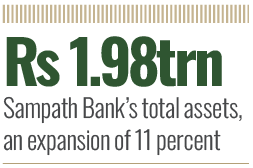
Sampath Bank’s total assets expanded by 11 percent to Rs 1.98trn ($6.4bn) driven by expansion in its gross loan portfolio. Stable macro-economic conditions and improving business confidence supported a 27 percent increase in gross loans and advances to Rs 1.22trn ($3.95bn), surpassing the Rs 1trn milestone in the second quarter of 2025. Asset growth was funded by healthy deposit growth and the purposeful rebalancing of its investment portfolio. The bank’s deposit base rose by 12 percent to Rs 1.65trn ($5.3bn) with moderate growth in current accounts and savings accounts (CASA), which increased in proportion to 34.7 percent as at end-December 2025 from 34.0 percent as at end-December 2024, easing pressure on net interest margins in an environment of declining interest rates. The bank’s capital position remained strong, with a Tier 1 capital adequacy ratio of 14.75 percent, which stood above industry standards, while asset quality indicators also recorded noteworthy improvement.
Strengthening long-term sustainability
The devastating impact of Cyclone Ditwah on lives, homes, property and livelihoods elevated the importance of emergency preparedness and a sharpened focus on environmental impact management and sustainability. The integration of SLFRS S1 and S2 enabled the formal identification, management and monitoring of the bank’s most critical sustainability and climate-related risks, while a climate first action plan set out clearly specified milestones for implementation. We also launched green deposits, which operate within the green deposit framework, enabling environmentally conscious consumers to participate in the country’s transition to a low-carbon economy. We enhanced our Environment and Social Management System (ESMS) and widened its scope to cover all lending facilities (except for schematised products), ensuring that environmental and social compliance was embedded across the bank’s financing activities. During 2025, we also received ISO14001:2015 certification, affirming compliance with global best practice in environment management.
We also invested in strategic environmental and social projects for shared prosperity. ‘Wewata Jeewayak,’ our flagship project, now in its 25th year, has restored 28 tanks as of December 31, 2025, with 2025 marking the highest number of tank restorations undertaken in a single year. This project has supported the livelihoods of over 16,000 families and rejuvenated over 4,000 acres of paddylands, supporting the nation’s food production while empowering local communities.
The bank also supports these communities by enhancing financial literacy through structured capacity building programmes. Extensions of these projects in partnership with other corporates have enabled many of these communities to thrive as capacity building and access to markets supported socio-economic progress. The ‘Breath to the Ocean’ project enabled the restoration of over 11 hectares of mangroves and wetland, protecting the endemic flora and fauna in these critical ecosystems. The bank continued to invest in its coral restoration programme, deepening our commitment to coastal environment restoration. We also implemented a programme to help 200 women-led start-ups, supporting them through capacity building and access to finance.
Strong foundations for future growth
Sri Lanka’s economic trajectory is expected to remain broadly on course, although the adverse impact of Cyclone Ditwah may moderate near-term recovery momentum as reconstruction of damaged infrastructure progresses. The financial sector is projected to experience measured growth supported by improving investor sentiment.
Against this backdrop, Sampath Bank will continue to execute its strategic agenda, scaling digitalised solutions and advanced data analytics underpinned by sustainability, to drive responsible growth, strengthen organisational resilience and deliver long-term value to all stakeholders.
Opening a trading account has become straightforward, but understanding price drivers, market speed, and the potential loss from unsuitable products requires more effort to understand. In markets shaped by oil shocks, tariff threats, inflation surprises, leveraged products, and rapid digital responses, education has become essential for traders to assess risk, select appropriate instruments and avoid losses caused by insufficient understanding rather than market movement alone.
Contemporary market shocks seldom remain confined to a single asset class. For instance, threats to energy supply can influence crude oil and natural gas prices, increase shipping and insurance costs, lift inflation expectations, and affect interest rates, currencies, airlines, and transport within the same trading session. Central bank statements and inflation data releases can shift bond yields, the US dollar, and growth-sensitive equities within minutes. Additionally, food and water stress increasingly affect global financial markets by influencing farm output, industrial input costs, supply reliability and inflationary pressures.
That describes the trading environment today: prices in equities, bonds, commodities, and currencies adjust rapidly due to interconnected global markets and instantaneous information flow. Volatility is not the primary concern, as price swings are necessary for markets to incorporate new information. The greater risk arises when participants enter fast-moving financial markets without understanding the underlying drivers, the potential for contagion across asset classes, the amplifying effects of leverage, and the influence of product structure on actual trade risk. The same market event may result in a minor controlled loss, a missed opportunity, or a significant trading error, depending largely on the trader’s level of understanding.
Access has expanded quickly
Technological advancements have simplified the process of opening trading accounts, accessing live prices, receiving market alerts, and executing orders within seconds. Although broader access is advantageous, it may cause traders to conflate speed with preparedness. The ability to trade rapidly does not equate to a comprehensive understanding of market drivers or the inherent risks associated with specific products.
Regulatory authorities have cautioned that finfluencers and online copy-trading practices may present high-risk activities as deceptively simple. This is significant because trading decisions are increasingly influenced not only by data, central bank communications, and corporate news, but also by social media content, replicated convictions, and rapid digital commentary. Traders may follow persuasive opinions without understanding the associated time horizon, the specific product involved, or the underlying risk controls.
In this context, education extends beyond acquiring terminology and includes learning how to prepare before assuming risk. Education enables traders to identify the true drivers of price movement, compare headlines with market expectations, select instruments aligned with their trade ideas, and determine when abstaining from trading is preferable to pursuing a forced position. Such preparation constitutes fundamental trading discipline in contemporary markets.
Education changes during an oil shock
An oil price spike illustrates why education alters outcomes. An unprepared trader observes a surge in crude prices due to conflict risk and enters the market late, perceiving the direction as obvious. In contrast, an educated trader begins with a more precise question: Is the movement driven by actual supply loss, fear of supply disruption, or a temporary increase in geopolitical risk premium?
Each answer leads to a different trading decision. If supply has been disrupted, the trader then asks how higher energy costs could affect inflation expectations, interest-rate expectations, oil-importing currencies, airline margins, transport costs, fertiliser prices and food prices. Only after mapping those effects does the trader decide whether crude oil is the best instrument to trade, or whether foreign exchange, rates or equity sectors offer a clearer way to express the same view.
This process protects capital in practical ways. It reduces the impulse to pursue initial price movements when spreads are wide and prices are volatile. It encourages smaller position sizes, recognising that event-driven oil markets can quickly breach stop-loss levels. It may also improve trade selection, as the optimal trade may exist outside the oil market itself. A trader may interpret news correctly yet incur losses if the trade is executed too late, at excessive size, or in a highly volatile instrument. Education enhances decision-making prior to order placement.
Data days punish unprepared traders
The same principle applies to inflation, employment, and central-bank announcement days. An unprepared trader perceives such releases as sudden market noise, whereas an educated trader regards them as scheduled events with defined timing and identifiable risks. Before the release, the educated trader checks the economic calendar, reviews the market forecast, and knows which assets are most exposed, and cuts leverage if an event could widen spreads or change interest-rate expectations. The trader also knows that the first move is not always the final move. Markets often jump in the first seconds and then reverse when traders read the full report.
Education enhances decision-making prior to order placement
This reduces a common type of avoidable loss. Many traders compare new data points with the previous month’s figures rather than with market expectations. Others take large positions before the release, if the most apparent reading will result in a straightforward price movement. Education changes this behaviour by teaching traders to consider whether the data alters the expected path of interest rates, whether the market has already priced in part of the result, and which asset best reflects the new information.
A stronger inflation number is not only a bond-market event. It can strengthen the US dollar, change equity valuations, affect gold prices, pressure rate-sensitive sectors, and alter broader risk appetite. Understanding those links helps traders choose better timing and better instruments.
The cost of one-market thinking
Tariff risk punishes narrow thinking in much the same way. The weak response is to hear the word ‘tariffs’ and place a broad directional bet on one stock index or one currency. The stronger response breaks the event into clear channels. Which manufacturers rely on imported inputs? Which exporters face weaker demand? Which sectors can pass higher costs on to customers? Which currencies may weaken if trade competitiveness deteriorates?
Such analysis does not guarantee profit. More importantly, it prevents traders from using broad macro headlines to justify trades that do not accurately reflect the event’s actual economic impact. Bitcoin belongs in this discussion as well. It is no longer enough to treat bitcoin as a stand-alone crypto story. ETF flows, the US dollar, real yields, market liquidity, leverage unwinds, and social-media-driven positioning can all affect prices simultaneously. An educated trader would ask what kind of move it is; is it a wider risk-off move, an ETF flow reversal, a derivatives liquidation or a social-media-driven sentiment shock?
This distinction influences position size, holding period, and product selection. A move driven by forced liquidations differs fundamentally from one prompted by a broader macroeconomic shift, even if initial price charts appear similar. Education helps traders avoid interpreting every movement as a single-market event when the underlying driver may originate in another market or in market structure.
The right view can still lose money
Product choice is where many traders discover, too late, that being right in the direction is not enough. Exchange-traded funds, contracts for difference and other leveraged products have widened access and flexibility. They have also increased the cost of misunderstanding the product. A trader can be correct about gold, oil, an index or a currency pair and still lose money because the chosen product carries financing costs, margin requirements, daily reset effects, spread costs or gap risk that were not properly considered. Education protects traders by teaching them to match the product to the trade horizon, understand margin rules before entering a position, set size based on account risk and stop-loss distance rather than hoped-for profit, and recognise how leverage changes the speed and size of losses when markets gap or liquidity weakens.
The trader also knows that the first move is not always the final move
Leverage amplifies both potential gains and losses and reduces the time available to respond when markets move unfavourably. In stable markets, large positions may appear manageable, but in stressed conditions, they can become difficult to control. This is why European regulators have imposed restrictions on CFD leverage, margin close-out rules and negative balance protection for retail clients, while UK rules require standardised CFD risk warnings. Education helps traders recognise that survival depends on aligning product choice, position size, stop-loss placement, time horizon and loss capacity.
How the EBC story fits this moment
At EBC Financial Group (EBC), providing market access with seamless, low latency is not the issue. Rather, emphasis is given to whether traders have the understanding to use that access responsibly. As more products, asset classes, and market data become available in real time, education becomes part of the risk framework rather than a nice-to-have support service.
EBC’s education ecosystem is built around that need. Through its Trading Academy, market insights, webinars, trading tools, research content and Pulse 360 podcast, EBC helps traders connect market events with product mechanics, risk exposure and decision-making before capital is put at risk. The aim is not simply to provide more information, but to help traders turn information into clearer judgement under pressure.
This extends beyond platform education. EBC’s collaboration with the University of Oxford’s Department of Economics through the ‘What Economists Really Do’ series reflects a broader commitment to economic understanding and financial literacy, showing how economics can explain major issues facing society and support more informed market participation.
In today’s volatile macroeconomic environment, treasury functions are no longer limited to transaction execution or cash administration. They have become strategic financial control centres that directly influence liquidity resilience, funding strategy, risk management, capital allocation and long-term business sustainability. For SOCAR Türkiye, this shift has been particularly important given the scale, complexity and integrated nature of its operations across the energy value chain.
As Türkiye’s largest foreign direct investor, SOCAR Türkiye operates through a broad group structure that includes more than 30 companies, including PETKİM, STAR Refinery, SOCAR Turkey Petrol Ticaret and SOCAR Turkey Depolama. Managing treasury activities across such a large and interconnected ecosystem requires not only operational discipline, but also strong visibility, reliable data, standardised controls and fast decision-making capability.
SOCAR Türkiye’s treasury transformation was initiated to address precisely these needs. Previously, treasury-related financial processes across group companies were managed through fragmented and manually intensive structures. Cash flow monitoring, transaction tracking and reporting activities were largely dependent on manual processes, which created challenges in efficiency, accuracy, visibility and forecasting. As transaction volumes increased and financial requirements became more complex, it became clear that a more centralised, automated and digitally enabled treasury infrastructure was essential.
The core objective of the transformation was to strengthen SOCAR Türkiye’s financial resilience by improving liquidity visibility, enhancing cash forecasting accuracy, reducing operational risk and enabling more effective management of funding and working capital requirements. Treasury digitalisation was therefore positioned not simply as an operational improvement initiative, but as a strategic enabler of financial sustainability and disciplined growth.
Building a transformation
The transformation was built around three main pillars: centralisation, system integration and automation. First, treasury processes were strengthened under a centralised operating model, supported by a team of treasury professionals responsible for group-wide financial oversight. This helped improve accountability, standardise workflows and create a clearer view of liquidity and risk exposure across SOCAR Türkiye companies.
Second, SOCAR Türkiye implemented and integrated key digital treasury systems, including SAP TRM and SAP BPC, together with internal dashboard structures. These systems enabled automatic daily bank balance tracking, real-time cash flow reporting, faster domestic and international payment processing, and enhanced monitoring of deposits, loans, bank limits, net cash position and risk metrics. As a result, management gained access to more timely and reliable financial information, supporting better-informed decisions in a fast-moving business environment.
Third, Robotic Process Automation was introduced to automate repetitive and high-volume treasury processes. This became one of the most important milestones of the transformation. Through AI-supported RPA and system integrations, manual transaction entries were significantly reduced, particularly in areas such as FX transactions, deposits, letters of credit and intra-company transfer requests. With Bloomberg integration, FX transactions could be automatically recorded in SAP TRM, improving both speed and accuracy.
These improvements reduced manual workload, minimised human error and enhanced transaction reliability across a total annual transaction volume of approximately $22bn. The automation initiatives also generated more than 600 workforce hours of savings, allowing treasury professionals to focus more on analytical, strategic and value-adding activities rather than repetitive operational tasks.
Governance, visibility, decision-making
Beyond efficiency gains, the transformation created broader organisational value. Near real-time financial dashboards strengthened management visibility and improved decision-making capability. Standardised digital workflows enhanced internal controls, audit traceability and governance. Data quality improved as manual intervention decreased, while risk monitoring became more transparent and consistent across group companies.
The transformation also supported a more sustainable workload structure within the Treasury team by reducing overtime pressure and enabling more efficient workforce utilisation. In addition, the integration of e-signature processes contributed to SOCAR Türkiye’s sustainability journey by reducing paper usage and supporting more environmentally responsible ways of working.
What distinguishes SOCAR Türkiye’s treasury transformation is not only the use of digital tools, but the way these tools were embedded into a scalable and group-wide financial management framework. The infrastructure now supports centralised monitoring across more than 30 consolidated companies and can be extended to newly established or acquired entities. This modular and standardised approach ensures that treasury capabilities can be replicated efficiently across the broader organisation.
Treasury as a strategic value creator
For a capital-intensive energy group, the ability to monitor liquidity, funding requirements, risk exposures and financial positions in near real time is a critical source of resilience.
SOCAR Türkiye’s digital treasury transformation has helped shift the Treasury function from a reactive operational unit into a proactive strategic partner. By combining automation, integrated systems, data visibility and strong governance, Treasury now plays a stronger role in supporting financial stability, operational excellence and long-term growth.
Ultimately, SOCAR Türkiye’s experience demonstrates that digital treasury transformation is not only about improving processes. It is about building a future-ready financial infrastructure capable of supporting strategic agility, risk resilience and sustainable value creation in an increasingly complex business environment.
KBC is a well-established European financial group, combining banking and insurance activities and serving approximately 13 million clients across Belgium, the Czech Republic, Slovakia, Hungary and Bulgaria. Within the Group, KBC Asset Management (KBC AM) functions as the investment arm, developing and managing solutions for both retail and institutional investors. KBC Asset Management develops investment products primarily for intra-group distribution and supports investors through both direct and indirect channels. Its activities span the full investment lifecycle, from product design and portfolio management to sales support and after-sales services. Innovation has been a defining feature of the organisation from its earliest days. The ambition is to be a reference player in the investment domain in each of its core markets, while making investing accessible, understandable and relevant for a broad range of clients.
Digitalisation plays an important enabling role in this strategy. Over the past decade, KBC Group’s mobile banking application has evolved into an all-in-one platform that increasingly serves as the primary interface with clients. The introduction of ‘Kate,’ the Group’s virtual assistant, represents a further step in enhancing the digital client experience, supporting a more intuitive and integrated investment journey.
Supporting savers on their journey
A central pillar of KBC AM’s approach is helping savers transition into investing and supporting them as their financial needs evolve over time. This is reflected in the significant number of active investment plans, a predominantly mobile first distribution model, and a client journey designed to offer guidance at key decision points.
Dedicated solution development teams are responsible for creating investment solutions from initial concept through to market launch, while also continuously reviewing and adapting existing products to ensure ongoing alignment with client needs. In parallel, solution support teams provide training, information and after-sales services, with a strong emphasis on digital channels. As of the end of the fourth quarter of 2025, KBC Asset Management managed close to €300bn in assets under management.
This total comprises approximately €127bn in direct client assets, €23bn in group assets and pension funds, around €82bn in fund of funds structures, and roughly €67bn associated with investment advisory mandates. A significant share of direct client assets is invested in line with KBC’s responsible investing framework, supporting consistently high levels of client satisfaction.
A commitment to sustainability
Sustainability is a core element of KBC AM’s long-term strategy and a key factor underpinning its recognition in this programme. The firm’s sustainability approach is closely linked to the local communities and economies in which it operates, with a clear objective to respond to societal needs in a balanced, transparent and relevant manner.
Environmental responsibility is a key pillar within KBC Group’s sustainable finance approach. This programme addresses issues such as climate change, biodiversity, circularity, pollution and water management, translating these themes into concrete investment policies and operational practices.
An important aspect of KBC Asset Management’s sustainability framework is its approach to exclusion policies and their periodic reassessment. In 2025, KBC Group reviewed elements of its exclusion framework for certain actively managed, non-structured Article 6 funds. As a result, and under clearly defined conditions, these funds may gain limited exposure to companies involved in nuclear weapons, provided these companies are domiciled in NATO countries or in Austria, Switzerland or Ireland.
Investments in controversial weapons, including chemical or biological weapons, cluster munitions and anti‑personnel mines, remain fully excluded in line with KBC Group’s blacklist framework. Funds that follow KBC Asset Management’s Responsible Investing methodology continue to apply their own exclusion policy and are not in scope of this update.
The decision reflects the view that credible defence capabilities, including nuclear deterrence, are considered by governments to be an essential component of collective security in the current geopolitical context. KBC Group framed the review within the applicable legal and regulatory context and communicated transparently with investors about the scope and implications. Transparency and client choice were central to the implementation: investors in the affected funds were proactively informed and offered the opportunity to exit without exit fees (excluding any applicable taxes) during clearly defined periods.
People at the core of value creation
Underlying KBC AM’s investment activities, digital innovation and sustainability strategy is a strong emphasis on human capital. Employees are viewed as key drivers of long-term value creation, and the organisation promotes a professional culture based on responsiveness, mutual respect and a results-oriented mindset. This people-centred approach supports the firm’s ambition to operate responsibly while continuously enhancing the client experience. Recognised as the ‘Most Sustainable Asset Manager 2025 – Belgium’ and awarded for excellence in client service, KBC Asset Management demonstrates how scale, responsibility and innovation can be combined within a coherent investment strategy.
By integrating digital capabilities, structured sustainability policies and a measured response to evolving societal and geopolitical realities, the firm continues to position itself as a long-term investment partner in its core European markets.
In times of geopolitical stress, markets tend to fall back on familiar patterns. Risk assets weaken, safe havens strengthen and correlations behave in predictable ways. Yet recent developments have challenged this conventional playbook. Gold, long regarded as the ultimate store of value during uncertainty, has behaved in a manner that appears at first glance contradictory. In the lead-up to the heightened tensions in the Middle East, gold prices rallied strongly, reflecting investors’ anxiety and a growing demand for protection. However, once the conflict materialised, the metal unexpectedly declined, defying its traditional role as a safe haven.
This divergence between expectation and reality offers a revealing window into how modern markets are evolving and why long-standing relationships between assets are becoming less reliable. At the heart of this shift lies a broader transformation. Markets today are increasingly driven not just by events themselves but by expectations of positioning and liquidity conditions surrounding those events.
Anticipation over reaction
Gold’s rally prior to the escalation of geopolitical tensions was largely rooted in anticipation. Investors anticipating instability following US President Trump’s return to the White House began positioning defensively. Central banks continued to accumulate gold as part of broader diversification strategies, while persistent concerns about the trade war, inflation and global growth added further support.
However, once the geopolitical event unfolded, markets had already priced in a significant degree of Trump-related risks. This led to a classic ‘buy the rumour sell the fact’ dynamic where the absence of further escalation or simply the realisation that worst-case scenarios had not materialised triggered profit taking. This coming hot on the heels of the winding down in precious metals’ speculative frenzy exacerbated the sell-off.
At the same time, macroeconomic forces began to exert greater influence. Rising bond yields increased the opportunity cost of holding non-yielding assets like gold. Meanwhile, a strengthening US dollar absorbed a significant portion of safe-haven demand. Together these factors outweighed the geopolitical premium that would typically support gold prices. This episode highlights a critical shift. Markets are no longer purely reactive. Instead, they are increasingly forward-looking, pricing in risks well before they materialise and adjusting rapidly as new information emerges.
US dollar dominance endures
One of the most important factors shaping gold’s recent behaviour is its relationship with the US dollar. Traditionally, gold and the dollar share an inverse correlation. When the dollar strengthens, gold tends to weaken and vice versa. This relationship is rooted in gold being priced in dollars and its role as an alternative store of value. In the current environment, this inverse relationship has reasserted itself with considerable force. Despite geopolitical uncertainty, the US dollar has remained exceptionally strong, underscored by relatively higher interest rates amid a resilient economic performance, and its enduring status as the world’s primary reserve currency.
As a result, safe-haven flows that might historically have supported gold have instead been directed towards the dollar. For global investors, particularly in times of crisis, liquidity and accessibility often take precedence over tradition. The dollar offers both, reinforcing its position as the dominant safe haven in the modern financial system. This dynamic suggests that while gold retains its long-term appeal as a hedge against systemic risk, its short-term performance is increasingly constrained by macroeconomic factors, especially monetary policy and dollar strength.
Unusual equity alignment
Perhaps more surprising than gold’s relationship with the dollar has been its recent interaction with equities. Historically, gold and equity markets tend to move in opposite directions. When appetite for risk declines and equities fall, gold rises as investors seek safety. Conversely, during risk-on environments, gold typically underperforms. However, recent market behaviour has revealed periods where both gold and equities have moved higher simultaneously. This apparent breakdown in traditional correlation reflects deeper structural changes in how markets function.
The recent behaviour of gold serves as a broader reminder that financial markets are not static
One key driver of this phenomenon is liquidity. In an environment where central banks have over the past decade injected significant liquidity into the financial system, asset prices across the board have become increasingly sensitive to capital flows rather than purely to fundamental distinctions between risk and safety. Institutional investors meanwhile are adopting more nuanced strategies. Rather than viewing gold strictly as a hedge against equity risk, they are incorporating it as part of diversified portfolios that can benefit from multiple macroeconomic scenarios.
This has led to overlapping demand where both equities and gold can attract inflows under certain conditions.
The result is a more complex market environment where traditional risk on and risk off frameworks no longer fully capture asset behaviour. Instead, markets are increasingly characterised by hybrid dynamics where assets can respond simultaneously to different and sometimes conflicting drivers.
Geopolitics and market asymmetry
While gold’s behaviour offers valuable insight, the broader impact of geopolitical tensions extends across multiple asset classes. The Middle East crisis in particular has highlighted how geopolitical risk creates asymmetrical effects, producing clear winners and losers across the global economy. Energy markets have been among the primary beneficiaries. Oil and gas prices have soared amid concerns over supply disruptions, reinforcing the strategic importance of energy security. Defence-related industries have also seen increased investor interest, reflecting expectations of sustained or increased military spending.
The US dollar, as noted, has strengthened further, benefiting its role as a global reserve currency and a preferred destination for capital during periods of uncertainty. On the other side of the equation, emerging markets have faced renewed pressure. Capital outflows stemming from currency volatility and heightened sensitivity to external shocks have made these economies particularly vulnerable. Risk-sensitive currencies have struggled while trade-dependent economies face additional challenges as global supply chains come under strain again. This divergence underscores a key feature of modern geopolitical risk. Its effects are not evenly distributed. Instead, they amplify existing strengths and weaknesses within the global economic system.
The persistence of elevated risk
If geopolitical tensions remain elevated, several broader market trends are likely to persist. Volatility, already a defining feature of recent years, is expected to remain high. Investors will continue to navigate an environment where sudden shifts in sentiment can lead to rapid price movements across asset classes. The dominance of the US dollar is also likely to endure particularly if interest rate differentials remain favourable. This could continue to place pressure on alternative assets, including gold, in the short term.
At the same time, commodities, especially energy, may remain supported by ongoing supply concerns and structural shifts in global trade patterns. Gold, despite its recent fluctuations, could still benefit over the longer term as a hedge against systemic risk, particularly if geopolitical tensions evolve into more prolonged or widespread disruptions. Central banks for their part are likely to maintain a cautious stance. Balancing inflation control with economic stability becomes increasingly complex in an environment shaped by both geopolitical uncertainty and shifting market dynamics.
The recent behaviour of gold serves as a broader reminder that financial markets are not static. Relationships that once held consistently can weaken or even reverse under new conditions. For investors, this presents both a challenge and an opportunity. Relying solely on historical correlations is becoming increasingly insufficient. Instead, a more flexible approach is required – one that recognises the interplay between macroeconomic forces for geopolitical developments and evolving market structures. Understanding the drivers behind asset behaviour is now more important than ever. Why is the dollar strengthening? How are interest rates influencing capital flows? What role does liquidity play in shaping price movements? These questions are central to navigating today’s markets.
A new market reality
The global financial landscape is entering a phase defined by complexity and transition. Geopolitical risks are becoming more frequent and more interconnected while macroeconomic conditions continue to shift in response to policy decisions and structural changes. In this environment, the concept of a safe haven is itself evolving. Gold remains an important component of the financial system, but its role is no longer as straightforward as it once was. The US dollar, supported by its unique position in global finance, continues to dominate in times of stress. Meanwhile, correlations between assets are becoming more fluid, reflecting the growing influence of liquidity and investor behaviour.
For market participants, the implications are clear. Adaptability rather than adherence to tradition is becoming the defining characteristic of successful investment strategies. The ability to interpret changing relationships and respond to new dynamics will be critical in an increasingly unpredictable world. As recent events have shown, even the most established assumptions can be challenged. In the evolving landscape of global finance, understanding these shifts is not just advantageous, it is essential.
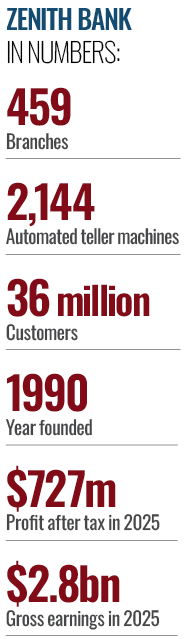
When Jim Ovia, CFR, founded Zenith Bank in May 1990, the unity and prosperity of Africa were among his greatest dreams. For the renowned businessman, banker, and philanthropist who went on to paint the picture of the continent he envisioned in his book, Africa Rise and Shine, one thing was crystal clear: building a formidable financial institution was a potent catalyst for Africa’s transformation.
In three and a half decades, Zenith Bank, his brainchild and the bank in which Ovia CFR previously served as chairman, has been integral in Africa’s remarkable metamorphosis into a continent expected to anchor global growth in the coming decades. Today, the International Monetary Fund’s World Economic Outlook ranks 11 of the world’s 15 fastest-growing economies in Africa, and the continent is among the world’s most resilient regions. In 2026, the African Development Bank’s African Economic Outlook puts Africa’s growth at 4.2 percent, among the highest globally.
For Africa, the journey toward unity, with 54 nations now pursuing shared and common goals, has been fundamental. For instance, the unity of purpose brought about by the African Continental Free Trade Area (AfCFTA) and the push to integrate payments through the Pan-African Payment and Settlement System are clear indications of a continent on the rise. The impacts of AfCFTA are nothing short of phenomenal. The agreement has created the world’s largest free trade area, a single market of over 1.4 billion people with a combined gross domestic product (GDP) of $3.4trn.
Dame Dr. Adaora Umeoji, OON, Group Managing Director/CEO of Zenith Bank
Zenith Bank has been central to Africa’s economic ascent. On this, the bank has been deliberate. From its home market in Nigeria, and through a business strategy anchored in people, technology, and service, Zenith Bank has evolved over the years into a top financial institution in Africa with a solid financial foundation. Today, the bank is not only Nigeria’s largest financial institution by Tier-1 capital but also one of Africa’s leading banks, a far cry from its modest beginnings when it commenced operations in July 1990.
While building the requisite financial scale has been critical, ensuring it meets market needs has been another masterstroke. In this regard, Zenith Bank offers a wide array of financial products and services for individual and corporate clients. The solutions span corporate and retail banking, commercial and consumer banking, personal and private banking, and investment banking. These include trade services and foreign exchange, treasury and cash management services, and other non-bank financial services mainly offered through its subsidiaries.
These solutions, supported by massive investments in technology and a deeply entrenched culture of innovation, have driven exponential growth across all metrics. Cumulatively serving 36 million customers, the bank operates an extensive branch and ATM network at home and also has a presence in the UK, France, Sierra Leone, the Gambia, the United Arab Emirates, as well as a representative office in China. In recent months, the bank has also embarked on a Pan-African expansion strategy, entering Côte d’Ivoire and Kenya.
Profitability anchored on execution
For Zenith Bank, one of its outstanding trends has been sustaining a strong culture of profitability through every economic cycle. In 2025, the bank once again lived up to this mantra, posting ₦1.04trn ($727m) in profit after tax. The performance was reinforced by robust capital and liquidity positions, both well above the regulatory minimum, alongside a prudent risk management culture that kept non-performing loans well in check.
Zenith Bank has been central to Africa’s economic ascent
One key metric in which the bank was an exceptional performer was cleaning its bad-loan book. In a policy directive, the Central Bank of Nigeria (CBN) required banks to clean up legacy exposures previously held under regulatory forbearance by June 30, 2025. Zenith Bank used the transition to clean its books, implementing measures such as write-offs and loan recoveries. Owing to decisive actions, the bank managed to reduce its non-performing loan (NPL) ratio substantially from 4.7 percent in 2024 to 3.8 percent in 2025, well clear of industry norms.
The Nigerian banking industry is highly competitive, and Zenith Bank’s impressive results reflect disciplined, focused execution of its strategy. Specifically, the bank has been astute in strengthening its asset quality, optimising its balance sheet and investing in capabilities to propel growth. A key differentiator during the year was the bank’s strong position in international trade and foreign exchange flows.
In recent years, Nigeria has been on a mission to reduce its dependence on the oil sector, which is a major source of forex and government revenues. Data from the Nigerian Export Promotion Council indicate that in 2025, the country’s non-oil exports reached a historical high of $6.1bn, an 11.5 percent increase from $5.4bn in 2024. As a key facilitator of international trade, Zenith Bank played a central role in repatriating over 40 percent of Nigeria’s non-oil export proceeds. Owing to its role, the bank was able to deepen relationships with large corporates and supported transaction-led income. The franchise remains critical for the bank, as trade finance generates recurring business, strengthens customer relationships, and supports foreign currency liquidity.
Apart from the trade sector, Zenith Bank also maintained a disciplined lending approach, which led to gross loans rising to about ₦11trn ($7.9bn). The major focus was on viable sectors such as manufacturing, agriculture, and telecommunications, as well as key value chains that offered more predictable cash flows. Non-interest income from fees, commissions and digital channels also contributed to the impressive performance, supported by a steady push in digital transformation that improved customer experience, increased transaction volumes and lowered operating costs. Also impactful was the high-interest-rate environment, which supported returns from the loan book and from investments in government securities.
For Zenith Bank, the high-interest-rate environment delivered strong returns across lending and investment activity. Through 2025, the Monetary Policy Committee held the policy rate at 27.50 percent at its February, May and July meetings before easing it 50 basis points to 27.00 percent in September. Inflation also moderated through the year, with the National Bureau of Statistics putting the annual 2025 average at 23.01 percent. Average private-sector credit stood at ₦75.6trn ($54.8bn) for the year, up from ₦75.3trn ($54.6bn) in 2024, with well-capitalised banks like Zenith positioned to grow lending as the easing cycle takes hold.
Reform momentum
Nigeria’s broader economy has undergone a transformative period of reform. The removal of fuel subsidies, the unification of exchange rates, and sustained monetary tightening have significantly helped correct long-standing distortions. The reforms have improved price discovery in the foreign exchange market, strengthened fiscal revenues, and restored investor confidence. A key pointer is capital inflows. Government data show that last year, inflows surged by 90 percent, driven by foreign portfolio investment as investors returned to Nigeria. During the year, net capital investments stood at $23.2bn, up from $12.3bn in 2024.
For the Nigerian economy, the reforms’ impacts have been encouraging. Growth has remained resilient, supported by services, higher oil production, stronger non-oil activity and a gradual recovery in external balances. According to the National Bureau of Statistics, real GDP growth in 2025 was 3.87 percent, up from 3.38 percent in 2024. This year, growth is projected to accelerate further to 4.4 percent. The rate of economic expansion is inspiring, and the next step is to ensure it translates into investment, jobs, food security, and stronger household purchasing power.
Nigeria’s economy has undergone a transformative period of reform
This is necessary, given that Nigeria, Africa’s third-largest economy with a rebased 2025 GDP of ₦441.5trn (about $320bn) per the NBS, is well positioned to build on its momentum. Hard work and tough decisions have been instrumental in stabilising the economy. Going forward, the next natural course of action is to ensure that the positive economic momentum translates into better living standards for Nigerians.
The government continues to advance its socio-economic agenda with strong intent. Building on the reform momentum, priority areas include productivity, employment, agricultural security, market access and logistics, all of which are reinforced by sustained delivery of the broader reform programme.
Over the medium term, the focus is shifting to inclusive growth. Agriculture, SMEs, manufacturing, digital enterprise and labour-intensive services are positioned to benefit from financing, infrastructure and policy support that creates jobs. Macroeconomic stability, paired with policies that strengthen household purchasing power, sets the stage for growth to translate into real prosperity.
In your best interest
The government has framed the reforms as the foundation for long-term gains. For the banking sector, the reforms have already brought a retinue of benefits. Among the benefits is the liberalisation of the exchange rate. For banks with strong foreign currency positions, this has led to an increase in foreign exchange trading income and revaluation gains. Besides, the high interest rates have supported net interest margins as asset yields repriced faster than funding costs in the early phase of tightening. Also, higher yields in the fixed-income market have provided attractive risk-adjusted returns on sovereign instruments.
Another benefit has been the recapitalisation of banks, which has built stronger capital buffers to support larger transactions, deeper credit intermediation, and greater financial system resilience. For Zenith Bank, the exercise has been more than a regulatory compliance to meet the raised minimum capital requirement for commercial banks with international authorisation to ₦500bn ($362.6m). Completed ahead of the CBN’s March 2026 deadline, the bank raised over ₦350bn, lifting its capital base to ₦614bn ($445m), comfortably above the threshold. The bank sees its enlarged capital base as a strategic foundation for growth, resilience and deeper real-sector financing. Specifically, the bank now has the balance-sheet strength to finance large and long-tenor projects not only in infrastructure but also across sectors that require patient capital and larger balance sheets.
For two of Zenith Bank’s key market segments, namely retail and SME banking, the importance of the new base is elevated to higher realms. First, it adequately equips the bank to support the two segments at scale. Second, it positions the bank to lead in an industry where consolidation is reshaping the competitive landscape, with well-capitalised institutions like Zenith Bank best placed to capture the opportunity.
Zenith Bank views retail as the engine of its long-term scalability, and the numbers back that up. In 2025, the bank’s total customer deposits stood at about ₦24trn ($17.4bn). Of this, retail deposits accounted for about ₦4.9trn ($3.5bn). Though corporate and commercial credit account for the bulk of the loan book, the bank disbursed nearly 3,000 retail loans valued at about ₦89.5bn ($65m), supporting household and individual financial needs. The segment’s significant contribution makes it central to the bank’s growth, particularly in providing a stable deposit base and deepening financial inclusion.
To grow its retail business, Zenith Bank has been proactive in expanding its digital offerings. For instance, migrating to a new core banking platform has improved speed, usability, and service quality. Also, enhancements to the internet banking solution now offer customers access to a redesigned interface with broader functionalities. These include cross-border intra-African transfers, treasury bill investments and payment of government levies. The bank is also expanding its physical channels, including agency banking aimed at underserved communities. Through this channel, the bank has reached over four million customers.
Another critical market that Zenith Bank is strategically determined to grow is the SME market. CBN data points to a ₦130trn ($94.4bn) MSME financing opportunity in Nigeria, reflecting the segment’s central role in job creation and broader economic activity. The bank is meeting the segment with innovative lending products tailored to its collateral, record-keeping, and credit history. Owing to their importance, Zenith Bank’s determination to support SMEs is anchored in its development priority and as a major commercial opportunity. Part of the bank’s lending solutions include cashflow-based finance, asset and equipment finance, the Z-Woman loan for women-led enterprises, and cooperative lending, among others. The bank has also been keen on building partnerships with multilateral financiers and export credit agencies that provide medium to long-term lines of credit for on-lending. This has been instrumental in reducing risk and widening access to credit for SMEs.
Aerial image of the shores of Victoria Island, Lagos, Nigeria
The Pan-African gear
That Zenith Bank has reached several significant milestones, cutting across capital fortification, products and services, and digital innovation, is indisputable. Having reached the pinnacle of becoming a Nigerian banking powerhouse, the bank is now transforming into a pan-African financial institution. Unlike its peers, the bank’s expansion strategy is not just about adding flags to a map. Rather, the ambition is driven by client demands, trade flows and regional economic connectivity, with the ultimate goal of supporting cross-border trade and capital flows for its wide range of multinational customers. Effectively, the bank is deploying a strategy that combines both greenfield and brownfield approaches to enter new markets. The strategy aligns with Founder Jim Ovia’s unequivocal desire to build a truly global brand with a strong presence across Africa and key international markets.
The bank now has the balance-sheet strength to finance large and long-tenor projects
On expansion, Francophone West Africa and Anglophone East Africa are a no-brainer for Zenith Bank. While the former offers access to a large integrated market, particularly through the West African Economic and Monetary Union (WAEMU) bloc, the latter provides a dynamic corridor with strong private-sector activity, capital market depth and advanced digital banking adoption. Notably, Zenith Bank is not going into new markets blindly. The bank is taking time to identify opportunities that it seeks to exploit and capture. These cut across corporate banking, trade finance, remittances, payments and structured transactions. More critically, the bank intends to prioritise countries with strong fundamentals, trade relevance and clear links to its existing client base. In essence, its expansion is a corridor strategy spanning the WAEMU, CEMAC and EAC blocs, not a race for geographic spread.
In April, Zenith Bank launched operations in Côte d’Ivoire and entered Kenya through the acquisition of a 100 percent shareholding of Paramount Bank. In line with the bank’s vision, the two markets are strategic gateways. In November 2024, the bank entered France, which is commercially linked to several Francophone African countries. The fact that Abidjan has grown into a major regional business hub means that Côte d’Ivoire was a natural first-step choice. Using the market as a springboard, the bank intends to support trade finance, payments and corporate banking across the WAEMU bloc, where a shared currency and integrated regulation reduce fragmentation.
Kenya, on its part, is expected to provide an anchor in East Africa. As the region’s top economy with $136bn in GDP, the country is a financial nerve centre with deep capital markets, a sophisticated private sector and booming digital banking innovations. By acquiring Paramount Bank, Zenith Bank has gained immediate market presence through seven branches, an established customer base, experienced local teams, and regulatory standing.
Zenith Bank is building for sustained relevance in its new markets, drawing on its Nigerian playbook while tailoring to each market’s local dynamics. To gain traction, the bank is taking a deliberate and structured approach, riding on local partnerships, talent, strong governance, careful attention to market realities and digital capability. Patience will be cardinal, with growth deliberate, risk-managed and aligned with client needs.
Even as it aspires to become a pan-African financial institution, some core principles will remain embedded in Zenith Bank’s DNA. Top is the bank’s strong corporate governance culture. Across the spectrum of its operations, governance is anchored on an enterprise risk management framework aligned with COSO and ISO 31000, a Three Lines of Defence control model, and independent board committees overseeing risk, audit and compliance.
The bank’s expansion strategy is not just about adding flags to a map
Another deeply entrenched principle is sustainability. On this, the approach is premised on the fact that environmental, social and governance (ESG) issues are financially material, with reporting aligned to the ISSB IFRS S1 and S2 standards. In essence, it means that ESG has a direct effect on credit quality, operational resilience, regulatory readiness, investor confidence and long-term value creation.
Overall, Zenith Bank remains committed to integrating sustainability into risk management, credit processes, and strategic planning. A case in point is in project finance transactions. In 2025, some 94 percent of new and existing transactions were assessed for environmental and social risks. The bank also actively monitored 95 percent of financed projects. For the bank, sustainability is closely intertwined with corporate social responsibility (CSR). On CSR, the bank is conscious of the fact that its success is inextricably linked to the well-being of the communities it serves. For this reason, Zenith Bank has been giving back to society in areas such as security, sports, health, and education.
Three and a half decades after Zenith Bank’s founding, Jim Ovia’s vision of a continent on the rise, as captured in Africa Rise and Shine, has become the daily work of the institution he built. With a deep capital base, an expanding African footprint, and a strategy that reads as patient as it is bold, Zenith Bank is positioned to write the next chapter of the African economy from within.
The pension funds sector has continued to navigate a year defined by economic uncertainty, demographic change, and evolving member expectations. In 2026, fund managers and trustees have faced the ongoing challenge of delivering stable long-term returns while responding to inflationary pressures, market volatility, and increasing regulatory demands. At the same time, the sector has accelerated its focus on responsible investing, digital engagement, and retirement solutions tailored to a changing workforce. The winners of this year’s Pension Fund Awards have distinguished themselves through prudent stewardship, innovation, and an unwavering commitment to protecting members’ financial futures.
Best Pension Funds
Australia Colonial First State Austria VBV Grupee Azerbaijan State Social Protection Fund of Azerbaijan Belgium Amonis Bolivia La Boliviana Ciacruz Seguros Personales Brazil Bradesco Seguros Canada BMO Caribbean Scotia Investments Jamaica Chile AFP Capital Colombia Grupo Sura Croatia Allianz ZB Czech Republic NN Penzijní Společnost Denmark PFA Pension Estonia SEB Varahaldus Finland Mandatum France Amundi Germany Generali Deutschland Ghana Pensions Alliance Trust Greece Piraeus Asset Management Iceland Gildi lífeyrissjóður Indonesia DPLK AXA Mandiri Italy Anima SGR (Arti e Mestieri) Jamaica Scotia Investments Jamaica Macedonia Triglav Penzisko Društvo Malaysia Gibraltar BSN Mexico Afore XXI Banorte Netherlands Meesman indexbeleggen Nigeria Fidelity Pension Managers Norway Storebrand Livsforsikring Peru AFP Habitat Poland PZU Portugal Caixa Geral de Depósitos Serbia DDOR Garant South Africa Sanlam Spain Banco Santander Sweden AMF Switzerland PostFinance Thailand SCB Asset Management Türkiye Anadolu Hayat Emeklilik US Fidelity Investments
Strong corporate governance has never been more critical than it is today. In 2026, organisations across the financial sector continue to operate under increasing scrutiny from regulators, investors, and stakeholders demanding greater accountability, transparency, and ethical leadership. From board diversity and executive oversight to ESG integration and risk management, governance frameworks are being tested in an increasingly complex and fast-moving environment. The Institute of Chartered Accountants and Administrators observed that effective governance is built upon “accountability, transparency, fairness, independence, responsibility and ethics,” principles that remain central to long-term corporate resilience. The organisations recognised in this year’s Corporate Governance Awards have demonstrated an exceptional ability to foster trust, uphold integrity, and embed responsible decision-making at every level of their operations.
Best Corporate Governance
Albania Kastrati Group Algeria Sonelgaz Angola Etu Energias Azerbaijan State Social Protection Fund Brazil CPFL Colombia Bancolombia Dominican Republic Banreservas Egypt Fawry Georgia TBC Bank Ghana OmniBSIC Bank Greece Public Power Corporation India ICICI Bank Japan Japan Securities Finance Kenya Safaricom Mexico Banorte Morocco Bank of Africa Group Nigeria Zenith Bank Romania Sphera Franchise Group Spain Iberdrola Sri Lanka Sampath Bank Thailand Siam Cement Group Türkiye Sisecam UAE Emirates NBD Vietnam Vinamilk
Corporate treasury has faced another year of significant transformation, as finance leaders navigate persistent economic uncertainty, evolving interest rate expectations, and increasingly complex global liquidity demands. In 2026, treasury teams have been challenged to balance resilience with agility – managing cash, mitigating risk, and ensuring operational efficiency in an environment shaped by geopolitical volatility, regulatory change, and rapid technological advancement. At the same time, the continued adoption of real-time payments, automation, and AI-driven forecasting tools is reshaping the function, enabling treasurers to move beyond traditional cash management toward more strategic, data-led decision-making. As the Association for Financial Professionals recently observed, “treasury is evolving from a control function into a strategic business partner,” reflecting the growing influence of treasury professionals in driving enterprise-wide value. This year’s Corporate Treasury Awards recognise the organisations and leaders who have embraced that evolution with distinction. Their achievements demonstrate excellence in liquidity management, innovation, and strategic foresight, setting new benchmarks for performance across the profession. We are proud to recognise those setting the pace for the next generation of treasury leadership and celebrating the vision that continues to redefine corporate finance.
Best Corporate Treasury Teams
Brazil Petrobras Germany Siemens India Reliance Industries Japan Toyota Motor Corporation Norway Equinor Saudi Arabia Saudi Aramco South Africa Standard Bank Group South Korea Samsung Electronics Thailand PTT Public Company Limited Türkiye SOCAR Türkiye UAE First Abu Dhabi Bank UK HSBC US Apple
The forex landscape has faced another year of complex challenges, from fluctuating interest rate environments and evolving regulatory demands to heightened market volatility and changing client expectations. Against this backdrop, this year’s winners have distinguished themselves through innovation, execution excellence, technological advancement and a steadfast commitment to clients. We congratulate all of the Forex Awards 2026 winners and highly commended firms for their outstanding achievements and contributions to the continued evolution of the global FX industry.
World Finance Forex Awards 2026
FX Broker of the YearXMTrading Best Mobile Trading AppCFI Financial Best CFD BrokerEBC Financial Group Best Execution BrokerTrading.com Best Partnership ProgramPrimeXBT Best Multi Asset BrokerInterstellar Group Most Reliable FX BrokerBtcDana Best FX Customer ServiceXMTrading Most Transparent BrokerCFI Financial Most Trusted BrokerEBC Financial Group Best Trading PlatformMy Maa Markets Most Innovative CFD BrokerBtcDana Most Reliable CFD BrokerMy Maa Markets Best FX Broker in AsiaXMTrading Best FX Broker in the United StatesTrading.com Most Reliable CFD Broker in AfricaKCM Trade
The banking sector has entered 2026 facing a landscape shaped by economic recalibration, technological acceleration, and evolving customer expectations. Against a backdrop of geopolitical uncertainty and shifting interest rate environments, banks have been challenged to balance resilience with growth while continuing to invest heavily in digital transformation. From advances in AI-driven customer services to enhanced cybersecurity and embedded finance, the industry continues to redefine how modern banking is delivered. As SAS UK noted earlier this year, “trust will morph from a promise to a performance metric” as AI becomes increasingly embedded within financial services. That sentiment captures the defining challenge facing the sector today: combining innovation with accountability. This year’s Banking Awards recognise the institutions that have risen to these challenges with distinction – demonstrating innovation, operational strength, and an unwavering commitment to customer trust. We congratulate all of our winners for setting new standards of excellence and helping shape the future of global banking.
World Finance Banking Awards 2026
Best Investment Banks
Brazil Itau Unibanco Dominican Republic Banreservas France Société Générale Germany BNP Paribas Hong Kong Morgan Stanley Jordan Arab Bank Kazakhstan Halyk Finance Kuwait KFH Capital Mexico BBVA Mexico Netherlands ING Oman Sohar International Pakistan HBL Portugal Banco Invest Taiwan CTBC Financial Holding Thailand Siam Commercial Bank Türkiye Garanti BBVA Secutities US JPMorgan Chase
Best Banking Groups
Angola Banco Angolano de Investimentos Austria BAWAG Group Brazil Itau Unibanco Brunei Baiduri Bank Chile Banco Internacional Colombia Davivienda Denmark Nordea Dominican Republic Banreservas Egypt Commercial International Bank Finland Nordea France Crédit Mutuel Germany Commerzbank Hong Kong HSBC Jordan Jordan Islamic Bank Kenya KCB Group Kosovo BKT Macao ICBC (Macau) Malaysia Maybank Morocco Attijariwafa Bank Pakistan Habib Bank Saudi Arabia Saudi National Bank Singapore DBS Bank Thailand Kasikornbank Tunisia BIAT Türkiye Garanti BBVA UAE Emirates NBD Vietnam Vietcombank
Best Private Banks
Andorra Andbank Armenia Ardshinbank Austria Erste Bank Group Belgium BNP Paribas Fortis Bulgaria Postbank Canada RBC Wealth Management Cyprus Bank of Cyprus Czech Republic KB Private Banking Denmark Jyske Bank Dominican Republic Banco Popular Dominicano France BNP Paribas Banque Privée Georgia Bank of Georgia Germany Deutsche Bank Greece Eurobank Hungary OTP Bank India Kotak Mahindra Bank Italy Intesa Sanpaolo Kazakhstan Halyk Private Banking Liechtenstein Kaiser Partner Luxembourg Indosuez Wealth Management Monaco CMB Monaco Netherlands Rabobank Private Banking Nigeria FirstBank Norway Nordea Private Banking Pakistan HBL Wealth Management Poland ING Bank Sląski Portugal Millennium Private Banking Slovakia Tatra banka Spain Sabadell Urquijo Sweden Carnegie Private Banking Switzerland BNP Paribas Wealth Management Türkiye TEB Private Banking UAE ADCB UK HSBC Global Private Bank and Wealth Uruguay Puente US BMO
Best Retail Banks
Armenia Ameriabank Austria Erste Bank Group Azerbaijan Pasha Bank Belarus Belarusbank Belgium Belfius Bulgaria Postbank Canada BMO Chile Banco de Chile Colombia Davivienda Costa Rica Banco Nacional de Costa Rica Denmark Spar Nord Bank Finland Nordea France BNP Paribas Georgia Bank of Georgia Germany Commerzbank Greece Optima Bank Hungary OTP Bank Italy Monte Dei Paschi Di Siena Kuwait National Bank of Kuwait Mexico Banorte Netherlands ING Nigeria Access Bank Norway SpareBank 1 Pakistan Habib Bank Peru BBVA Peru Portugal Millennium BCP Saudi Arabia Saudi National Bank South Africa First National Bank Spain Banco Bilbao Vizcaya Argentaria Sri Lanka Sampath Bank Sweden Handelsbanken Türkiye Isbank UAE Emirates NBD UK NatWest US Bank of America
Best Commercial Banks
Armenia Ardshinbank Austria Raiffeisen Bank International Belgium Belfius Bank Canada BMO Colombia Davivienda Czech Republic CSOB Denmark Nordea Dominican Republic Banreservas Ethiopia Commercial Bank of Ethiopia France BNP Paribas Germany Commerzbank Hungary OTP Bank India State Bank of India Kazakhstan ForteBank Macao BOC Macau Malaysia CIMB Group Mozambique Banco Comercial e de Investimentos Netherlands ING Nigeria Zenith Bank Norway Nordea Portugal Banco Finantia Saudi Arabia Saudi National Bank Singapore DBS Bank Sri Lanka Sampath Bank Sweden SEB Switzerland Zurcher Kantonalbank Thailand Bangkok Bank Türkiye Akbank US BMO Vietnam Vietcombank
Most Sustainable Banks
Brazil Itau Unibanco Chile Banco de Chile China ICBC Colombia Davivienda Costa Rica Banco Nacional de Costa Rica Dominican Republic Banco Popular Dominicano Germany Umwelt Bank India YES Bank Malaysia CIMB Group Morocco Saham Bank Singapore DBS Bank Sri Lanka Hatton National Bank Sweden Ekobanken Thailand Kasikornbank Tunisia Amen Bank Türkiye Garanti BBVA Uganda dfcu Bank
Sustainability has moved from ambition to imperative across the financial industry, and 2026 has seen organisations intensify their efforts to align growth with environmental and social responsibility. As regulatory expectations evolve and stakeholders demand measurable progress, firms are increasingly embedding sustainability into core business strategy rather than treating it as a standalone initiative. From green finance and climate risk management to social impact programmes and responsible investment practices, the pace of innovation and accountability across the sector continues to accelerate. In its recent outlook for the year ahead, HSBC Sustainability Research described 2026 in one word: “pragmatism”, reflecting the shift from broad commitments toward practical, measurable implementation. This year’s Sustainability Awards recognise the institutions and leaders that have demonstrated genuine commitment, measurable impact, and forward-thinking leadership in driving positive change. We congratulate all of our winners for helping shape a stronger, more sustainable future for global finance.
Most sustainable companies (by industry)
EUROPE Agriculture & Food SecurityNestlé AirportAeroporti di Roma AluminiumNorsk Hydro Asset ManagementKBC Asset Management BrewingCarlsberg Group ChemicalsAkzoNobel Climate FinanceBlume Equity Commercial Real EstateUnibail‑Rodamco‑Westfield Concrete & Aggregates ProductsCementir Holding FootwearCCC GlassBA Glass Green Hydrogen & Energy TransitionRWE Hospitality & LeisureMeliá Hotels International Industrial Materials RecyclingUmicore Logistics & Supply ChainGLS Group Low-Cost AirlineWizzair Major AirlineAir France PowerIberdrola Railway TransportationGo-Ahead Group Reusable & Circular PackagingCoveris SteelArcelorMittal Wine ProductsCorticeira Amorim
AFRICA Agriculture & Food SecurityFarm Africa AluminiumSouth32–Mozal Aluminium Asset ManagementSustainable Capital BrewingEast African Breweries ChemicalsNalco Water Climate FinanceAfrica Finance Corporation Concrete & Aggregates ProductsBamburi Cement Green Hydrogen & Energy TransitionCWP Global Hospitality & LeisureHotel Verde Cape Town Airport Logistics & Supply ChainCHEP South Africa Low-Cost AirlineJambojet Major AirlineKenya Airways PowerKenya Electricity Generating Co. Railway TransportationLobito Atlantic Railway Real EstateGrit Real Estate Income Group Responsible Resource ExtractionAnglo American SteelHyIron Oshivela Stock Exchange PlatformJohannesburg Stock Exchange
NORTH AMERICA Agriculture & Food SecurityCargill AluminiumNovelis Blockchain TechnologyAlgorand BrewingSierra Nevada Brewing ChemicalsEcolab Concrete & Aggregates ProductsAmrize Data CentreQuality Technology Services Digital Asset MiningIREN Green Hydrogen & Energy TransitionPlug Power Life Science Real EstateKilroy Realty Corporation Logistics & Supply ChainFedEx Low-Cost AirlineJetBlue Airways Major AirlineUnited Airlines Railway TransportationCPKC Renewable Power UtilityENGIE North America Responsible Resource ExtractionFreeport‑McMoRan SteelSteel Dynamics
LATIN AMERICA Agriculture & Food SecurityMarfrig Agro-IndustrialIngenio San Antonio Asset ManagementBradesco Asset Management BrewingAmbev ChemicalsAlpek Climate FinanceEcoEnterprises Fund Compostable PackagingCompanhia Melhoramentos Concrete & Aggregates ProductsCementos Progreso Finance by a CooperativeSicredi Financial InclusionBanco W Forestry and Bio-Based MaterialsEucatex Green Hydrogen & Energy TransitionEnel Green Power Hospitality & LeisureHotel Las Torres Patagonia Logistics & Supply ChainEmergent Cold LatAm Low‑Cost AirlinesAzul Linhas Aéreas Major AirlinesAvianca PowerEnel Green Power Latin America Railway Transportation Rumo Logística Residential Real EstateConstructora Bolívar Responsible Resource ExtractionBHP SteelCompanhia Siderúrgica Nacional Stock Exchange PlatformB3-Brasil Bolsa Balcao Wine ProducerVSPT Wine Group
MENA Agriculture & Food SecurityOCP Group AirportHamad International Airport Asset ManagementMubadala Investment Company Aviation Communication TechnologySaudi Air Navigation Services ChemicalsSABIC Climate FinanceAMEA Power Concrete & Aggregates ProductsDucon Green Downstream Energy & MobilityADNOC Distribution Financial ServicesRAKBANK Green Hydrogen & Energy TransitionNEOM Green Hydrogen Hospitality & LeisureMinor Hotels MENA Logistics & Supply ChainARAMEX Low‑Carbon Aluminium & RecyclingEmirates Global Aluminium Low-Cost AirlineAir Arabia Mining & ResourcesOCP Group PowerACWA Power Railway TransportationEtihad Rail Real EstateZāZEN Properties Renewable EnergyScatec SteelEMSTEEL Stock Exchange PlatformSaudi Tadawul Group Telecommunicationsstc Group Waste ManagementBeeah Group
ASIA Agriculture & Food SecurityAsian Agri BrewingLion ChemicalsLG Chem Climate FinanceImpact Investment Exchange Compostable Food PackagingVandapac Bio Concrete & Aggregates ProductsAsia Cement Corporation eCommerce RetailDFI Retail Group Financial & Investment-Aligned ESG StrategyAzerbaijan Airlines Flag Carrier AirlineTurkish Airlines Green Hydrogen & Energy TransitionHyrasia One Hospitality & LeisureParkRoyal Collection Marina Bay, Singapore Logistics & Supply ChainKLN Logistics Group Low‑Carbon Aluminium & RecyclingEmirates Global Aluminium Low-Cost AirlineAirAsia Major AirlineAll Nippon Airways Mining & ResourcesHindustan Zinc Power CompanyContact Energy Pulp, Paper & Fibre‑Based MaterialsNippon Paper Industries Railway TransportationCentral Japan Railway Real EstateSwire Properties
As the list of companies citing AI efficiencies as the rationale for staff restructuring grows, many have rushed to speculate about the future of work and to surmise that the next logical step for AI is towards replacing humans in the workforce. But, from where I sit, at the intersection of translation and AI sectors, the more compelling transformation is not simply what AI replaces, but how AI is learning, or failing, to understand the human dimension – eventually the human touch – behind every action or task.
As a true believer that language is the most important factor for human evolution, I founded Translated in 1999 to help people translate their words, and indeed cultures, all over the world, by allowing everyone to understand and be understood in their own language. Since AI is powering the possibility for increased connection, I believe that our industry is the perfect vantage point from which to consider the wider world.
Firstly, because it was with the combination of language and AI that saw the first mass adoption of use: in large language models that answer our questions in full sentences and tailor their responses based on our preferences. Decades of research on machine translation – and indeed language – have enabled this. AI is in turn enabling the translation of language. However, despite its increasing speed and accuracy, one thing remains abundantly clear to experts: it does not replace the need for human sensitivity. Instead, it can perform the repetitive and monotonous tasks that occupy the time of skilled experts and allow them to focus on more complex elements of their roles, most notably those parts of translations that are most steeped in emotion and in ‘human-ness.’
Human-centred intelligence
For many businesses, the discussion around AI still revolves around productivity gains and potential labour displacement: ‘Which jobs will go?’ and ‘How many will remain?’ These questions we see posed over and over and are, of course, important to provide answers to, not only for those fearing replacement but for future generations questioning what the world of work will look like for them. Perhaps though, the more important questions are ‘What do humans do best?’ and ‘How can AI enable us to do more of this?’
The question is no longer which tasks AI can perform, but how it can elevate human potential
Undoubtedly, for AI to work in partnership with a human workforce, the next phase of progress will be towards better understanding us. In this respect, Translated is leading a pioneering project: DVPS (Diversibus Viis Plurima Solvo), backed by a €29m European seed investment across 20 partners in nine countries, precisely to tackle this challenge. DVPS is about moving beyond language models that digest text and images collected in the past, and into models that sense vision, audio, and sensor input, models that engage in real time with the physical world and have a greater contextual awareness.
Equally, this progress must be assessed and managed appropriately, and global conversations are necessary to achieve this. I was recently invited to participate in the World Meeting on Human Fraternity in Rome. The discussion saw top AI scientists, including Nobel Laureate Geoffrey Hinton, the most cited AI scientist Yoshua Bengio, and professor and leading author Stuart Russell, come together to share their insight with Pope Leo XIV on the social, cultural and ethical dimensions of AI. The message was clear: AI must serve humanity, not erode its dignity, and must be anchored in dialogue and care. It is with no surprise that this group agreed that the two most significant positive impacts AI can have are ‘scientific discovery’ and ‘global human understanding.’
Leading in the age of understanding
For leaders and organisations, the path forwards demands a shift in perspective. The question is no longer which tasks AI can perform, but how it can elevate human potential. The most successful companies will be those that invest in understanding and context rather than just efficiency. True leadership in the age of AI means embedding empathy and ethics at the core of innovation, ensuring that technology amplifies what is most human about us: our ability to care, to interpret and to connect.
The next decade of AI will not be defined by fewer jobs and faster machines. It will be defined by machines that understand contexts, emotions, and human values, and by humans who leverage that understanding to do what only humans can do: build relationships, innovate culture, and lead with meaning.
When machines finally grasp that a sentence is not just a sentence, but an expression of human intent, when they discern not just words but tone, gesture, and cultural context, then we will emerge from automation into augmentation. That is the moment when AI truly becomes a partner in human progress. The real progress of AI will not be measured by how many jobs disappear, but by how many new forms of human value emerge.
One of the fears of pension fund investment managers as they strive to deliver the UK government’s targets for investment into infrastructure and other large-scale private assets is that quality assets will quickly be snapped up. Exploring niches offers a solution to that challenge.
Energy infrastructure provides one such opportunity, says Christian Schwenkenbecher, chief client officer of MPC Capital, which works with institutional investors to access structural growth opportunities in the maritime and energy infrastructure markets. With the growing importance of energy security within a more de-centralised energy infrastructure, especially in Europe, there are some exciting prospects.
“Our approach to energy infrastructure investments focuses on generation assets such as onshore wind, solar PV as well as storage. We focus on structuring and securing long-term cash flows primarily through corporate offtake structures, allowing us to take an active role as a vertically integrated investor, ensuring we remain close to the underlying asset. Going forward we will be looking for additional niches across the entire value chain of energy infrastructure.”
This effectively gives the client a ringside seat, reassuringly close to the decision-making centre of the firms they are investing in, a point underlined by Schwenkenbecher. “We look for majority ownership in assets to fully exploit our active management approach. However, we also see value in partnering when skillsets are complementary, and return and performance expectations are aligned. This means we have built a track record of working successfully for and alongside institutional investment partners but also industrial partners. Combining the two is a key ingredient for performance.”
Flexible system
The focus on Europe is driven by the quality of assets, reliable political and regulatory systems and the substantial investment backlog building a new, more flexible and de-centralised energy infrastructure system. Schwenkenbecher continued; “The industrial sector in particular will increasingly depend on private capital to drive economically feasible decarbonisation. This is a compelling investment thesis for institutional investors, including private equity firms, such as KKR, Apollo and EQT, which have stepped up their investment activity, particularly in Germany, Europe’s largest economy.”
We will be looking for additional niches across the entire value chain of energy infrastructure
Schwenkenbecher explained that while MPC Capital’s target markets will remain unchanged, there seems to be a growing overseas interest from the US and the Middle East to invest in Europe. While this seems sensible considering recent political events, he sees ample investment opportunities in Europe both in the short and medium to long term, across the entire value chain, from generation to grid infrastructure to energy services.
“Energy will likely be the key bottleneck for new, rising technologies such as AI and will continue to facilitate overall GDP growth and domestic competitiveness. Ahead of these mega-trends and structural growth drivers it seems sensible to be invested along those structural trends,” Schwenkenbecher said.
While governments are looking to an expansion of nuclear power to play an important part in their longer-term plans to create national greater energy security and capacity, it does not figure prominently in MPC Capital’s strategy. “We are agnostic to overall energy sources, but our focus on renewable production capacity is mostly due to its cost competitiveness and shorter time to market compared to nuclear power,” Schwenkenbecher continued.
Robust infrastructure
The current waves of geo-political unrest sweeping around the world also create a neat intersection for MPC Capital’s core expertise in maritime and energy assets. With European governments – especially those within the NATO alliance – now committed to increasing defence spending to five percent of GDP in the next decade, he sees some of that funding major port expansions, all of which will need a robust energy infrastructure.
“Increased spending on port infrastructure and other maritime assets validates the importance of both sectors, and the focus on attractive niches is rather geared towards the intersection of maritime and energy infrastructure.” These wider macro-economic, geo-political and regulatory issues are constantly on our radar screens, says Schwenkenbecher; “We have to be sensitive to the impact of interest rate developments on transaction as well as fundraising activity. This leads us to adopt a selective approach to overall transaction activity in a still high-interest-rate environment. We will be very cautious as central banks start to ease interest rates. If continued, this trend should act as a tailwind for our transaction activities.”
He emphasised the importance of balancing transactional and management revenues, and that recurring service revenues have been a key reason for MPC Capital’s resilient business model. It has enabled the company to remain disciplined and focused on those investment strategies while ensuring high visibility of earnings growth.
Regulatory structures and policies are also a key influence when it comes to deciding which projects to commit capital to. The jolt to the world’s energy markets following the Russian invasion of Ukraine put national energy security firmly on government agendas. So far, the response in terms of impactful regulatory change has been mixed.
“The importance of sensible regulation to drive investment to accelerate the build-out of energy infrastructure cannot be under-estimated. In particular, the regulatory approaches in the UK and US have been very encouraging,” Schwenkenbecher said, while also expressing a desire for similar regulations to be enacted in Germany to attract more capital to the infrastructure sector. “Private capital will play a key role, with governments likely to provide frameworks to attract capital.”