


Mexico is entering a defining period in its economic trajectory. Not because its structural challenges have disappeared – they have not – but because several long-term trends are beginning to reinforce one another at the same time: the reorganisation of global supply chains, the growing fragmentation of international trade, renewed emphasis on infrastructure investment, and the maturation of domestic pension savings into a meaningful source of long-term capital.
At the centre of this convergence are Mexico’s pension funds, the Afores. Once viewed primarily as administrators of retirement accounts, they are increasingly emerging as institutional investors with the scale and time horizon needed to help finance the country’s next phase of development. The discussion is no longer just about pensions. It is about how the savings of millions of workers can support the infrastructure required for sustained economic expansion.
In an environment defined by volatility, inflation pressures, and geopolitical uncertainty, infrastructure has become one of the most attractive asset classes for long-term investors. For pension funds, the appeal is straightforward. Infrastructure assets – whether in transportation, logistics, energy, telecommunications, or water systems – typically generate predictable cash flows over extended periods, offer some protection against inflation, and behave differently from traditional public-market investments. For institutions managing liabilities measured in decades, those characteristics are especially valuable.
But infrastructure offers something beyond financial returns. It expands productive capacity. Unlike many other assets, it has a direct impact on economic competitiveness and long-term growth.
That distinction matters in today’s environment. As supply chains are reconfigured and governments prioritise economic resilience, institutional investors are steadily increasing allocations to real assets. This is not a short-term tactical shift; it reflects a broader structural change in how capital is being deployed globally. The numbers already point in that direction. Roughly 49 percent of institutional investors worldwide currently have exposure to infrastructure, and that figure is expected to approach 60 percent by 2030.
Why Mexico is positioned to benefit
Mexico stands out as one of the clearest beneficiaries of this transition. Nearshoring has moved well beyond theory. Companies across industries are actively relocating manufacturing capacity closer to end markets in an effort to reduce logistical risks, shorten delivery times, and improve operational resilience. Within that shift, North America has become one of the most strategically important regions in the world economy. The USMCA bloc accounts for close to 30 percent of global GDP and more than 24 percent of world trade. Mexico occupies a particularly advantageous position within that framework: geographic proximity to the US, deep industrial integration, a broad trade network, and a manufacturing base that continues to expand.
Investment flows are already reflecting those advantages. In 2025, Mexico attracted approximately $40.8bn in foreign direct investment, up 10.8 percent from the same period a year earlier and the highest level on record. Demand for industrial and logistics facilities continues to rise rapidly, placing increasing pressure on existing capacity.
But nearshoring does not materialise on its own. Manufacturing relocation requires physical infrastructure capable of supporting large-scale industrial activity: reliable power generation, modern highways, efficient ports, rail connectivity, and robust digital networks. In short, it requires investment.
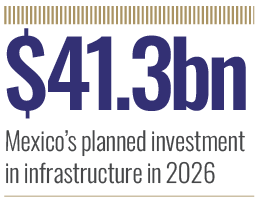
The Mexican government appears to have embraced a more pragmatic approach to infrastructure development. Public investment is not being framed as a substitute for private capital, but rather as a mechanism for crowding it in. That shift is visible in the scale of planned spending. For 2026 alone, the government has outlined infrastructure investment of roughly $41.3bn, equivalent to around two percent of GDP. Over the course of the administration, cumulative investment is projected to reach approximately $320.5bn.
The allocation of planned spending reveals the priorities:
• Energy accounts for 54.1 percent ($52.6bn)
• Rail infrastructure represents 15.6 percent ($14.9bn)
• Highways account for 13.9 percent ($13.5bn)
• Ports represent 6.5 percent ($6.3bn)
The operational targets are equally ambitious: the rehabilitation of 4,000 kilometres of roads, the construction of more than 3,000 kilometres of new rail lines, the modernisation of 11 ports, and 51 strategic energy projects expected to add more than 22,600 megawatts of capacity.
What matters just as much as the spending itself is the financing model behind it. The current strategy increasingly relies on mixed-investment structures in which the state provides coordination and long-term direction while opening space for institutional private capital. The emphasis is less on direct state control and more on improving project design, reducing uncertainty, sharing early-stage risks, and creating regulatory frameworks that provide long-term visibility for investors.
That philosophy is reflected in both the National Development Plan and the 2026–2030 Infrastructure Investment Programme, which prioritise structured public-private participation schemes and more sophisticated financing vehicles. At the same time, regulatory adjustments are gradually making it easier for long-term institutional capital to participate in productive investment opportunities. This is where the Afores become especially important.
Long-term development capital
By March 2026, Mexico’s Afores managed more than $480bn in assets, equivalent to roughly 23.6 percent of GDP. That makes the system one of the largest pools of domestic savings in Latin America. And it continues to grow. The 2020 pension reform gradually increased mandatory contributions from 6.5 percent to 15 percent of salary by 2030, significantly expanding the long-term growth potential of the system.
What matters just as much as the spending itself is the financing model behind it
Current projections suggest that by 2040, assets managed through the SIEFORES Target Date Funds could reach 56 percent of GDP, compared with an estimated 35 percent without the reform. More important than the size of the system, however, is how its investment profile is evolving. Mexico’s regulatory framework now allows pension funds greater exposure to long-duration assets, including infrastructure. Structured instruments, Fibras, simplified issuance processes, and more flexible investment vehicles have expanded the range of opportunities available to institutional investors.
Current limits allow up to 30 percent allocation in structured instruments such as CKDs and CERPIs, and up to 12.5 percent exposure through Fibras and REIT-style vehicles. None of this represents a weakening of investment discipline. Afores remain subject to strict governance, valuation and risk-management requirements. Their fiduciary obligations remain unchanged.
What has changed is the ability to align long-term retirement savings with long-term productive investment. The shift is already visible in the data. As of March 2026, Afores had invested more than $57.4bn in infrastructure-related assets, representing approximately 12 percent of total system assets. Investments linked specifically to the energy sector exceed $17bn. This is no longer a marginal allocation. It reflects a broader strategic repositioning of capital.
The conditions for success
The broader economic logic is compelling: retirement savings finance infrastructure, infrastructure supports productivity and growth, and stronger growth ultimately improves both investment returns and living standards. But none of this happens automatically. Infrastructure investing is inherently complex. Projects often involve long execution timelines, multiple stakeholders, political and regulatory uncertainty, and significant technical and financial risks.
Not every project creates the same value. Some may generate attractive financial returns but limited economic spillovers. Others may deliver substantial social benefits while struggling to meet purely commercial thresholds. That is why institutional quality becomes critical. The challenge is not simply attracting capital. It is building projects and frameworks capable of balancing profitability, public value, and long-term sustainability. That requires credible regulation, contractual certainty, stronger financial markets, better project preparation, and deeper technical expertise across both public and private sectors.
In other words, it requires building an ecosystem capable of sustaining long-term investment. Nearshoring may ultimately become the clearest test of whether Mexico can translate its structural advantages into durable economic gains. Global manufacturers are operating within real investment windows. Capital will not wait indefinitely.
If Mexico can provide reliable infrastructure, sufficient energy capacity and regulatory clarity, it has an opportunity to consolidate itself as one of the world’s most important industrial platforms over the next decade. If it cannot, investment will move elsewhere. That is why coordination between public policy, institutional savings and private capital matters so much.
Afores are uniquely positioned in this environment because their investment horizon is inherently long term. Unlike short-term capital flows, they are not driven by quarterly volatility or tactical repositioning. They can support projects through full development cycles. But long-term capital depends on long-term certainty.
A different economic framework
For decades, Mexico’s economic debate often revolved around familiar binaries: state versus market, public versus private investment, regulation versus liberalisation. That framework increasingly feels outdated. What is emerging instead is a more practical model based on coordination: the state as facilitator, private enterprise as operator, and institutional savings as the long-term source of financing.
Under this framework, infrastructure stops being viewed primarily as public spending or political symbolism and becomes what it fundamentally is: a platform for productivity, competitiveness, and sustained growth. Government estimates suggest that infrastructure investment alone could increase GDP growth by as much as three percent. Within that process, Afores are no longer peripheral financial institutions. They are becoming central components of the country’s long-term development strategy.
Mexico is not starting from scratch. It has strategic geographic advantages, deep industrial integration, an increasingly sophisticated financial system, and one of the largest domestic savings pools among emerging economies. But structural advantages alone are not enough. The real challenge is execution: turning plans into viable projects, projects into investment, and investment into measurable economic growth.
All of this could allow Mexico not only to capitilise on nearshoring but to completely reshape its long-term development path. And in that transformation, the Afores will play a far larger role than simply managing retirement accounts. They may ultimately become one of the key financial bridges between the country’s accumulated savings and the infrastructure needed to sustain its future growth.

