


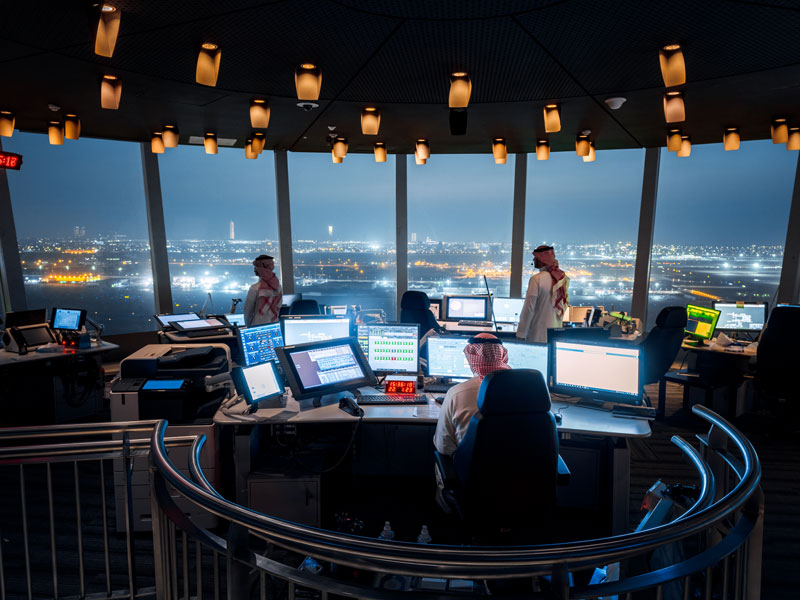
Saudi Arabia is undertaking one of the most ambitious aviation expansions in the world. As the Kingdom advances Vision 2030 and prepares to host events that will attract millions of additional visitors, the airspace above it is becoming more strategically important. Saudi Air Navigation Services (SANS), a leading air navigation service provider in the MENA region, sits at the centre of that growth, and the standard to which we hold ourselves extends well beyond keeping flights moving safely. Our remit is to help the wider aviation ecosystem become cleaner, more efficient and more resilient.
For an air navigation services provider, sustainability extends far beyond environmental disclosure. It runs through every part of how the company is led, how decisions are made, how resources are deployed and how value is created over time. Across each of these dimensions, our objective is consistent: to deliver long-term value, responsibly.
Governance built on transparency
Sustainability at SANS is embedded within corporate strategy. In 2024, sustainability was formally adopted as the company’s sixth strategic pillar, reinforcing its standing as a board-level priority. Our sustainability governance model is structured across three tiers – the Sustainability Steering Committee for strategic direction, the ESG Committee for cross-functional execution, and the Sustainability Community for organisation-wide engagement.
Our governance approach is reinforced by internationally recognised frameworks. Our Enterprise Risk Management framework is aligned with ISO 31000 and the COSO Internal Control. Financial reporting is prepared in accordance with IFRS. This year, we extended the same discipline to our sustainability disclosure with the publication of our first ESG report developed with reference to the Global Reporting Initiative (GRI) Standards, giving investors, regulators and partners internationally comparable visibility of our ESG performance.
Capital allocation that funds the future
Long-term financial planning and disciplined capital allocation are key enablers of strategic and sustainable growth. At SANS, financial planning provides the structure to assess priorities, manage risks, and direct resources toward areas that strengthen long-term resilience and sector readiness. Through a multi-year financial view, investment decisions are aligned with operational priorities, national development objectives and ESG considerations. This approach has already led directly to action, most clearly in the creation of two SANS subsidiaries: NERA, which channels SANS’s air navigation expertise into innovative technology and services for aviation clients across MENA and beyond, and the Saudi Academy of Civil Aviation (SACA), which builds the specialised national talent that the sector will need to grow.
Sustainability was formally adopted as the company’s sixth strategic pillar
Capital allocation decisions are assessed against a broader set of criteria than financial return alone. We evaluate each investment for its contribution to safety, operational efficiency and environmental performance. Our Comprehensive Cash Investment initiative will introduce a structured policy framework for treasury and investment decisions, protecting risk-adjusted returns while preserving the liquidity required to fund strategic priorities and ensure operational continuity over time. Early results show strong progress, with investment returns performing significantly above target. This has strengthened SANS’s ability to fund long-term sustainability initiatives internally, while avoiding the need for external debt.
Operations engineered for efficiency
Sustainable finance is also a matter of operational excellence. Over the past year, we have strengthened our operational performance through continued improvements in the invoicing cycle, timely supplier payment practices and supplier satisfaction. These efforts were supported by disciplined collection management, healthy cash flow performance and close monitoring of overdue balances. Together, they have improved working capital management, strengthened financial reliability, and reinforced the operational discipline needed to support long-term sustainable growth.
Behind these results sits a strengthened credit risk management framework, supported by enhanced service level agreements with key counterparties, digital automation across billing and customer engagement, and continuous improvement in receivables management. Together these initiatives strengthen cash flow and reduce credit risk. The same discipline is visible in our compliance, control and quality outcomes. Most notably, SANS was honoured with the Silver King Abdulaziz Quality Award, independent confirmation of the financial discipline and operational quality that credible sustainability disclosure ultimately rests on. The result is a finance function that stays ahead of regulation rather than reacting to it.
Digital transformation
Reliable sustainability outcomes depend on reliable data. This principle guides our digital agenda within finance, where we have developed a connected technology environment to strengthen accuracy, control, and decision-making. At the foundation, our core ERP and broader data management framework provide a trusted source of financial information across the organisation.
Building on this foundation, our Enterprise Performance Management (EPM) platform for planning and budgeting went live this year, replacing fragmented spreadsheets with a more controlled and consistent planning environment. In parallel, our customer relationship management platform applies the same digital discipline to billing and customer engagement.
In addition, Power BI dashboards covering financial performance, divisional KPIs, and revenue insights give management timely and consistent visibility across the business, supporting faster and more informed decision-making. We are also supporting the implementation of the Financial Governance App, which provides structured oversight of financial governance practices across the company. Together, these advancements do more than improve efficiency. By reducing manual effort, eliminating duplicated reporting and improving data accuracy across the board, they lower the operational footprint of our finance activities while equipping us to track sustainability KPIs with accuracy, trace ESG data back to its source and disclose it with confidence.
Procurement that delivers value
At SANS, local content is central to our procurement approach. Through our procurement decisions, we aim to support local manufacturers, develop national capabilities, increase participation from Saudi manufacturers, and retain more economic value within the Kingdom. SANS has made strong progress in this area through its Local Content Programme, which has supported supplier engagement, internal awareness, enhanced visibility across mandatory list categories and the development of a qualified list of local manufacturers for mandatory categories. Beyond local content, supplier satisfaction is treated as a key outcome. We operate a supplier classification framework integrated into our ERP, supported by a formal supplier feedback survey that captures supplier needs, improvement opportunities and challenges.
These foundations have translated into strong procurement performance. In 2025, our Supply Chain team was awarded the globally recognised CIPS Procurement Excellence Award. Structured negotiations delivered savings comfortably ahead of target, while the registered supplier base expanded competition, strengthening supply chain resilience and creating wider opportunities for Saudi SMEs.
Where strategy meets the sky
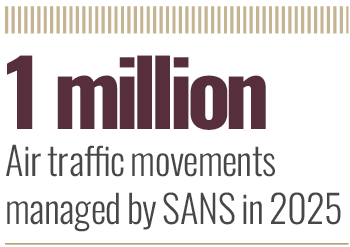
For an air navigation services provider, one of the most important sustainability levers is airspace design itself. In 2025, SANS managed more than one million air traffic movements safely across an area exceeding two million square kilometres. Growth and reliability progressed together, supported by continued capital investment in airspace modernisation, technology and infrastructure. Finance plays an important role in this process by evaluating major CAPEX decisions, supporting prioritisation, and helping to ensure that investment is directed toward initiatives that create long-term operational and environmental value.
The wider impact is reflected in how the airspace is being reshaped to reduce emissions. Through the Saudi Future Airspace Concept, Free Route Airspace, Performance-Based Navigation, continuous climb and descent operations, and reduced separation at major airports, SANS is helping reduce fuel burn, flight inefficiencies, and holding times. These operational improvements directly support the Civil Aviation Environmental Sustainability Program (CAESP) – the Kingdom’s national environmental roadmap for aviation, cascading directly from Vision 2030, for which SANS serves as a primary execution arm across the programme’s seven environmental pillars. Under this framework, the national commitment is to reduce flight emissions by 30 percent by 2032, supported by SANS’s target to achieve ISO 14001 certification in 2026.
Growth, safety, regulation and ESG are supporting one another. Strong governance protects safety. Efficient operations help reduce emissions. Disciplined financial management funds the technology and infrastructure that enable both.

