



For much of the post-Cold War period, the global financial system operated under the assumption that it was, if not entirely apolitical, then at least insulated from the harsher realities of geopolitical conflict. Capital flowed across borders with relative ease, reserve assets were treated as sacrosanct, and the infrastructure underpinning global finance, from correspondent banking to payments systems, was seen as broadly neutral.
That assumption is now under sustained pressure. What is emerging is not an economics politics substitutive, but a more complex intersection of both. Geopolitical factors, once peripheral, are increasingly impacting financial decision-making by central banks, sovereign wealth funds, institutional investors and multinational corporations. The implications are huge, not because the system has splintered, but because the perception of it being neutral is fraying. Its evolution of financial sanctions has been the most visible driver of that shift. Historically often symbolic, sanctions have become systemic in scope, capable of isolating entire economies from the global financial architecture.
The shuttering of Russian banks from parts of the SWIFT messaging infrastructure following the invasion of Ukraine and around $300bn of Russian central bank assets immobilised after that, in some cases, was a turning point. These were by no means modest moves; they were tests of the profound ways in which entrenched financial infrastructures can be weaponised as a tool of statecraft. Such actions always have the effect of spreading beyond their intended targets.
Contemporary supply chains, energy markets and cross-border flows of investment are tightly interconnected, meaning sanctions can reverberate through the global economy in non-structural and unpredictable ways. Currency fluctuations, commodity price shocks, and disruptions to trade financing are no longer secondary effects, they are factored into the calculus. This has raised concerns that are felt by legislators and investors, too. Desmond Lachman, a senior fellow at the American Enterprise Institute, said, “the US freezing of Iranian and Russian assets seems to be raising questions as to the reliability of the US as an economic partner.”
The undercurrent here is clear: financial access is no longer all rules-based, it is increasingly conditional upon political alignment. But what is more recent is how sanctions are now anticipated, priced and, in some cases, pre-empted. Banks are incorporating geopolitical risk scenarios into compliance frameworks more and more; asset managers are scrutinising portfolios for sanction exposure; and corporates are also adjusting their supply chains, so they don’t merely deliver efficiency but also are able to weather political disruption. The result is a financial system that is responding to geopolitical shocks before they happen, rather than just dealing with them.
The question of reserves
Nowhere is this more relevant than in the handling of foreign exchange reserves. Reserves stored in major financial centres have been regarded as the ultimate safe asset for many years: liquid, secure and free of political interference. But that assumption has been made murkier by the freezing of Russian sovereign assets. While such steps are not without precedent, their scale and visibility have challenged people to consider what if any geopolitically contested environment is considered ‘safe.’
Banks are incorporating geopolitical risk scenarios into compliance frameworks
Yet the response has been more nuanced than some early remarks implied: “It hasn’t reduced holdings of euro reserves – other factors, notably the yield increase, have mattered more,” says Brad Setser, a senior fellow at the Council on Foreign Relations. That underscores an important point: geopolitical risk is growing but not supplanting long-held financial considerations such as yield and liquidity. Instead, it has been put on top of them. But there are signs of a gradual recalibration.
Central banks are diversifying, especially in emerging markets, not just by currencies, but by jurisdiction and asset type. Gold accumulation has persisted, not as a reaction against the dollar system but as a hedge against potential limits on access to financial assets under political catastrophe.
This has been mirrored, of course, in central banking circles, where policymakers have been putting more value on ‘resilience’ and ‘optionality’ in the management of reserves, suggesting that reserves are now not only judged on factors such as their financial structure but also strategically on the ability through which they can be accessed.
While the idea that the global financial system is fragmenting along geopolitical lines has gained traction in recent years, the structural imbalances that feed global capital flows remain firmly in place. China still runs large current account surpluses that need to be recycled into deficit economies like those in the US and the UK.
These flows, by necessity, cross geopolitical fault lines. Such attempts to create alternative financial architectures through regional payment systems, or through bilateral currency exchanges, have yet to meaningfully displace the dollar-centric system.
Senior market players share this sentiment. Blackrock CEO Larry Fink, in his most recent annual letter, warned not of fragmentation per se, but of a ‘reordering’ of global capital flows, driven by industrial policy, supply chain realignment and national security concerns. The distinction matters. A reordered system may look different at the margins – more regional, more politically conditioned – but it is still deeply interconnected at its core.
Similarly, Christine Lagarde, President of the European Central Bank, has argued that while geopolitical tensions are reshaping trade and investment patterns, they are doing so within an existing framework rather than replacing it. Financial globalisation, in this reading, is evolving, not unwinding. This enduring interdependence places a natural constraint on how far financial decoupling can go. It also explains why, despite political tensions, global capital continues to flow in recognisably familiar patterns.
The changing nature of safe havens
Where geopolitics may be having a more subtle impact is in perceptions of risk, especially around so-called ‘safe haven’ assets. Lachman says that, “US Treasury bonds and the US dollar seem to be losing their safe haven status” amid heightened geopolitical and financial market volatility. Whether justified or not, this perception is of great import.
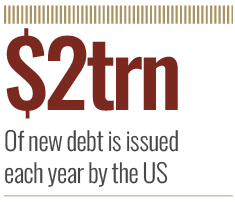
The US depends on foreign demand to fund its fiscal position, needing to issue around $2trn in new debt each year but refinancing a much larger stock of existing obligations. A sustained shift in investor sentiment would, theoretically, create more complexity here. Still, the counterargument remains compelling. The depth, liquidity and institutional credibility of US financial markets have largely helped anchor global portfolios. As Setser observes, “most flows are still driven by considerations of return.” It is the tension between perception and structure that will define the next phase of global finance. Safe havens may be questioned, but they are not easily replaced. Instead, investors will increasingly consider them conditionally safe, sound under most circumstances, yet not entirely immune to political risk.
If we are not dismantling the system, then geopolitics is sure reformulating how capital is allocated. This is most evident in cases like the return of industrial policy in industrialised economies. National security concerns are even further connected to macro-level fiscal programmes. That is influencing private capital flows, as investors align with policy priorities or react to incentives embedded in legislation.
The effect is subtle but significant: capital is no longer flowing solely to where returns are highest, but also to where political support and strategic importance are greatest. Asset managers are also tasked with navigating not just macroeconomic cycles, but also policy regimes that are potentially sensitive to geopolitical developments. Now, longer-term strategies are requiring greater consideration of regulation, political alignment and vulnerability to cross-border tensions.
A more complex calculus
Complexity is the defining feature of the current environment. Financial decisions once guided predominantly by growth differentials, interest rates and inflation expectations must now also account more explicitly for political risk. This is not entirely new. Capital flows have always been guided by influences beyond merely economic fundamentals, including regulatory arrangements, institutional credibility, and geopolitical alliances. What has changed is the salience of these considerations. The problem is especially acute in emerging markets. Many have developed deep reserve buffers in the past 20 years, which have protected them from external shocks. Yet exposure to major financial centres – especially the US – remains a defining feature of the global system.
This can cause unexpected vulnerabilities. Economies heavily invested in US assets may face greater risks from currency movements than from geopolitical fragmentation. The interplay between financial exposure and political alignment is, in other words, highly context-specific. However, smaller, more vulnerable economies have different risks. Limited access to global capital markets, in addition to their exposure to commodity price shocks and currency volatility, makes them especially vulnerable to disruptions caused by geopolitical developments elsewhere.
The financial system is neither collapsing nor being entirely remade by geopolitics. But its character is evolving. The notion of neutrality – the idea that financial infrastructure has an autonomous relation to political power – is beginning to dwindle. Instead, it is a more explicit acknowledgement that access to capital, payments systems, and reserve assets can be governed by strategic considerations. To investors and policymakers these new frameworks do not mean relinquishing the old ones. Yield, liquidity and risk-adjusted return remain central. But they must now be assessed alongside a more explicit evaluation of geopolitical exposure. The world may be entering a period defined less by global integration and more by competing systems of economic, political and financial influence. The result is a world in which financial strategy and political strategy are increasingly intertwined. Navigating it will require not just economic insight, but a sophisticated understanding of how power is exercised through markets. In that sense, the question is no longer whether finance is becoming geopolitical. It is how deeply that reality will be embedded and how adeptly global actors can adapt to it.

