


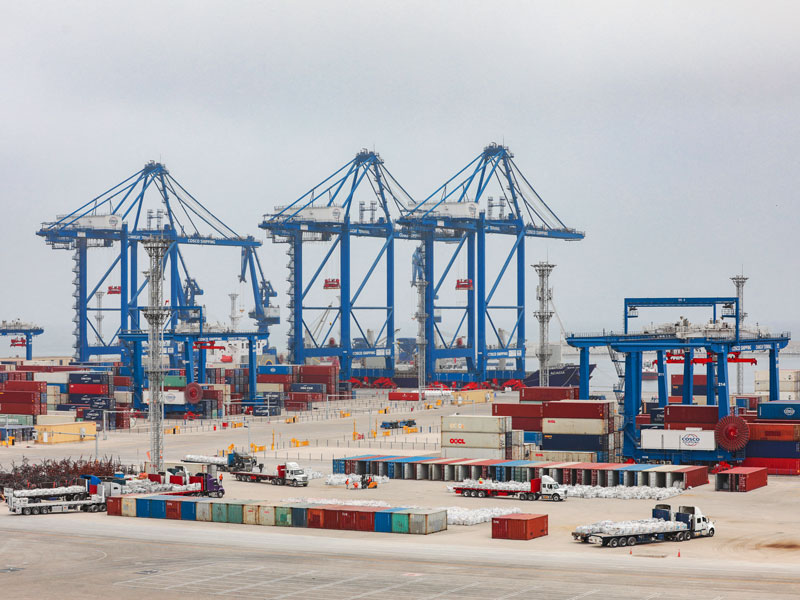
When Peru opened a new $3.6bn mega-port in late 2024, it was the latest of the giant projects that China has built and funded in Latin America under its global, trillion-dollar Belt and Road programme. And it was typical of many other B&R projects.
First, China gets much more out of it than Peru because the port, named Chancay, slashes shipping time between Latin America and Asia by two whole weeks. This means Chinese state-owned container vessels are shifting electric vehicles and many other manufactured goods into the region much faster than before and shifting raw materials back home to feed China’s enormous factories.
Second, the financial arrangements cost Peru a lot more than they do China. For a relatively small investment of about $1.6bn of the total $3.6bn, state-owned port giant Cosco has booked a 60 percent stake.
Third, courtesy of the Peru government, which rewrote the rules of foreign ownership, Cosco gets exclusive use of the deep-water port for up to 60 years. Overall, the deal is so beneficial for China in the long term that President Xi, who formally opened the port, promised in early 2025 at least another $9bn in credit for B&R-type projects in Latin America. “We ride the tide of progress together to pursue win-win cooperation,” he told Latin American dignitaries in Beijing. Although the Chinese economy has weakened in the last two years, there is still money on the table for the right B&R projects. Typically, the funds come from what a UN report described as “a complex web of policy banks, commercial banks, state-owned enterprises, sovereign funds and public–private partnerships.”
New infrastructure
Until recent years, B&R-funded projects were mainly to build conventional infrastructure such as new roads, railways, airports, dams and ports. For instance, the Chancay port is one of at least a dozen wholly or partly owned or run by China. Now though, China’s state-owned and controlled giants are moving in new directions. Currently, according to recent studies, PowerChina has invested in no fewer than 11 Latin American countries including, once again, in Peru, where it acquired two electricity suppliers for some $3bn in a deal that gave China virtual control over the nation’s electricity distribution. In other energy coups, Chinese companies are running Latin America’s largest solar plant in Jujuy, Argentina and a wind farm in Coquimbo, Chile.
While China has been assiduously cultivating Latin America, the US has neglected it lately
Huawei is one high-tech Chinese company that has established a strong foothold in new infrastructure such as artificial intelligence, smart cities and 5G technology. By 2020, in Curitiba, Brazil, Huawei was running over half of internet connections. Although not officially under the B&R umbrella, Brazil has quietly become Beijing’s biggest trading partner in the region. “Even though Brazil is not formally part of the Belt and Road, we are in many ways very much aligned with its spirit,” Tulio Cariello, director of content and research at the Brazil-China Business Council, told Dialogue Earth, a non-profit environmental media outlet. “We have been receiving investments in infrastructure for quite some time now – especially in the energy sector – but also in ports, storage, logistics and more.”
In a region hungry for foreign investment, Brazil is one of 20 other countries to sign deals with China, the most recent being Colombia. Of these nations Brazil, Argentina, Peru, Chile, Ecuador and, most controversially, Venezuela have gone in the deep end – to the regret of numerous activist organisations that argue Beijing has too much control over their countries’ future.
For instance, China is also heavily invested in Peru’s mines, hydropower, transmission and copper projects. On top of existing projects, Brazil is discussing with Beijing a trans-continental rail link that would run from the Amazon (where China already has significant interests) to the Pacific, thus bypassing the Panama Canal.
Argentina, which was only too pleased to grab an $18bn currency swap lifeline from Chinese banks to tide it over a debt crisis, is also home to B&R-financed hydropower dams and space-tracking facilities, the latter of great concern to the US. Billions of Venezuela’s debt to China is paid in oil exports, much to the detriment of the domestic economy.
The main attraction for China remains Latin America’s critical minerals, notably the ‘lithium triangle’ that links Chile, Argentina and Bolivia. This has aroused fierce domestic criticism over the wholesale export of raw and rare materials that could be exploited much more profitably at home.
Deals with dictators
In the first years of B&R in Latin America, it was Chinese officials who opened the door, preferring to work with dictatorships – or at least authoritarian governments – rather than with democratic, market-led nations. Talking to Dialogue Earth, Colombia-based expert on China, Parsifal D’Sola, puts it diplomatically by saying that Beijing has tended “to favour state-to-state relations, which facilitates the entry of projects and financing in countries where decision-making is concentrated in a small group and the market plays a secondary role.”
Others put it more bluntly. China’s role in such countries is that of “an incubator of populism,” argues Evan Ellis, professor of Latin American Studies at the US Army War College Strategic Studies Institute. “It’s not that China’s trying to produce anti-democratic regimes, but that anti-democratic regimes find a willing partner in the Chinese.” Until President Xi’s promise of $9bn or more of extra credit for Latin America, China had held the purse strings tighter in the last two or three years, at least for big-ticket projects, as Beijing waits for the original investments to pay off. And they are paying off handsomely.
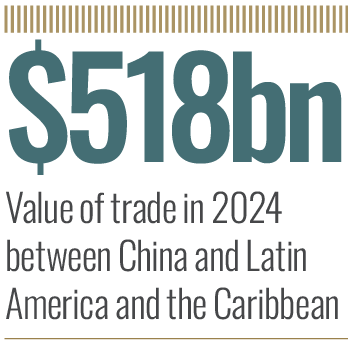
In 2024, total trade between China and Latin America and the Caribbean (the LAC region) hit $518bn, according to official Chinese figures. China imports agricultural produce to feed its 1.4 billion people, and metals and minerals to supply its high-tech industries such as BYD, the world’s largest manufacturer of electric vehicles that, incidentally, has taken over a former Ford-owned plant in the Bahia region of Brazil.
In short, Latin America sells to China vast quantities of low-value products such as soy, copper, lithium, iron ore and oil while buying high-value machinery, electronics, electric vehicles, turbines and other cleverly mass-produced technologies. Economists would say that Latin America is on the wrong end of the supply chain. Yet China is widely applauded for its consistent, long-term implementation of an economic strategy while Latin America’s nearest neighbour and natural economic partner – the US – sat on its hands. For instance, in the last few years few American companies even bothered to bid for the many infrastructure projects that B&R was able to snap up under Uncle Sam’s nose.
Peru’s Chancay Port provides a good example. It is an investment that capital-rich America could have made to its enormous benefit. Yet Peru, a nation of 38 million, has a substantially bigger trade with China than it does with the US – and it can only get bigger.
While China has been assiduously cultivating Latin America, the US has neglected it lately, even though the US is still the region’s biggest trading partner. Former President Joe Biden visited South America just twice while Donald Trump made just one visit to the region in his first term. Trump has gone out of his way to put the region offside rather than cultivate it, for instance by imposing punitive tariffs on Brazil and by threatening to seize the Panama Canal.
Although it is far too late, senior US military are increasingly concerned about Beijing’s leverage in Latin America. General Laura Richardson of the US Southern Command has warned that “China is on the 20-yard line, to our home land,” citing Chancay Port’s potential to be used for military vessels spying on American naval and commercial ships.
Strategic think tanks like the Atlantic Council has warned: “If a conflict were to break out in, for example, Taiwan or the South China Sea, this global network of 38 Cosco-operated ports could pose a serious logistical challenge for foreign militaries looking to move ships or supplies to the Indo-Pacific.”
Some B&R projects go wrong. New research shows that up to a third globally aren’t completed or run into trouble – a dam in Ecuador is mired in dispute over structural defects, and recipient nations all too often end up with unsustainable debt burdens against which China extracts payment in kind; for instance, Venezuela’s oil exports. Complaints about severe ecological damage at Chancay were quickly shut down.
Yet only one nation has signed itself out of B&R. Although he told Trump that “our canal’s sovereignty is not negotiable,” Panama’s president Jose Raul Mulino kicked China out of planned projects there. Others are nervous of Beijing involvement and, like Mexico, prefer to remain outside the fence.
In the meantime, China’s trading boom looks unstoppable. In 2021 trade with Latin America was worth over $450bn. Three years later it was worth $518bn for an increase of over 40 times since the turn of the century. And there are plenty of experts who predict $700bn within another decade.

