


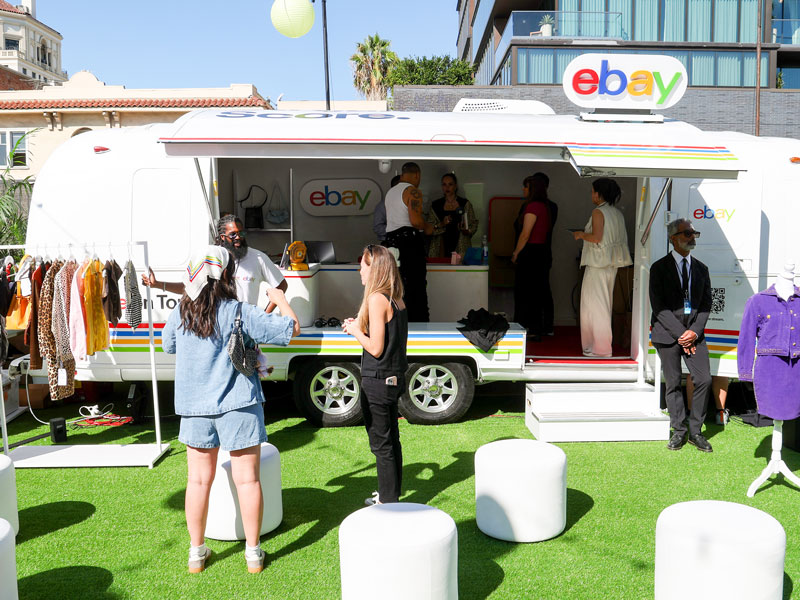
Second-hand shopping has come a long way. What was once the preserve of charity shops and car boot sales has evolved into one of the fastest-growing sectors in global retail. Today’s resale market is a vibrant, tech-driven space powered by savvy shoppers who care about both value and sustainability. It is the circular economy in action, where products are designed, used and reused to give them a longer life.
From fashion to electronics, buying pre-owned has become a mainstream habit that is changing the way people, and brands, think about ownership and waste. For marketplaces and investors, this shift opens up huge opportunities, but it also brings new challenges as they navigate a fast-moving and increasingly sophisticated resale landscape.
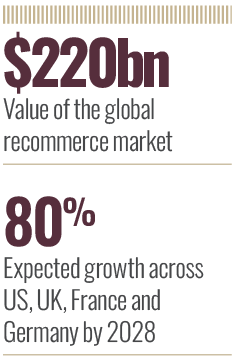
A recent report, Second-Hand, First Choice: The Psychology of Recommerce by Retail Economics and MPB, values the global recommerce market (excluding cars) at around $220bn – and it is expected to grow by almost 80 percent by 2028 across the US, UK, France and Germany.
Rising living costs have made value a key concern for shoppers, but this boom isn’t just about saving money. It reflects a deeper cultural and generational shift. Younger consumers, especially Millennials and Gen Z, are turning away from fast fashion and throwaway tech in favour of items that reflect personality and ethics. Buying second-hand has become a lifestyle statement, a way to shop with purpose and express individuality.
Resale also delivers real environmental impact. Every pre-owned purchase helps extend the life of an existing product, reducing the need for new manufacturing and cutting carbon emissions. For consumers who want to live more consciously, resale offers a simple, rewarding way to support a more responsible and less wasteful economy.
The professionalisation of resale
Today’s marketplaces are polished and tech-enabled, combining convenience with trust. Depop, for example, has redefined fashion resale by blending social media-style discovery with commerce, while Vestiaire Collective has built a reputation for authenticated luxury fashion. Vinted, ThredUp and eBay have all expanded certified pre-owned programmes, further embedding resale into the mainstream retail ecosystem.
At the heart of this transformation is technology, but it is the way it is used that really makes the difference. AI now helps shoppers find exactly what they are looking for, suggesting items, setting fair prices and curating personalised experiences. Smarter logistics make buying and selling seamless, with integrated systems that handle shipping, returns and reverse supply chains efficiently. Many platforms also use expert authentication teams or even blockchain-based certificates to verify the provenance of high-value items. Together, these innovations have removed much of the friction and doubt that once surrounded second-hand shopping, giving the resale market the same polish and professionalism as traditional retail.
For investors, the rise of the resale and circular economy is a clear market opportunity with long-term value potential. The appeal lies in the combination of growth and strong ESG credentials. Venture capital and private equity firms are increasingly backing businesses that extend product lifespans through refurbishment and repair models that generate healthy returns while supporting sustainability goals. The investment logic is straightforward: as resources become scarcer and regulation around waste and emissions tightens, circular business models are positioned to outperform. The sector’s resilience during economic downturns, driven by consumer demand for value, adds another layer of stability, making resale and refurbishment a rare mix of defensive and growth investment.
Funds are now focusing on scalable, technology-led platforms that make circularity efficient across industries such as fashion, electronics and furniture. For investors, supporting these companies is a way to futureproof portfolios against changing consumer expectations and regulatory pressure. The circular economy is proving that profitability and responsibility can go hand in hand, and that is an equation the finance world is increasingly keen to back.
Retailers rethink ownership
For established retailers, the resale revolution is proving both a challenge and an opportunity. Traditional linear business models – sell, discard, repeat – are increasingly at odds with consumer expectations and ESG commitments. In response, many brands are integrating resale and repair directly into their operations.
Patagonia’s Worn Wear programme, IKEA’s buy-back initiatives and Gucci and Burberry’s certified pre-owned collections all signal a shift towards more circular retail practices. These initiatives extend product life and tap into new revenue streams. By facilitating resale within their own ecosystems, brands can control quality and capture residual value that once leaked into third-party marketplaces. This approach also allows retailers to demonstrate tangible progress against sustainability goals, something investors and consumers increasingly demand.
For all its growth, the resale sector’s success ultimately hinges on trust. The risk of counterfeit goods and misrepresentation remains a persistent challenge, particularly in luxury and electronics categories. The platforms that will endure are those investing heavily in authentication and verification.
AI algorithms capable of spotting anomalies in photos, blockchain-based provenance records, and specialist teams that inspect and certify goods before listing are fast becoming industry standards. These measures not only protect consumers but also preserve the reputations of brands entering the pre-owned space. Insurance integration complements this framework by offering financial protection against misrepresentation or faults.
Consumers want confidence that their purchases, whether refurbished electronics, luxury handbags, or vintage furniture, are protected. Insurers are responding with products tailored to these needs, covering risks such as counterfeiting, misrepresentation, or faults.
Companies like Bolttech, Cover Genius and Embri are working with marketplaces and retailers to offer embedded insurance, making coverage easy to access at the point of sale. Platforms like Oyster integrate protection plans directly into online checkouts, ensuring that buyers receive reassurance without extra hassle. By providing this safety net, insurers help legitimise the resale sector, encouraging customers to buy higher-value items with confidence. For marketplaces, offering embedded insurance has become a key way to build trust and stand out, providing peace of mind for their users.
In the UK, Back Market covers refurbished mobile devices against damage. Its General Manager, Katy Medlock, explains: “While the refurbished tech movement is growing in the UK, many people still consider pre-loved gadgets a risk. Our insurance is part of an ongoing commitment and we hope this will give more customers peace of mind that their refurbished device is covered and the confidence to swap something ‘new’ for something that’s ‘like new’.”
The sustainability equation
The environmental benefits of resale are undeniable. Extending the life of products reduces the need for new manufacturing, conserving raw materials and cutting carbon emissions. The impact is particularly profound in industries with heavy resource footprints: fashion, which accounts for around 10 percent of global emissions, and electronics, where production involves significant energy use and mineral extraction. Buying a refurbished smartphone or laptop, for instance, avoids the carbon cost of producing a new one, an advantage that resonates with climate-conscious consumers.
For all its growth, the resale sector’s success ultimately hinges on trust
Yet sustainability in resale is not automatic. The rise of ‘fast resale,’ quick turnover of second-hand goods driven by trends and social media, can encourage overconsumption rather than replace new purchases. In such cases, environmental benefits may be diluted. True sustainability depends on quality refurbishment and systems that prioritise reuse over replacement. The most responsible players are taking this seriously, investing in transparent supply chains and low-carbon logistics. Their challenge now is to ensure that the circular economy remains genuinely circular, rather than just a new form of fast consumption with greener branding.
As resale becomes a major global industry, regulatory scrutiny is inevitable. Variations in warranty rules and return policies across markets can create confusion and limit cross-border trade. A move towards greater standardisation would benefit both consumers and platforms, simplifying compliance and fostering trust. Another challenge lies in logistics. Managing returns and restocking adds cost and complexity. Efficient reverse supply chains, capable of collecting and redistributing products at scale, are critical to maintaining profitability. The winners in this space will be those who master operational efficiency as well as consumer engagement.
From trend to norm
The trajectory of the resale market points to continued acceleration. Consumer awareness and technological sophistication are converging to make second-hand desirable. For marketplaces, the opportunity lies in scaling responsibly: combining convenience with credibility and profit with purpose. For retailers, the challenge is to embed circularity as a structural component of their business models.
Those who succeed will redefine the meaning of ownership, turning products from disposable commodities into long-term assets with multiple lives. The future of consumption will not be defined by constant replacement but by continuous renewal. The rise of the resale market shows that extending the life of products is economically advantageous.
With $197bn in clothing resale sales last year and projections of $350bn by 2028, along with multi-billion-dollar valuations for refurbished tech platforms, the numbers speak for themselves. Beyond the figures lies something more profound: a reimagining of the consumer economy that prizes longevity over disposability and purpose alongside profit. Companies that recognise and adapt to this transformation will define the next wave of retail.

