


Samvel Khachikyan’s career path may seem unusual, but in many ways, it is quite typical for Armenia – a small Caucasian country of fewer than three million people. His personal journey mirrors the challenges and achievements his homeland has experienced in recent years.
At 17, through hard work and determination, Khachikyan earned a place at the United World College on nearly a full scholarship. But just six months into his studies, he was forced to pause his education to complete mandatory military service. In 2020, he joined the army and served in Nagorno-Karabakh – known as Artsakh by Armenians, a mountainous region at the southern end of the Karabakh range within Azerbaijan.
That same year, after decades of sporadic clashes, Azerbaijan launched a large-scale military operation that became known as the Second Karabakh War. In just 44 days, it broke through Armenian defences and regained seven surrounding districts along with about a third of Nagorno-Karabakh itself. At least 6,500 lost their lives in the conflict.
Having witnessed one of the hardest chapters in his country’s recent history, Khachikyan completed his service with a renewed sense of purpose. “I was a guy with little experience, no knowledge, nothing in my background – just a big desire to do something and a strong hunger to learn,” he says.
Today, Khachikyan is the Director of Programs at SmartGate, a venture capital firm based in both California and Armenia that focuses on tech investments. The company connects Armenian founders with Silicon Valley and Los Angeles, helping them build networks with leading US companies and investors.
Between Russia and the West
When Khachikyan was serving in the military, he recalls vividly that he never once encountered a Russian soldier – yet Russian forces have long maintained a strong presence in Armenia. The Russian 102nd Military Base in Gyumri, under the command of Moscow’s Southern Military District, stands as a visible symbol of the Kremlin’s enduring influence. For decades, Armenia has been regarded as Russia’s closest ally in the South Caucasus.
Armenia appears to be turning its back on its long-time political and economic partner
Natalie Sabanadze, a Senior Research Fellow with the Russia and Eurasia Programme at Chatham House, says the relationship was “historically determined – shaped by security and geopolitical priorities.”
She explains, “You choose an ally to balance threats and reduce risks. Historically, the greatest threat to Armenia in the region came from Turkey. Later, as a result of the Karabakh conflict, Azerbaijan also became a threat. To minimise the risks, Armenia chose to maintain its alliance with Russia after the collapse of the Soviet Union.”
As a result, two geopolitical axes emerged in the Caucasus: one reinforcing Russia’s dominance – Russia, Armenia and Iran – and the other, comprising Turkey, Georgia and Azerbaijan, aligning more closely with the West. Now, however, Armenia appears to be turning its back on its long-time political and economic partner.
In a historic moment, the Armenian president stood at the White House alongside his Azerbaijani counterpart to sign a peace deal brokered by US President Donald Trump. The move signals a bold realignment – and leaves Prime Minister Nikol Pashinyan with a daunting challenge: convincing Western partners that Armenia is ready for closer cooperation.
“Compared to previous years, Pashinyan is actively trying to shift from a balancing policy to one focused on moving out of Russia’s sphere of influence,” says Natia Seskuria, an Associate Fellow at the Royal United Services Institute (RUSI). “It is not easy to make Armenia a compelling case for investment – especially given the ongoing geopolitical turbulence.”
Armenia’s bet on technology
Technology has emerged as Armenia’s niche – a route to greater political and economic independence. The country’s quiet digital transformation is now drawing the attention of global players. Among the most ambitious projects is an AI data centre by US tech giant Nvidia, slated to open in 2026 – a development few could have imagined just a decade ago.
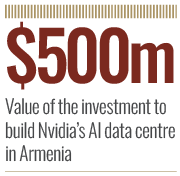
According to Minister of High-Tech Industry Mkhitar Hayrapetyan, the initiative will be the region’s largest technological undertaking: a $500m investment, the deployment of thousands of Nvidia Blackwell GPUs, and the construction of infrastructure with more than 100 megawatts of capacity.
The country aims to strengthen its technology sector and position itself as a regional hub. But this is not purely a technological ambition – it is also a strategic one. Technological progress could play a crucial role in helping Armenia grow into a more independent and influential state on the global political and economic stage.
Seskuria believes the strategy is logical, given Armenia’s lack of natural resources and limited geostrategic importance. “The niche it is trying to occupy can make Armenia attractive not only to European but also to Asian countries,” she says. “This has an economic dimension first and foremost, but also a political one, since the two are interconnected.”
Armenia’s goals are considered largely realistic, given other successful examples in the wider region. Soon after gaining independence from the Soviet Union in 1991, Estonia decided that building a digital economy and investing heavily in technological innovation would be the best path forward for a small nation with few natural resources. Substantial investments in computer networking and digital infrastructure followed – and today, this former Soviet republic stands as one of the most technologically advanced countries in the world. Perhaps it is a path Armenia is determined to follow.
Inside Armenia’s push for innovation
Khachikyan believes that the driving force behind Armenia’s recent technological pivot is its people. “People started building tech start-ups without any support from inside the country,” he says. “They understood that this could become something important – something that could position Armenia as a regional hub.” According to him, both the Armenian government and the public are now paying unprecedented attention to the country’s tech ecosystem – largely because Armenia has the intellectual capacity to compete globally.
Technological progress could play a crucial role in helping Armenia grow
There are already companies proving that Armenians have the ability to achieve ambitious goals in technology. ServiceTitan – an Armenian-founded, cloud-based tradesperson software company – became the first Armenian tech firm to list its shares on the Nasdaq stock exchange when it went public last December and was valued at over $10bn. The company was founded in 2012 in California, by Armenian entrepreneurs Ara Mahdessian and Vahe Kuzoyan. Over the past 12 years, it has grown into a leading developer of software to help HVAC businesses solve the challenges they face.
Khachikyan’s SmartGate VC is another example of an Armenian tech company that has found success abroad. The firm has been investing in artificial intelligence, brain–computer interfaces, cybersecurity and other emerging technologies. Khachikyan notes that their work began long before the current AI boom. “We were investing back in 2018, when AI wasn’t a hype,” he says. “We are not just investing in start-ups that use ChatGPT – we are investing in the fundamentals of AI.”
SmartGate also supports early-stage founders through community initiatives. “We are organising lots of events and programmes for start-ups,” Khachikyan explains. “One of those initiatives is the Armenia Start-up Academy, which we launched in 2018 with one simple goal – to help Armenian founders understand what a start-up really is and give them the resources to build one.”
Collaboration and mutual support have long been essential drivers across Armenia’s different sectors. According to official data, around seven million Armenians live in more than 100 countries worldwide. The diaspora – diverse, far-reaching and active across 24 time zones – plays a vital role in connecting Armenia with the rest of the world and amplifying its influence. “Armenia has always maintained strong connections with both the West and the East, largely thanks to its diaspora. The diaspora factor is very significant, as Armenia has a highly influential global community that closely follows developments in the country,” says Sabanadze.
Armenia’s path forward
As Armenia aims to become a hub for innovation and investment, being a neighbour of Russia presents significant challenges – especially given Moscow’s long-standing role as a close ally in economic, political and military matters. The central question now is whether Russia will step aside and allow Armenia to successfully attract Western investments and establish itself as a technology hub in the region. The answer is far from straightforward, particularly in light of the Kremlin’s aggressive actions in both recent and more distant history. While many believe that Russia lacks the capacity to block Armenia’s Western path, Seskuria holds a different view.
“Militarily, Russia’s resources are quite limited due to the enormous expenditures in Ukraine,” she says. “However, if we look at other hybrid warfare methods in the region – not just in Armenia – Russia has become more active since the war in Ukraine began.”
Seskuria warns that Armenia’s upcoming elections warrant close attention. “Elections are a politically vulnerable moment,” she explains. “Russia often sees them as an opportunity to intervene and influence the outcome using its resources.”
Despite these risks, Khachikyan remains optimistic. He believes that growing international interest and investment signal a bright future for Armenia’s technology sector. Nvidia’s forthcoming project, along with other major initiatives, will provide local researchers and engineers with access to advanced technologies and greater computing power. Yet, he emphasises that one factor will determine whether Armenia’s ambitions can truly take root: peace. “If people feel safer – free from wars and conflicts – growth will be stronger,” Khachikyan says. “Because the most fundamental requirement for developing any economy, or any field, is security.”

