


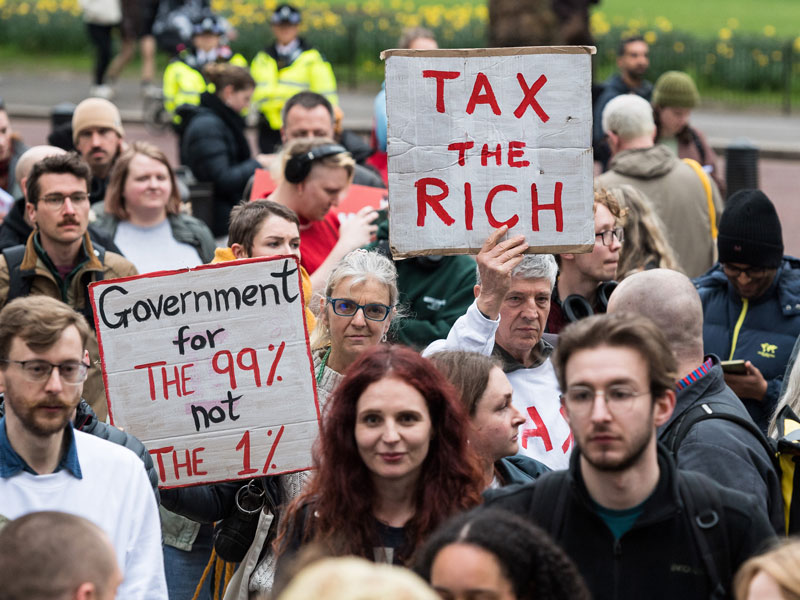
Gary Stevenson is agitated. Leaning forward in his chair, the self-styled social economist gesticulates animatedly and says to his counterpart, serial entrepreneur Daniel Priestley, “I don’t need to be here. I am a multimillionaire just like you. Sometimes we have to do things not because they are easy, but because they are hard; that is what makes a rich country rich.” Stevenson and Priestley are guests on a two-and-a-half-hour special edition of the number one Diary of a CEO podcast. We are almost an hour into the conversation and both guests are presenting passionate, well-researched points offering different views on the solution to increasingly severe inequality in the west and what Stevenson sees as the imminent collapse of the UK economy.
What is striking about the debate is not only that both men make excellent arguments for how to approach the undeniably urgent problem, but that the nature of the discussion, although heated and frustrating to listen to at times, remains curious, understandable, and crucially, respectful throughout. Against the current political backdrop, that is impressive. There are no easy answers and, refreshingly, neither guest is pretending otherwise.
Influencer politics
It is almost impossible to consume any mainstream or social media in 2025 without being sucked into highly adrenalised, even dangerously oversimplified arguments. DOAC and other online broadcasts deliberately play into this, using ‘urgent’ graphics and inflammatory language. But stick with this episode and the nuances are allowed to unfold – one of the benefits of longform podcasting, albeit one that does warrant some scrutiny as many of host Steven Bartlett’s guests (and some controversial viewpoints) do go largely unchallenged.
A media controlled by ‘wealthy elites’ will naturally attempt to shift public debate away from itself
The algorithms and clickbaity nature of social media has shaped public discourse to the point of entertainment and agitates people into commenting, following, and pouring fuel on the fire. Not only that, but the issues of the day – increasing poverty, environmental disasters, geopolitical emergencies – naturally lead people to seek simple solutions; someone to blame. You have only to look at recent political events in France, the US, the UK, and elsewhere to sense that political and social polarisation is posing a genuine threat to democracy.
A recent episode of Stevenson’s ‘Gary’s Economics’ videos helpfully explains this phenomenon: he goes into 25 minutes of detail outlining how to control a media narrative by using techniques such as salience and storytelling. All of this to address the question of why the working class and the media have been swept into overwhelming public debate about migrant hotels, protests and counter-protests, flag flying and so-called ‘illegals.’ Stevenson believes it was deliberate. “At the end of June, the economy and inequality and taxation of the rich were being discussed every single day on every single news show; we had massive salience. And now if you look at the TV, what you see is immigration and asylum seekers and refugee rights. Refugee protests outside hotels are being spoken about much, much more, and the issues of inequality, taxation, distribution have kind of been put on the shelf.” In other words, a media controlled by what Stevenson calls ‘wealthy elites’ will naturally attempt to shift public debate away from itself and onto an ‘easy’ answer: immigrants. It is a tale as old as time.

If you are engaged in business and economics in 2025, you will be aware of the many disruptors who have emerged across industries, but Stevenson’s disruption, rather than getting rich, cashing out, and retiring somewhere tropical, is to take aim at the very structures and systems that enable people to do that without paying their fair share.
Stevenson’s path is an inspiring one: he is a ‘working-class boy done good’ who studied hard, got into LSE and literally won his way into an investment banking job. He became fantastically successful at trading, which almost broke him, and has now written a book about his experiences and vlogs about economics ‘for normal people.’ And it is this new outlet where things swiftly get political. With a quick mind, a sharp tongue, and a penchant for winding himself up, Stevenson is compulsively fascinating to watch – he has created a YouTube channel with 1.49 million subscribers featuring nothing more than him chatting at his kitchen table with the occasional scribbled line graph on a pad of paper. A member of the lobby group Patriotic Millionaires, which campaigns for governments to tax them and others like them, Stevenson uses his growing platform to talk to the working class that he came from, but he is taking aim at his new peers: “I come in here because I come from a poor background and it is ordinary people like my family, like the kids I grew up with, whose kids are gonna be in poverty. Tackling wealth inequality is difficult, but it is necessary.”
Why a wealth tax?
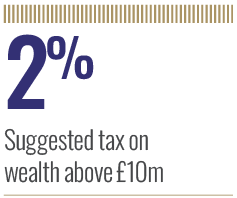
So, to the core argument. Having made his millions betting on the economy never recovering after the 2008 crash, Stevenson believes that the solution is to implement a one to two percent wealth tax on wealth above £10m. Crucially, he is not interested in raising income tax in basically any scenario but focuses solely on curbing the compounding of existing wealth at levels far beyond even the highest salaries for everyday corporate work.
One counterargument to this is that such a tax would lead to an exodus of the super-rich, and the number of millionaires leaving the UK is often used to back this up. Stevenson believes that millionaire entrepreneurs are leaving the UK because its spending power is so weak – middle- and working-class families are struggling and so spending less money. A wealth tax would stop the super-rich being able to simply stockpile assets and squeeze out the poor and middle classes, opening up opportunities to buy homes, have a family, and become more economically active.
It is also the case that ultra-high net worth individuals (UHNWIs) are essentially globally mobile, as are the businesses that they run. One of the joys of the technology age is the ability to start an online business from anywhere, but this makes it difficult to trace and track profits and wealth, especially when it is so easy to shift where these are held to tax havens. This begs the question of traction – it almost feels as though for this to work, it is not enough for one country to implement it, it would need to happen the world over. In a time when places like Dubai are cutting taxes there is something systemic and far-reaching here that may very well be beyond the scope of one economic influencer. What is interesting though, is that this ‘millionaire exodus’ is already happening to some degree, without the UK implementing any wealth tax of the type Stevenson supports. And truly, he does seem to care about the 99 percent of the population that aren’t millionaires, so when challenged with this, he remains committed to the cause he knows he is likely to lose.
Politics and polarisation
In a striking shift toward progressive economic reform, the Green Party’s newly elected leader Zack Polanski is also calling for a wealth tax. Not dissimilar in attitude, Polanski himself made well over 100 media appearances and interviews in the first week after his leadership announcement in September, and among the first guests on his new podcast was one Gary Stevenson. Since then, the Green Party has increasingly echoed the call for a comprehensive wealth tax, calling for a two percent tax on wealth above £10m.
A wealth tax would stop the super-rich being able to simply stockpile assets
It is too reductive to say that influencer politics have shaped the Green Party’s approach to wealth taxation, but in a summer of identity politics overtaking almost all nuance of complex issues, they have surely been emboldened by it.
With the next election approaching, Stevenson is keen for other voices to take up the message and spread the idea of wealth taxation, particularly among the working classes. The challenge will be to keep enough salience – to churn out enough content, command enough of the narrative, and present ideas accessible enough that people understand them and are prepared to vote for them over identity. Thanks largely to social media amplifying increasingly extreme viewpoints, both the right and left in the UK have never felt so stark, and the traditional parties of Labour and Conservative have scarcely been more similar. Stevenson’s influence not only appears to be shaping grassroots politics, but if the next UK election really does become a choice of either Reform or the Greens to oust Labour, the question becomes which way the country ultimately swings. Both sides of the debate will need to capture the hearts and minds of the working class; it is a question of exactly which issue will capture the public imagination more. No doubt, Stevenson has his work cut out.
Slowing down to stay ahead
This article was written over a period of several weeks. As I started it, Stevenson’s DOAC debate had just aired. During its development time, Polanski announced his wealth tax plan in an almost perfect echo of Stevenson, and the two men were backing and complimenting one another online. By the time it was finished, Gary’s Economics had a new video out titled ‘Goodbye and Good Luck.’ Not an announcement of Stevenson quitting, but of taking an extended break, essentially because he has recognised that he is exhausted and fighting a very difficult battle. A marathon, not a sprint, for the ideals he champions. No doubt those who are against him will hope that the idea dies down, but this doesn’t feel likely. In the show notes for the video, Stevenson lists several individuals and organisations his followers can support in the meantime. The first on the list: Patriotic Millionaires. The second: Zack Polanski.

