



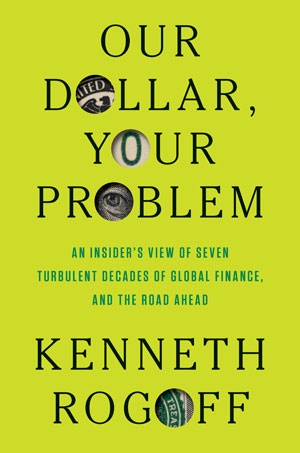
Few economists can claim a résumé as eclectic as Kenneth Rogoff’s. Before he was advising governments and lecturing at Harvard as the Thomas D. Cabot Professor of Public Policy and Professor of Economics, he was outthinking opponents as an internationally ranked chess player, even achieving the title of grandmaster. His career includes serving as Chief Economist at the International Monetary Fund (IMF), where he played a pivotal role in navigating economic challenges of the early 2000s. Rogoff has now turned his analytical mind to the future of the US dollar. In his latest book, Our Dollar, Your Problem, he explores how America’s currency shapes – and sometimes destabilises – the world economy in an era of shifting global power. Blending economic insight with a strategist’s instinct, Rogoff unpacks the risks and realities of a financial system still ruled by the greenback, but increasingly undermined by rivals such as the renminbi and stablecoins, as well as political polarisation in the US.
Is the dollar still an exorbitant privilege or an exorbitant burden for the US?
There are some burdens, the biggest one being that you need to remain a dominant military power. The cost is far in excess of most other numbers we are talking about. The idea that the big problem is that demand for the dollar makes it overvalued and hollows out our manufacturing might have a grain of truth, but it is a small issue. The dollar is strong because we are good at technology, engineering, services and intellectual property. Manufacturing jobs have been hollowed out mostly due to automation. In fact, manufacturing as a share of GDP has risen. So there is some truth to it, but it is one of a dozen factors. Saying that it is the dominant one is polemical nonsense.
What is the biggest threat to the dollar’s dominance?
My book envisions a slow decline of the dollar’s share. It will still be first, but in a more multipolar system where the euro expands its footprint and the renminbi becomes a regional currency in Asia and maybe parts of Africa and Latin America. Not long ago, the dollar’s share was smaller. It grew because of the euro crisis and because China made its economy dollar-centric. In 2015, the dollar reached a level higher than it had ever been at, but it has been in decline since then. If you look at countries’ exchange rate systems, the share of reserves, the dollar has been gradually losing market share, going back to the pre-euro-crisis equilibrium. Also, the promiscuous use of sanctions has made countries wary of being over-reliant on the dollar. The US is the world’s back office, which allows us to spy on everyone. So it is not just the Chinese, but also Arabs, North Koreans, Russians, Europeans, even Latin Americans, who are looking for ways to diversify their back office so they are not reliant on dollar plumbing.
Is there a point beyond which rising US public debt will make foreign investors lose confidence in the dollar and Treasuries?
I don’t think so. Gradually the interest rate will rise, and that puts pressure on the government to find other means to free resources to pay for spending in the case of Democrats, for Republican tax cuts, for military expenditure in the case of both parties. For a large country that issues and borrows in its own currency, debt crises don’t have the suddenness they have for countries that borrow in other currencies. But that doesn’t mean that it is not a problem.
The US is the world’s back office – which allows us to spy on everyone
Carmen Reinhart and I wrote a paper in 2010 where we divided countries into buckets and found that countries with high debt tend to grow more slowly. It was claimed that there were myriad errors and it was completely wrong. There was one error that didn’t affect things that much. We have a 2012 paper that has no errors and gets the same results. More than a decade later, many other people found this. High debt slows growth. You have less money to spend on infrastructure, to react to financial crises. But there is no known upper limit on debt that leads to a crisis. Japan has a 240 percent debt-to-GDP ratio. It hasn’t had a crisis, but it has grown spectacularly slowly. Japan was the second richest country 35 years ago. Now it has an income per capita similar to the poorest US state, Mississippi.
Could the renminbi threaten the dollar’s status as the global reserve currency?
In 100 years, sure. In the near term, the renminbi is likely to become a regional currency in Asia. As China breaks free from its dollar peg, it will hold fewer dollars. Its Asian partners, who will be stabilising their currencies against both the renminbi and the dollar, will be holding fewer dollars. We are not going to be using the renminbi in New York, not unless the US badly loses a war to China! But will the renminbi become used in Indonesia, even India? Of course it will. It is not necessarily going to replace the dollar, but its footprint will grow significantly in a multipolar system.
Is the digital yuan part of China’s strategy to undermine the dollar?
Yes. Both the EU’s and China’s central bank digital currencies (CBDCs) are directed at undermining dollar dominance. This is part of building a back office, replacing the plumbing. It also makes it more convenient to hold. Now a large share of settlements are done in dollars. China has already built alternative systems; even Brazil and Europe have. New digital technologies allow ways for them to compete more effectively. The US has launched stablecoins to counterattack, but that will not stop the rise of CBDCs. They help facilitate the move away from dollar dominance.
Why do you think that the US under Trump has embraced stablecoins and banned a digital dollar?
There are two ways to look at it. One is that the US is far ahead on stablecoins and behind on CBDC, so it is leaning into its strengths. Alternatively, this is an example of extreme corruption. The crypto industry made a quarter to half the donations to both parties in the last election, and it is being paid off. The financial industry had a similar profile in the 2008 election, and we saw what happened. Some positive things were done in trying to define crypto regulation, but the government allowed the industry to write everything without any discussion from outside. We will get an underregulated crypto industry that competes with dollars. That undermines the ability of the Treasury to take in tax revenues and makes it easier to evade regulations and engage in criminal activity. When all is said and done, this will be viewed as a colossal over-reach.
Can the Fed withstand political pressures and how will they affect the dollar?
Both sides want to undermine Fed independence. If Harris had prevailed, we also would have had an assault on central bank independence with different goals, but similar effects. We will end up with more bouts of high and volatile inflation and higher and volatile long-term interest rates. All the benefits of central bank independence will be weakened. Not overnight; it will take years. To say that this is a mistake by Trump isn’t accurate, because in the short term, he could benefit. Often, populist policies work for a while. He may succeed in holding interest rates lower for a while, but in the long run, we will get higher inflation, especially if there is another big shock. That undermines the dollar. Europe faces the same problem. More volatile and higher average inflation makes safe assets less safe, and weakens demand for them, not just the dollar.
It is often argued that one advantage the dollar has is the rule of law. Given the current political climate, is that still true?
Trump’s assault on the rule of law undermines the US’s competitive position. If you were a foreign investor, you could depend on a non-political court system. The US was exceptional. You didn’t have to worry about what the President thought about some court case involving, say, default in Argentina. Now the President takes an outsized role over Congress and the courts. One thing Republicans are short-sighted about is that they won’t always be in power.
In the future, it could be Ocasio-Cortez or Gavin Newsom who assumes these same powers. So it will weaken the appetite for US assets. The subtle change, which many investors overlook, is the US tariff wall. Many countries are retaliating, which weakens demand for US assets. If you make tariffs high enough, it collapses demand for US assets. You can’t easily get your money in and out. Some argue that geopolitical fracturing and the rise of AI will inevitably require a more autocratic government, and Trump sees ahead the need for that. If that is true, fine, but it is also going to lead to a more fractured system where the dollar is no longer quite as dominant, but king of a smaller hill.
If Europe invested in its defence, would that help the euro compete with the dollar?
One reason the euro can’t fully compete with the dollar is Europe’s lack of geopolitical heft. If it became a military power, that would benefit the euro. It allows you to have a security umbrella over friendly countries that might be more inclined to hold the euro. But it also helps you in international negotiations. Not just Trump, but also Nixon, Reagan and Johnson used military power to get their way in financial negotiations. The shape of the IMF, SWIFT’s design, the way clearing houses are set up. All that has roots in US military power, not just dollar dominance and the US’s economic size. So if the US forces Europe to become a military power, it may find to its chagrin that the euro will become more important.
Is a world currency possible?
It is not possible in the foreseeable future, unless we have a world government. Look at the trouble the eurozone has coordinating countries that share similar values and income levels, and compare that to differences between African countries and Norway. It is simply not possible, unless you are willing to massively redistribute income. I favour that, but a world currency will not gain traction. Take the IMF’s Special Drawing Rights; there are people like Joe Stiglitz and Janet Yellen who believe that it is free money we can give out. It is not free money; it is just like any other loan. For the foreseeable future, we will not have a world currency until we have a dominant country globally.

