


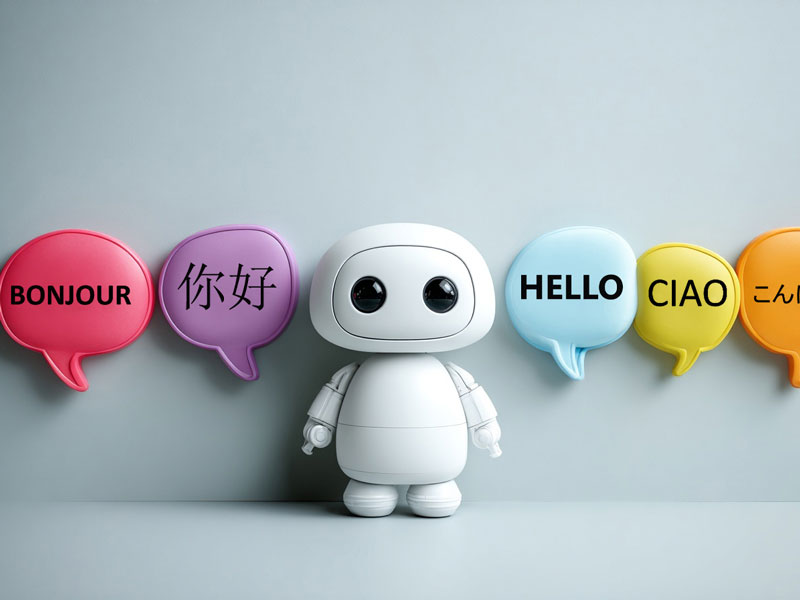
As the list of companies citing AI efficiencies as the rationale for staff restructuring grows, many have rushed to speculate about the future of work and to surmise that the next logical step for AI is towards replacing humans in the workforce. But, from where I sit, at the intersection of translation and AI sectors, the more compelling transformation is not simply what AI replaces, but how AI is learning, or failing, to understand the human dimension – eventually the human touch – behind every action or task.
As a true believer that language is the most important factor for human evolution, I founded Translated in 1999 to help people translate their words, and indeed cultures, all over the world, by allowing everyone to understand and be understood in their own language. Since AI is powering the possibility for increased connection, I believe that our industry is the perfect vantage point from which to consider the wider world.
Firstly, because it was with the combination of language and AI that saw the first mass adoption of use: in large language models that answer our questions in full sentences and tailor their responses based on our preferences. Decades of research on machine translation – and indeed language – have enabled this. AI is in turn enabling the translation of language. However, despite its increasing speed and accuracy, one thing remains abundantly clear to experts: it does not replace the need for human sensitivity. Instead, it can perform the repetitive and monotonous tasks that occupy the time of skilled experts and allow them to focus on more complex elements of their roles, most notably those parts of translations that are most steeped in emotion and in ‘human-ness.’
Human-centred intelligence
For many businesses, the discussion around AI still revolves around productivity gains and potential labour displacement: ‘Which jobs will go?’ and ‘How many will remain?’ These questions we see posed over and over and are, of course, important to provide answers to, not only for those fearing replacement but for future generations questioning what the world of work will look like for them. Perhaps though, the more important questions are ‘What do humans do best?’ and ‘How can AI enable us to do more of this?’
The question is no longer which tasks AI can perform, but how it can elevate human potential
Undoubtedly, for AI to work in partnership with a human workforce, the next phase of progress will be towards better understanding us. In this respect, Translated is leading a pioneering project: DVPS (Diversibus Viis Plurima Solvo), backed by a €29m European seed investment across 20 partners in nine countries, precisely to tackle this challenge. DVPS is about moving beyond language models that digest text and images collected in the past, and into models that sense vision, audio, and sensor input, models that engage in real time with the physical world and have a greater contextual awareness.
Equally, this progress must be assessed and managed appropriately, and global conversations are necessary to achieve this. I was recently invited to participate in the World Meeting on Human Fraternity in Rome. The discussion saw top AI scientists, including Nobel Laureate Geoffrey Hinton, the most cited AI scientist Yoshua Bengio, and professor and leading author Stuart Russell, come together to share their insight with Pope Leo XIV on the social, cultural and ethical dimensions of AI. The message was clear: AI must serve humanity, not erode its dignity, and must be anchored in dialogue and care. It is with no surprise that this group agreed that the two most significant positive impacts AI can have are ‘scientific discovery’ and ‘global human understanding.’
Leading in the age of understanding
For leaders and organisations, the path forwards demands a shift in perspective. The question is no longer which tasks AI can perform, but how it can elevate human potential. The most successful companies will be those that invest in understanding and context rather than just efficiency. True leadership in the age of AI means embedding empathy and ethics at the core of innovation, ensuring that technology amplifies what is most human about us: our ability to care, to interpret and to connect.
The next decade of AI will not be defined by fewer jobs and faster machines. It will be defined by machines that understand contexts, emotions, and human values, and by humans who leverage that understanding to do what only humans can do: build relationships, innovate culture, and lead with meaning.
When machines finally grasp that a sentence is not just a sentence, but an expression of human intent, when they discern not just words but tone, gesture, and cultural context, then we will emerge from automation into augmentation. That is the moment when AI truly becomes a partner in human progress. The real progress of AI will not be measured by how many jobs disappear, but by how many new forms of human value emerge.

