



For the last several years, data was considered mainly an administrative tool. Governments treated digitalisation only as a way to improve efficiency by decreasing bureaucracy, boosting access and streamlining services. This approach is now shifting, with nations increasingly treating digital infrastructure as economic and strategic assets. From Singapore’s integrated digital identity platforms to Estonia’s decentralised databases, governments are designing new models of national data ecosystems. Instead of only regulating the data, they are extracting key insights from it, while controlling and designing the digital infrastructure. These insights are helping support secure data exchange, financial verification, urban planning and AI-driven systems, generating measurable economic value. However, this raises key questions around data ownership, value and monetisation. As governments take greater control of national infrastructure and citizen data, who really benefits? And could data-driven platforms become a new class of economic asset?
From digital systems to economic assets
Rising digital sovereignty is swiftly reshaping how countries view, build and use economic infrastructure. Today, national platforms are integrated systems underpinning vital financial services, while enabling greater economic access and data exchange through public-private data ecosystems. Estonia’s decentralised, open-source data exchange layer, X-Road, is the foundation of its e-state, allowing online tax filing, residence registration and health records. By connecting 99 percent of government databases, independent systems can exchange information directly, while maintaining their own data.
This supports Estonia’s ‘once-only’ principle, where data is only entered once, decreasing duplication and streamlining commercial and administrative processes. Data can be exchanged across different countries through the X-Road Trust Federation, highlighting the platform’s potential to scale internationally.
Similarly, Singapore’s MyInfo allows citizens to securely share and manage verified personal data with both private sector and government digital services. It is used by over 1,000 private and government digital services and has greatly streamlined banking and loan applications. The UAE’s Digital UAE platform and initiatives like United Digital Platform and UAE Pass offer a centralised access point and digital identity for more than 12,000 private and government services. It enables digital signatures, biometric-based identity systems and paperless transactions, like business licensing and visa applications for seamless cross-sector interaction. These platforms are evolving beyond individual administrative tools to form the foundational systems through which economic activity is carried out by embedding digital identity into core national operations.
Where the value comes from
State platforms have significantly advanced digitalisation; however, the biggest value comes from decreased economic friction. By enabling faster verification and more efficient data reuse, they are transforming large-scale transactions. “The real asset is not the citizen data itself, but the velocity of transactions that are derived from the usage of that data,” Kuldeep Kundal, founder and CEO of Cyber Infrastructure (CIS), highlighted. “When governments create a digital foundation for their infrastructure, it essentially reduces the cost of doing business – and therefore creates a huge macro-economic multiplier effect.”
Estonia’s X-Road offers value by reusing verified data across ecosystems. This allows administrative burden and costs to be considerably reduced, while accelerating service delivery through direct data exchanges between organisations like police, healthcare and tax authorities. X-Road saved both the government and citizens over 1,345 years of working time annually or two percent of its GDP in time and resources in 2018. Singapore’s MyInfo has decreased credit processing and identity verification times, which greatly slashes compliance expenses for companies. It also accelerates financial services onboarding and increases client acquisition and access to finance. Digital UAE helps businesses and entrepreneurs to operate more smoothly in the country by simplifying services like property transactions and licensing.
Another important way these platforms generate value is by ensuring that all traffic is signed, time-stamped and encrypted, to protect confidentiality and integrity. This significantly reduces the chances of fraud while avoiding expensive audit procedures. Organisations can also scale more sustainably through these systems, by adding services gradually, lowering the risks of costly implementation failures. Similarly, they support AI-enabled tools, analytics and predictive systems for sectors like urban planning.
As such, rather than directly monetising data, these platforms enable economy-wide efficiency improvements, which translates into millions of transactions carried out faster, cheaper and more transparently. These efficiency gains then act as economic leverage, which can directly boost national productivity.
Who gains the most value
Although these digital platforms have significant advantages, their value is unevenly distributed across stakeholders. “Governments gain efficiency and visibility. The private sector gains lower onboarding costs and better rails for service delivery. Citizens gain convenience, speed, and in some cases stronger inclusion,” Michelle Li, chief operating officer at Bisblox, said. “Historically, governments captured the first wave of value through modernisation. Now the centre of gravity is shifting toward ecosystems, where the biggest upside comes from what others can build on top.”
As the primary designers and controllers of these infrastructures, governments remain at the core. By using national platforms as the foundation for financial verification, service delivery and digital transactions, governments retain considerable power over how data is accessed, reused and shared throughout the economy. This boosts significant indirect value through GDP savings, higher public service efficiency and a stronger tax base.
Private sector players capture much of the direct commercial value, as they can build services on these platforms using verified, reliable data, which decreases compliance costs. “By providing the pipelines for many new products (fintech, logistics, insurance, etc) that previously were blocked by red tape, these platforms will now provide the private sector with a means of accessing markets in ways that no longer inhibit them from being able to operate within those markets,” Kundal noted. However, this also means greater reliance on government-controlled platforms, as companies do not own or control the infrastructure they use. Citizens provide the vast majority of the data for these platforms and enjoy enhanced convenience and access through less paperwork, faster services and greater financial inclusion. Despite this, they are almost never monetarily compensated, with control and consent over this personal data remaining murky areas. This creates a complex value distribution model, as most efficiency gains are tempered by a loss of autonomy and control. As these platforms deliver more economic value, they are reshaping how power is distributed within digital economies.
As national digital systems scale, economic and efficiency improvements also have some key trade-offs. One of these is privacy versus economic value creation. While enabling seamless data exchange, faster verification and lower costs, sensitive data is highly concentrated within a few government-controlled systems too.
This raises the potential for state scrutiny and surveillance, leading to an important question: When does monetisation and efficiency creation become overreach? “Regulators are pushing for citizens to have rights over their data as it flows downstream. That pressure is important because the legal structure supporting the majority of these platforms is much weaker than most governments would like to admit,” Marcus Denning, senior lawyer at MK Law, explained. “The largest risk is that most governments are attempting to define rights to the data without actually having the authority to convey those rights. Most citizens have no idea this is happening.”
This data concentration within a few platforms can worsen systemic risk and magnify losses in cases of cyber attacks, technical failures or governance issues. Similarly, while allowing thousands of private sector companies to access personal citizen data can speed up service delivery, client retention and onboarding, the risk of commercial misuse can increase too. This includes data selling, credit profiling and targeted advertising.
“Governance is still treated as a layer on top, while the data itself is moving in real time underneath. This leads to consent, access control, and auditability failing to keep up with how fast the ecosystem expands,” Pratik Mistry, EVP of Technology Consulting at Radixweb, said.
“The real risk here is not just privacy in isolation, but that once these systems scale, it becomes very difficult to trace who is using what data and for what purpose.” Another growing tension is between control and innovation. National systems can enhance efficiency and greatly decrease friction for businesses, but also limit economic activity into narrower, predetermined functions. As a result, business experimentation could be slower and restricted to the edges of the ecosystem. As state powers grow through digitalisation, individual rights also come more into focus. In many cases, it may not always be possible to inform citizens when their data moves between organisations, resulting in eroded trust in the government. This raises another fundamental question: could open and distributed systems be a fairer and more transparent way than centralised platforms to maintain efficiency and trust?
A new asset class?
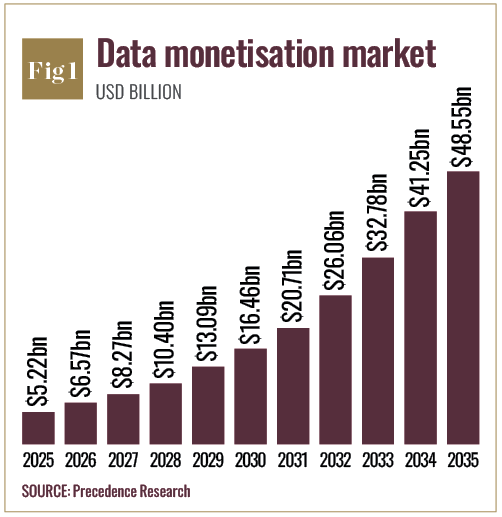
The rapid growth of national digital platforms has led to them being seen more as financial than administrative assets, mainly due to their ability to underpin core economic services at scale (see Fig 1). This is similar to other regulated infrastructure assets such as payment systems and telecom networks, where the main value comes from the reliability and mass volume of the transactions they support.
Down the line, this could potentially pave the way for them generating stable and long-term economic returns, much like other traditional infrastructure assets. If so, they could attract investments from institutional investors, sovereign wealth funds and private capital alike, as digital state capacities grow. However, platform pricing is likely to remain complicated, as their performance is closely linked to trust, governance and political continuity. As a result, a new type of hybrid asset class could emerge, which would be a combination of economic asset and public utility, redefining economic value and control in modern economies.

