



Top 5
Technology has enabled the transformation of business models and customer experiences, with those organisations strategically integrating it, unlocking greater value for its stakeholders. In the banking sector, rising customer expectations for instant and seamless on-demand services and wider adoption of digital technologies have necessitated the modernisation of service delivery. The entry of fintechs and new operating models continue to push the boundaries of traditional banking while intensifying competition. Moreover, the capacity for digital banking services to transcend geographic boundaries has accelerated financial inclusion by improving accessibility for underserved communities and facilitating greater participation in the formal financial system.
Digital transformation
2025 was a significant year for Sampath Bank, as we embarked on our digital transformation journey, embedding technology with intent, across all pillars of strategy and business operations, while remaining true to our vision of making banking convenient and affordable at scale. Our strategy, anchored on the enduring pillars of customer centricity, operational excellence, digital leadership and sustainable growth, is now underpinned by strategic investments in advanced data analytics, formally elevating it as a core strategic capability.
This analytics-driven approach has deepened customer centricity by enabling hyper-personalisation and predictive services while driving operational excellence through intelligent automation and risk foresight. It has also formed the cornerstone of our digital leadership, creating smarter platforms and products while underpinning sustainable growth by allowing for portfolio steering and impact assessment.
Technological advancement directly fuelled our mission of financial inclusion and access
Executing this strategy necessitated deliberate and significant upfront investments in foundational IT infrastructure. This included the deployment of upgrades to the core banking system, a data lake and an advanced API integration platform to create a unified customer data ecosystem. These systems are expected to enable deeper personalisation, unparalleled speed and scalability in product development and service delivery, strengthening our competitive edge and market position within the Sri Lankan banking industry. We also responsibly adopted artificial intelligence and machine learning in areas such as credit assessment and personalised financial insights to enhance credit decisions.
We consciously invested in accelerating team capabilities through focused training and development while supporting their transition to new ways of working through targeted change management initiatives. A newly established team of data scientists and data analysts worked closely with business units to ensure data-led insights translated into actionable decisions to support sustainable growth and an elevated customer experience.
Reflecting its strategic significance, every aspect of technology integration is subject to robust oversight through a strong governance structure that is led by the Board of Directors. This has ensured the alignment of digital investments with strategic priorities, optimised resource allocation and prioritised investments while ensuring compliance with regulatory requirements and industry standards. Moreover, our robust IT governance framework, customer privacy and data security protocols and business continuity plans have reinforced trust in our digital ecosystem while strengthening long-term resilience.
Delivering value
Our digital transformation programme inspired relevant innovation while accelerating financial inclusion, resulting in measurable value creation for our customers. We launched ‘Sampath Select’ in 2025, representing a pioneering step in digital lending. This AI-powered instant personal loan provided our retail customers with a seamless and secure credit application experience, enabling completion in just five clicks via the ‘Sampath Vishwa’ mobile app.
Our retail customers also benefited from tailored lending plans and financial advice, enhancing financial wellness. Data-led insights supported the launch of zero equity housing loans in partnership with selected real estate developers supporting individuals to ownership of their own home. Meanwhile, high net-worth customers benefited from enhanced features on digital platforms elevating and personalising their banking experience.
For our corporate customers, our digitalisation and data analytics strategy enabled innovative, holistic financial solutions tailored to fulfil broad-ranging business needs, enhanced, streamlined and expedited service delivery and sophisticated treasury and trade solutions that improved their operational efficiency and liquidity management. The launch of our API banking platform enabled the seamless integration of corporate systems with the bank, streamlining transactions across supply chains.
Timely data-driven advice on cashflow management and market opportunities delivered to small- and medium-scale enterprises, the backbone of the Sri Lankan economy, elevated our service delivery to that of a strategic enabler that facilitated their growth. The implementation of several systems and digital tools also enabled faster credit decisions and relationship-based pricing alongside increased support delivered by an enlarged and trained team of relationship managers positioning the bank as a preferred partner within this customer segment.
Most significantly, technological advancement directly fuelled our mission of financial inclusion and access. By building sophisticated digital profiles, we are now able to responsibly extend services to segments previously deemed underserved, using alternative data to assess creditworthiness beyond traditional metrics. This allowed us to reach more first-time entrepreneurs, rural businesses, and individuals, ensuring that growth was not just facilitated, but was also equitable and far-reaching.
Building on a legacy
Our designation as a ‘Domestic-Systemically Important Bank’ in 2025 affirmed Sampath Bank’s critical role in safeguarding the country’s financial stability. It also underscored the need to pursue strategies that contributed to broader economic growth within a framework of prudent risk management, robust corporate governance and optimised capital management.
While direct value creation from new strategies will accrue to shareholders over the medium term, value delivered to our investors in 2025 remained significant. Our EPS increased by 11 percent to Rs 25.76 in 2025 compared with Rs 23.30 in 2024 despite higher upfront costs.
The bank’s PAT rose by 11 percent to Rs 30.2bn ($97.5m) in 2025, driven partially by a commendable 21 percent expansion in net fee and commission income, which cushioned the impacts of narrowing net interest margins in an environment of declining interest rates. The bank’s return on equity also improved to 17.93 percent in 2025 from 17.74 percent in 2024.
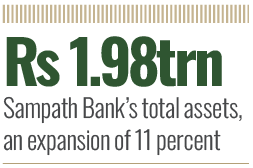
Sampath Bank’s total assets expanded by 11 percent to Rs 1.98trn ($6.4bn) driven by expansion in its gross loan portfolio. Stable macro-economic conditions and improving business confidence supported a 27 percent increase in gross loans and advances to Rs 1.22trn ($3.95bn), surpassing the Rs 1trn milestone in the second quarter of 2025. Asset growth was funded by healthy deposit growth and the purposeful rebalancing of its investment portfolio. The bank’s deposit base rose by 12 percent to Rs 1.65trn ($5.3bn) with moderate growth in current accounts and savings accounts (CASA), which increased in proportion to 34.7 percent as at end-December 2025 from 34.0 percent as at end-December 2024, easing pressure on net interest margins in an environment of declining interest rates. The bank’s capital position remained strong, with a Tier 1 capital adequacy ratio of 14.75 percent, which stood above industry standards, while asset quality indicators also recorded noteworthy improvement.
Strengthening long-term sustainability
The devastating impact of Cyclone Ditwah on lives, homes, property and livelihoods elevated the importance of emergency preparedness and a sharpened focus on environmental impact management and sustainability. The integration of SLFRS S1 and S2 enabled the formal identification, management and monitoring of the bank’s most critical sustainability and climate-related risks, while a climate first action plan set out clearly specified milestones for implementation. We also launched green deposits, which operate within the green deposit framework, enabling environmentally conscious consumers to participate in the country’s transition to a low-carbon economy. We enhanced our Environment and Social Management System (ESMS) and widened its scope to cover all lending facilities (except for schematised products), ensuring that environmental and social compliance was embedded across the bank’s financing activities. During 2025, we also received ISO14001:2015 certification, affirming compliance with global best practice in environment management.
We also invested in strategic environmental and social projects for shared prosperity. ‘Wewata Jeewayak,’ our flagship project, now in its 25th year, has restored 28 tanks as of December 31, 2025, with 2025 marking the highest number of tank restorations undertaken in a single year. This project has supported the livelihoods of over 16,000 families and rejuvenated over 4,000 acres of paddylands, supporting the nation’s food production while empowering local communities.
The bank also supports these communities by enhancing financial literacy through structured capacity building programmes. Extensions of these projects in partnership with other corporates have enabled many of these communities to thrive as capacity building and access to markets supported socio-economic progress. The ‘Breath to the Ocean’ project enabled the restoration of over 11 hectares of mangroves and wetland, protecting the endemic flora and fauna in these critical ecosystems. The bank continued to invest in its coral restoration programme, deepening our commitment to coastal environment restoration. We also implemented a programme to help 200 women-led start-ups, supporting them through capacity building and access to finance.
Strong foundations for future growth
Sri Lanka’s economic trajectory is expected to remain broadly on course, although the adverse impact of Cyclone Ditwah may moderate near-term recovery momentum as reconstruction of damaged infrastructure progresses. The financial sector is projected to experience measured growth supported by improving investor sentiment.
Against this backdrop, Sampath Bank will continue to execute its strategic agenda, scaling digitalised solutions and advanced data analytics underpinned by sustainability, to drive responsible growth, strengthen organisational resilience and deliver long-term value to all stakeholders.

