


The non-life insurance industry has consistently demonstrated resilience in the face of natural catastrophes over the past years, and 2024 was no exception. Riding on the growth of the economy, the non-life insurance industry posted growth in premiums and bottom lines. It is optimistic that the industry will continue to grow in the coming years, anchored on the strong prospects of the economy. Be that as it may, said optimism is not without evolving challenges, both natural and manmade, market-induced, or the dynamics of strong competition among the players.
Climate change and catastrophic natural disasters have wreaked havoc on the global environment, negatively impacting the global reinsurance market. The effects have shown an increasing severity and frequency of devastating natural events, which have widened the protection gap (the difference between the insured and uninsured losses). This protection gap dictates the financial resiliency of global economies from these events.
With the increasing risk exposures to catastrophic events or calamities in recent years, on the back of climate change, among others, the Philippine non-life insurance industry is experiencing a surge in reinsurance costs with more stringent terms and conditions. Reports have it that this rising cost of reinsurance is making non-life products more costly and is placing additional pressure on local insurers.
The severe effects of climate change have been a major challenge in recent years and will continue to be so in the years ahead. Around 20 typhoons enter the Philippine Area of Responsibility from the Pacific Ocean annually, with around eight or nine crossing through the Philippines. Typically, typhoon season runs from July to October, but climate change has shifted it to more random months, doubling catastrophic challenges with noticeable changes in trends of catastrophic events.
These market realities are proving to be extremely challenging in addition to increasing claims and indemnity costs as a result of inflationary pressures in recent years, particularly spare parts and labour costs for motor car insurance and replacement costs for property insurance.
Trailblazing teamwork
We are a trailblazing team, working together as market movers and innovators, achieving our goals steadily and sustainably. The company’s ecosystem is composed of dynamic and innovative groups that closely collaborate, always practising our corporate ethos – working as a team towards the same goals, embracing our culture of passion for excellence, underpinned by our massive transformational purpose, ‘Peace of Mind for all Mankind.’
Proactively prepared for any kind of calamity, the company has an innate capability to update its systems and enhance risk management capabilities, systematically and effectively, meeting the demands of an evolving market and weather unpredictability, at any time.
After a relatively benign year of catastrophic events in 2023, the year 2024 ushered in myriad challenges, including Super Typhoon Carina (internationally known as Typhoon Gaemi) in July, and a record-breaking six consecutive storms clustered within barely a month, three of which were classified as super typhoons, from late October to mid-November 2024. This record-breaking typhoon season was said to be ‘supercharged’ by climate change.
With 66 years of experience competently weathering calamities, the company is programmed to immediately mobilise and respond to these catastrophic events effectively. Financially, the company, supported by a dependable and financially strong reinsurance facility, remains protected amid the onslaught of catastrophic events.
Moreover, all claims platforms are powered by internally developed technological systems, aided by artificial intelligence, allowing the company to facilitate prompt and appropriate handling and monitoring of claims; aggregate limits are meticulously monitored, with the extent or highest level of the unit reached by flood indicated in the AON questionnaire, allowing us to immediately gauge aggregate losses per area, nationwide; but more importantly, digitalised procedural processes allow the effective and efficient handling and payment of claims.
Despite the loss experience, our clients felt supported by us, giving them peace of mind amid the chaos of the moment. For our claims team, who are experts in their respective roles, it has always been ‘just another day’ of service to our clients.
Embracing the uncomfortable
Throughout these years and amid a challenging business environment, Standard Insurance steadfastly continues to focus on proper underwriting, intelligent pricing across all lines, fast and accurate claims turnaround and sustainability.
As a leading motorcar insurer, the company utilises its wealth of data to understand the particular risks and characteristics related to the different vehicle types and markets, the peculiarities of motorcar losses, vis-à-vis recoveries, among others. The resulting motorcar analytics underpin our informed and intelligent motorcar strategies – better pricing and underwriting analysis and decisions, as well as improved churn rates.
The severe effects of climate change have been a major challenge in recent years
The lessons from the CAT events in 2024 taught us to be comfortable with the uncomfortable, never ceasing to challenge what is comfortable and pivot to the uncomfortable. With the destructive effects of CAT events, claims frequency and severity have become more extreme, and reinsurance costs have become more restrictive and expensive. Inflation and disruptions in supply chains have likewise pushed up claim costs, with minimal or sometimes no increase in premiums on the back of a very competitive market. Who then covers the gap or the rising burning cost?
The company implemented game-changing underwriting policies, never before tried within the industry, but perceived to be a response to the evolving hard realities of the non-life industry, especially in the motorcar insurance business.
Equally important, non-motorcar risks follow clear and defined underwriting guidelines and discipline. Standard Insurance remains consistently vigilant in protecting our balance sheet, vis-à-vis, the underlying risk portfolio. We conduct selective and stringent underwriting, focusing on maintaining and developing a risk spread that is consistent with the company’s directives for sustained profitable growth. We continue to strictly follow our preferred and ideal risks, cross-selling with the deliberate intention of portfolio diversification. The strict adherence to the NatCat Underwriting Guidelines via CRMS resulted in well-managed Property CAT claims in 2024.
All these have led to our ultimate validation from a global perspective. The Global Credit Rating (GCR) has recently upgraded Standard Insurance’s national scale financial strength rating to AA-(PH) from A+(PH). At the same time, GCR has upgraded Standard Insurance’s international scale financial strength rating to BB+ from BB, a notch lower than the Philippine sovereign rating. Both ratings were placed on Stable Outlook. GCR is wholly owned by Moody’s Corporation (NYSE:MCO).
Equally important, the company’s recent SGS audit reaffirmed our commitment to excellence, thus maintaining our ISO 9001:2018 certification. By conforming to standards, adhering to disciplined processes, delivering consistent quality service and fostering a culture of accountability, we continue to raise the bar for serving our clients and partners. These global awards reflect the passion for excellence that transcends our DNA and culture.
Driving the circular economy
Recently, Toyota Motor Philippines Corporation (TMP), the leading motorcar dealer in the market, officially endorsed Standard Insurance as its second model end-of-life vehicle (ELV) dismantling facility in the Philippines, and included in the ‘Toyota Global 100 Dismantlers Project’. Standard Insurance’s Technical and Training Centre (TTC) is the fifth dismantling facility in Asia and the 19th worldwide. This global project aims to establish proper ELV dismantling operations, addressing key environmental challenges.
This partnership further enhanced its existing partnership with TMP under the Toyota Insure Programme, where Standard Insurance is already part of its panel of accredited insurers. Toyota remains the leading brand in the country.
Born out of a need to accommodate the huge volume of inundated motorcar units after a devastating typhoon in Metro Manila, which the dealers could no longer handle due to the sheer volume, our TTC was established in 2014 and since then has been a major part of the company’s ecosystem. TTC is located in Naic, Cavite, spanning close to seven hectares, with five buildings housing our restoration facilities, as well as our dismantling and recycling or ELV facilities.
The TTC complex is a one-of-a-kind motorcar and motorcycle restoration, dismantling, and recycling facility in the industry, supporting an innovative loss-mitigating mechanism. It provides a circular economy, where the proceeds from the sale of these restored units and parts revert to savings, thus mitigating our losses. TTC has always recognised the importance of sustainable practices and aims to lead the industry in promoting environmental stewardship. It took a transformative step, championing technical excellence and environmental responsibility, ushering in a circular future, turning discarded vehicles into valuable resources and fuelling jobs, innovation, and sustainability.
The company implemented game-changing underwriting policies
To better equip its role in motorcar dismantling, the company sent its engineers and mechanics to train in car recycling operations with the biggest Japanese recycler, Kaiho Sangyo, located in Kanazawa, Japan.
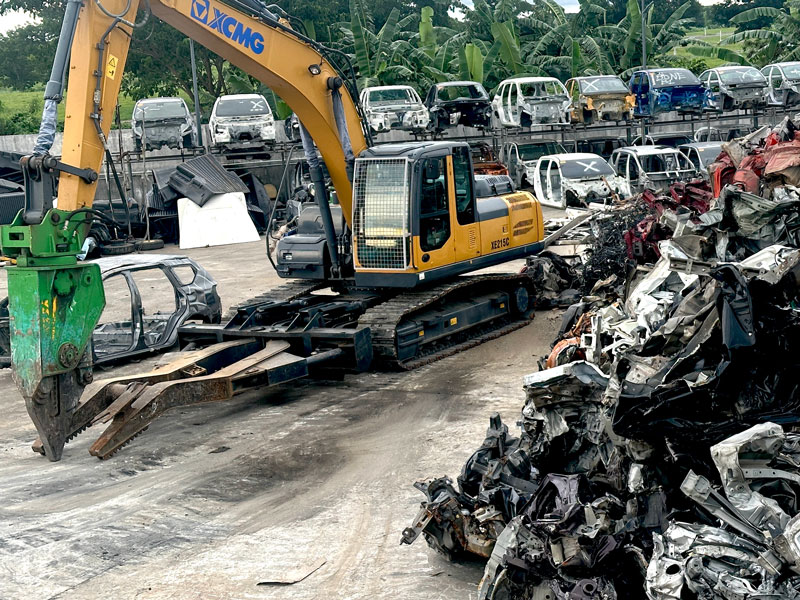
The company intensified investments in its state-of-the-art restoration and dismantling infrastructure. TTC is the only one with a motorcycle frame straightening bench that allows for the precise repair of motorcycles with bent frames. Moreover, to enhance its ELV dismantling operations, acquisitions of specialised equipment were completed, such as an excavator fitted with a hydraulic shear that has scissor-like jaws used to dismantle an end-of-life vehicle; a metal baler or baling press that is used to compress scrapped metals from dismantled body panels, ready for recycling; and a shredder that is used to reduce the size of waste materials such as scrapped metals and other materials, including tyre shredding.
Trained technicians, following globally accepted practices for depollution, ensure the safe removal and disposal of fluids and hazardous materials from these end-of-life vehicles, minimising ecological impact during the dismantling process. Chemicals drained from ELVs are sold to a treater hauler accredited by the DENR. Scrap metals are sold to local metal scrappers.
TTC is a shared mission with Toyota, DENR, TESDA, LGUs, and other community partners. In fact, Standard Insurance has been recognised by the DENR for its exemplary environmental programmes in pursuit of a circular economy. Moreover, a certificate of recognition was awarded to our Group Chairman, Ernesto T. Echauz, our Pollution Control Officer and a chemical engineer, for his unwavering commitment in partnership with EMB CALABARZON Region in pursuit of a healthy and clean environment.
With increasing frequencies of unpredictable weather disturbances and calamities, resulting in increasing motorcar claims, our investments in advanced recycling infrastructure, implementing responsible dismantling practices and training, maximising material recovery and resources, and collaborating with recycling partners are more than worth it. Standard Insurance is indeed leading the way towards a greener automotive industry.

