



Anti-migrant movements in different developed countries like the US, UK and parts of Europe are taking a new shift. Many individuals who oppose globalisation argue that migration policies have created unfair labour conditions, widened global inequalities and contributed to political instability in underdeveloped countries. Yet the other side of the story is equally strong. Migration has indeed enabled millions of households to survive, build resilience and even prosper.
Remittances, the money migrants send back to their home countries, are now considered one of the most important sources of external financing for developing economies. In fact, in many countries, remittances have surpassed foreign direct investment (FDI). As per the World Bank’s Global Remittance Report, there remains a large data gap between officially recorded flows and actual remittances, as migrants often rely on both formal and informal transfer systems.
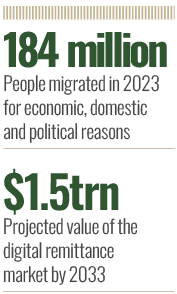
The World Development Report 2023 notes that around 184 million people migrated globally in 2023 due to economic, domestic and political reasons. At least 77 countries now rely on remittances for more than three percent of their GDP, and in about 30 countries, remittances account for over 10 percent of GDP. For low- and middle-income countries (LMICs), remittance inflows exceeded $650bn in 2023, a figure higher than FDI for many economies. By 2026, the global remittance market is predicted to exceed $800bn, underscoring its critical role in economic development. Migration patterns, fintech innovation and geopolitics are shaping this huge market, making it more dynamic than ever before.
Remittance drivers
From consumer brands to tech giants like Procter & Gamble, Apple, Amazon, Alibaba, Google and Microsoft, outsourcing and hiring across borders is now part of business models. Developed economies with high GDP are also confronting structural challenges like aging populations, low birth rates and persistent labour shortages. Countries like Japan, Germany, Italy and the UK increasingly rely on foreign workers to sustain their industries. At the same time, poor infrastructure and low wages in home countries continue to push individuals to migrate in search of better opportunities.
While anti-migrant campaigns and rising nationalism seek to limit immigration, the global demand for labour shows no sign of slowing down in 2026. This continued demand sustains the flow of migrant workers and, with it, the flow of remittances. Another dimension is climate change, which is becoming a central driver of migration. By 2050, millions of people are projected to be displaced due to extreme weather conditions, global warming and disruptions to agriculture. By 2026, these factors are already accelerating migration patterns.
The World Meteorological Organisation highlights that there is a 48 percent chance that global temperatures will exceed 1.4°C above pre-industrial levels in the next five years. Regions like Southwest America and Southern Europe are expected to be drier, while parts of Africa, Brazil and Australia will face heavier rainfall and flooding.
These weather disruptions are reshaping mobility. Skilled workers in Alaska or Canada, facing harsh winters, may seek opportunities elsewhere. Likewise, extreme heat in Brazil is likely to push workers toward countries offering both better pay and more favourable climates. Regardless of the economic necessity, political instability, or climate disruption, migrants consistently send funds back home. These cross-border cash flows not only secure the livelihoods of families but also stimulate local economies. The use of remittances is also evolving. Traditionally, funds were directed toward household consumption such as food, rent or education. Migrants are leveraging their earnings for investment opportunities in their home countries, financing small businesses, purchasing property or supporting community projects.
This shift means remittances are no longer simply tools of survival but also drivers of entrepreneurship and economic diversification. Both sending and receiving countries benefit from this where migrants strengthen their financial security abroad while simultaneously stimulating economic growth back home.
A fintech makeover
Before the technological boom, sending and receiving money across borders was costly, slow and often inaccessible. According to the World Bank’s 2020 data, the global average cost of sending $200 was between six and seven percent, far higher than the UN Sustainable Development Goal (SDG) target of three percent. In Africa, costs often exceeded 10 percent, making remittances especially burdensome for low-income migrants. The fintech revolution has transformed this landscape. Instant money transfers are now possible thanks to digital platforms that complete transactions in seconds rather than days. Migrants no longer need to stand in long queues at remittance centres; with the tap of a mobile app, they can send funds home almost instantly. This convenience has redefined the experience of sending and receiving money across borders. Equally transformative has been the rise of mobile money services. Platforms such as M-Pesa in Kenya, Easypaisa in Pakistan, and bKash in Bangladesh have given millions of people access to financial services for the first time. By allowing recipients to receive funds directly on their mobile phones, these systems eliminate the need for bank accounts, which remain inaccessible for many in rural or underserved areas.
The dominance of mobile money is set to expand further. By 2026, analysts predict that mobile money applications will become the primary channel for remittances in many developing countries. In regions where traditional banking infrastructure is limited, these digital platforms are emerging as the backbone of financial inclusion, ensuring that remittances reach families quickly, securely and at a fraction of the previous cost.
Cryptocurrencies and stablecoins have added a new dimension to remittances. Stablecoins, backed by assets like the US dollar, offer a less volatile way to transfer funds. While cryptocurrencies remain riskier, they are increasingly popular in regions with weak financial systems. At the same time, central banks are experimenting with Central Bank Digital Currencies (CBDCs).
Although still in their early stages, CBDCs could become a secure and low-cost remittance channel within a few years. Security is another frontier where fintech has made advances. Digital wallets now incorporate biometrics, facial recognition and multi-factor authentication, reducing the risk of fraud. Moreover, by moving migrants into the formal financial system, these innovations allow governments to collect data, improve transparency and even broaden their tax base. The result? By 2026, digital transformation will have made remittances not only cheaper and faster but also more integrated into everyday financial life.
The geopolitical cut
Remittance channels are deeply influenced by geopolitics. Changing alliances, sanctions and rivalries will shape how money moves across borders in 2026. Countries under heavy sanctions often experience reduced remittance flows, as migrants resort to informal networks such as hawala or unregulated crypto transfers. These alternatives undermine transparency and weaken oversight. At the same time, shifts in global financial power are producing new dynamics. For example, Russia and China are working to develop regional payment systems to reduce dependence on western platforms, potentially redrawing the global remittance map. Governments are also seeking to better track remittances and encourage the use of formal systems. India, for instance, has introduced diaspora bonds, enabling its large migrant population to invest directly in infrastructure projects. Other countries are introducing policies to incentivise banking channels over illegal transfers. By 2026, the emphasis will be on making remittances not just transparent and secure, but also strategically aligned with national development goals.
Is the $800bn milestone enough to understand the future of remittances? The answer is more complex. In countries such as India, Bangladesh, the Philippines, and across Latin America and throughout Sub-Saharan Africa, remittance inflows are expanding at double-digit rates. These regions rely heavily on migrant earnings, and the steady increase highlights the resilience of remittances even in times of global uncertainty.
The digital remittance market has already surpassed $800bn as of 2024, and projections suggest it will continue to grow rapidly. With a compound annual growth rate of around 8.5 percent forecast from 2026 to 2033, the sector could reach as much as $1.5trn by 2033. This scale not only reflects rising migration but also the speed at which digital platforms are transforming the industry. Yet challenges persist. Economies with weak digital infrastructure risk falling behind in this transformation. In several parts of Sub-Saharan Africa, limited internet connectivity, inadequate regulation and gaps in financial literacy hinder the widespread adoption of digital channels. Without targeted investment and policy support, these countries may not fully capture the benefits of the digital remittance boom. While digital channels are quickly dominating, traditional money transfer operators remain relevant in certain regions. Countries like Nigeria and some parts of Latin America continue to rely on conventional platforms due to low digital penetration. Yet, experts estimate that within a few years, more than 50 percent of global remittances will be digitalised. Remittances carry both opportunities and risks. On the opportunity side, they improve household welfare, finance education, and stimulate entrepreneurship. Governments can channel these funds into development initiatives such as infrastructure, healthcare and small and medium enterprise (SME) support.
The rapid rise of fintech offers another opportunity: digital channels bring millions of previously unbanked people into the financial system. By 2026, fintech platforms could provide consistent economic growth and the financial security that developing economies urgently require. Yet risks remain. Heavy dependence on remittances can make economies vulnerable to downturns in host countries. If a host economy faces recession or imposes restrictive policies, remittance flows could decline sharply. Furthermore, strict regulations or heavy taxation may drive migrants back toward informal transfer systems, undermining transparency. Geopolitical conflicts and sanctions also remain a constant threat to the smooth flow of funds. The future of remittances is promising, but it is not without pitfalls. The key lies in making them affordable, transparent and resilient.
The road to 2026
Remittances are far more than financial transfers. They are lifelines for families, catalysts for fintech innovation, and drivers of economic growth in both host and home countries. By 2026, the global remittance market will not just be a story of money moving across borders but of resilience, opportunity, and transformation. Predictions from global analysts suggest steady growth well into the next decade. Yet, the key question remains: can governments, financial institutions and fintechs keep remittances affordable, transparent and impactful? If they can, remittances will evolve from survival tools into engines of prosperity; a bridge not just between countries, but between present needs and future opportunities. n

