


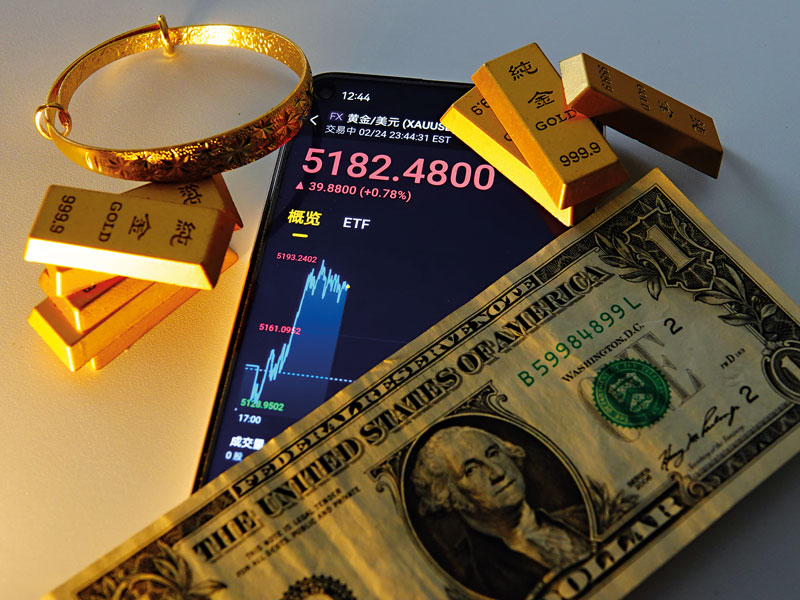
In times of geopolitical stress, markets tend to fall back on familiar patterns. Risk assets weaken, safe havens strengthen and correlations behave in predictable ways. Yet recent developments have challenged this conventional playbook. Gold, long regarded as the ultimate store of value during uncertainty, has behaved in a manner that appears at first glance contradictory. In the lead-up to the heightened tensions in the Middle East, gold prices rallied strongly, reflecting investors’ anxiety and a growing demand for protection. However, once the conflict materialised, the metal unexpectedly declined, defying its traditional role as a safe haven.
This divergence between expectation and reality offers a revealing window into how modern markets are evolving and why long-standing relationships between assets are becoming less reliable. At the heart of this shift lies a broader transformation. Markets today are increasingly driven not just by events themselves but by expectations of positioning and liquidity conditions surrounding those events.
Anticipation over reaction
Gold’s rally prior to the escalation of geopolitical tensions was largely rooted in anticipation. Investors anticipating instability following US President Trump’s return to the White House began positioning defensively. Central banks continued to accumulate gold as part of broader diversification strategies, while persistent concerns about the trade war, inflation and global growth added further support.
However, once the geopolitical event unfolded, markets had already priced in a significant degree of Trump-related risks. This led to a classic ‘buy the rumour sell the fact’ dynamic where the absence of further escalation or simply the realisation that worst-case scenarios had not materialised triggered profit taking. This coming hot on the heels of the winding down in precious metals’ speculative frenzy exacerbated the sell-off.
At the same time, macroeconomic forces began to exert greater influence. Rising bond yields increased the opportunity cost of holding non-yielding assets like gold. Meanwhile, a strengthening US dollar absorbed a significant portion of safe-haven demand. Together these factors outweighed the geopolitical premium that would typically support gold prices. This episode highlights a critical shift. Markets are no longer purely reactive. Instead, they are increasingly forward-looking, pricing in risks well before they materialise and adjusting rapidly as new information emerges.
US dollar dominance endures
One of the most important factors shaping gold’s recent behaviour is its relationship with the US dollar. Traditionally, gold and the dollar share an inverse correlation. When the dollar strengthens, gold tends to weaken and vice versa. This relationship is rooted in gold being priced in dollars and its role as an alternative store of value. In the current environment, this inverse relationship has reasserted itself with considerable force. Despite geopolitical uncertainty, the US dollar has remained exceptionally strong, underscored by relatively higher interest rates amid a resilient economic performance, and its enduring status as the world’s primary reserve currency.
As a result, safe-haven flows that might historically have supported gold have instead been directed towards the dollar. For global investors, particularly in times of crisis, liquidity and accessibility often take precedence over tradition. The dollar offers both, reinforcing its position as the dominant safe haven in the modern financial system. This dynamic suggests that while gold retains its long-term appeal as a hedge against systemic risk, its short-term performance is increasingly constrained by macroeconomic factors, especially monetary policy and dollar strength.
Unusual equity alignment
Perhaps more surprising than gold’s relationship with the dollar has been its recent interaction with equities. Historically, gold and equity markets tend to move in opposite directions. When appetite for risk declines and equities fall, gold rises as investors seek safety. Conversely, during risk-on environments, gold typically underperforms. However, recent market behaviour has revealed periods where both gold and equities have moved higher simultaneously. This apparent breakdown in traditional correlation reflects deeper structural changes in how markets function.
The recent behaviour of gold serves as a broader reminder that financial markets are not static
One key driver of this phenomenon is liquidity. In an environment where central banks have over the past decade injected significant liquidity into the financial system, asset prices across the board have become increasingly sensitive to capital flows rather than purely to fundamental distinctions between risk and safety. Institutional investors meanwhile are adopting more nuanced strategies. Rather than viewing gold strictly as a hedge against equity risk, they are incorporating it as part of diversified portfolios that can benefit from multiple macroeconomic scenarios.
This has led to overlapping demand where both equities and gold can attract inflows under certain conditions.
The result is a more complex market environment where traditional risk on and risk off frameworks no longer fully capture asset behaviour. Instead, markets are increasingly characterised by hybrid dynamics where assets can respond simultaneously to different and sometimes conflicting drivers.
Geopolitics and market asymmetry
While gold’s behaviour offers valuable insight, the broader impact of geopolitical tensions extends across multiple asset classes. The Middle East crisis in particular has highlighted how geopolitical risk creates asymmetrical effects, producing clear winners and losers across the global economy. Energy markets have been among the primary beneficiaries. Oil and gas prices have soared amid concerns over supply disruptions, reinforcing the strategic importance of energy security. Defence-related industries have also seen increased investor interest, reflecting expectations of sustained or increased military spending.
The US dollar, as noted, has strengthened further, benefiting its role as a global reserve currency and a preferred destination for capital during periods of uncertainty. On the other side of the equation, emerging markets have faced renewed pressure. Capital outflows stemming from currency volatility and heightened sensitivity to external shocks have made these economies particularly vulnerable. Risk-sensitive currencies have struggled while trade-dependent economies face additional challenges as global supply chains come under strain again. This divergence underscores a key feature of modern geopolitical risk. Its effects are not evenly distributed. Instead, they amplify existing strengths and weaknesses within the global economic system.
The persistence of elevated risk
If geopolitical tensions remain elevated, several broader market trends are likely to persist. Volatility, already a defining feature of recent years, is expected to remain high. Investors will continue to navigate an environment where sudden shifts in sentiment can lead to rapid price movements across asset classes. The dominance of the US dollar is also likely to endure particularly if interest rate differentials remain favourable. This could continue to place pressure on alternative assets, including gold, in the short term.
At the same time, commodities, especially energy, may remain supported by ongoing supply concerns and structural shifts in global trade patterns. Gold, despite its recent fluctuations, could still benefit over the longer term as a hedge against systemic risk, particularly if geopolitical tensions evolve into more prolonged or widespread disruptions. Central banks for their part are likely to maintain a cautious stance. Balancing inflation control with economic stability becomes increasingly complex in an environment shaped by both geopolitical uncertainty and shifting market dynamics.
The recent behaviour of gold serves as a broader reminder that financial markets are not static. Relationships that once held consistently can weaken or even reverse under new conditions. For investors, this presents both a challenge and an opportunity. Relying solely on historical correlations is becoming increasingly insufficient. Instead, a more flexible approach is required – one that recognises the interplay between macroeconomic forces for geopolitical developments and evolving market structures. Understanding the drivers behind asset behaviour is now more important than ever. Why is the dollar strengthening? How are interest rates influencing capital flows? What role does liquidity play in shaping price movements? These questions are central to navigating today’s markets.
A new market reality
The global financial landscape is entering a phase defined by complexity and transition. Geopolitical risks are becoming more frequent and more interconnected while macroeconomic conditions continue to shift in response to policy decisions and structural changes. In this environment, the concept of a safe haven is itself evolving. Gold remains an important component of the financial system, but its role is no longer as straightforward as it once was. The US dollar, supported by its unique position in global finance, continues to dominate in times of stress. Meanwhile, correlations between assets are becoming more fluid, reflecting the growing influence of liquidity and investor behaviour.
For market participants, the implications are clear. Adaptability rather than adherence to tradition is becoming the defining characteristic of successful investment strategies. The ability to interpret changing relationships and respond to new dynamics will be critical in an increasingly unpredictable world. As recent events have shown, even the most established assumptions can be challenged. In the evolving landscape of global finance, understanding these shifts is not just advantageous, it is essential.

