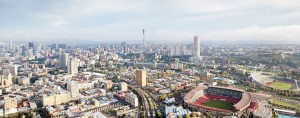
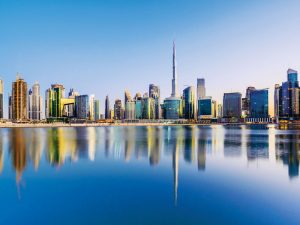
China could soon be the GCC’s biggest trading partner by the end of the decade
The world’s fastest growing economy over the last decade is set to significantly increase its trade with the Gulf Cooperation Council (GCC) over the coming years. China already has strong links with GCC member states, enthusiastically buying as majority...
Colliers International provides a variety of infrastructure development services in the MENA region, where the rapidly growing and restless population is demanding new projects
Since the 1980s, public-private partnerships (PPPs) have gained global popularity as a means of effectively delivering projects in the public sector. PPPs emerged against the backdrop of financial constraints and management capacity in the public sector t...
With Ghana’s government looking to build on public services through the private sector, Magdalene E Apenteng, Sampson Nortey, Ekow Coleman and Irene Addo-Dankwah address the living standards of future generations at the forefront of the country’s development
Ghana’s economy has remained relatively strong in recent years, even throughout the global economic crises. Real GDP growth rose from four percent in 2009 to 7.7 percent in 2010, and 13.6 percent in 2011, aided by oil revenues and strong export performa...
Nigeria’s impressive economic growth seemed to be faltering in 2011 as the global recession took its toll, but recent legislative changes suggest a brighter financial future, says Koye Edu, Managing Partner of Jackson Etti Edu
Over the past decade, Nigeria’s economy has witnessed substantial growth, and the economy grew at an annual average of 7.4 percent. In 2011, economic growth dropped marginally by 0.18 percent. At the outset of 2012, the big question was whether Nigerbuy...
The Democratic Republic of Congo needs to make better use of its natural resources to adequately support its growing population, says Eustache Ouayoro, Country Director at the World Bank
The signs are there, although they are still somewhat tentative, that the Democratic Republic of Congo (DRC) may be emerging from its many years of conflict and instability and navigating its way towards a new development era. It cannot come soon enoorder...
The Democratic Republic of Congo has seen vast change recently, as services have improved and boosted its economy. With more to do, Prime Minister Matata Ponyo discusses the country’s best interests
Many prime ministers and presidents in crisis-hit Europe may feel they have more than their fair share of problems, but they could spare a thought for the Prime Minister of the Democratic Republic of the Congo (DRC). When Matata Ponyo took office in buy c...
Mozambique has endured civil war and a lack of investment, but the discovery of natural resources could transform the country’s economy
Mozambique has emerged from a period of instability as a source of great interest for international investors, not least because of its abundance of natural resources. GDP has grown on average seven percent during the last two years, and many feel that th...
Proving to be excellent at harnessing natural resources, Mongolia, Myanmar and Mozambique are all strong countries attracting wider investment opportunities
Silk Road Finance (SRF) is developing successful investment banking business focused on strong frontier markets. The M3: Mongolia; Myanmar; and Mozambique. We firmly believe that these three countries will be among the world’s top five fastest-growing...
There has been anguish for almost every region since the global financial crisis struck in 2008, but political will and effective policy will prevent further torment, writes Shoyeb Ali
Irrelative of bullish or bearish tagging, the year 2011 will be remembered predominantly as a year where market volatility reached its peak. The year was marked by a period of international institutions bailing out countries within the eurozone, in compar...
If you are looking for a trusted investment solutions provider in Saudi Arabia then Alistithmar Capital is the company excelling within the region
As one of the leading providers of asset management and brokerage services in Saudi Arabia, Alistithmar Capital helps its clientele to take advantage of the favourable local economic conditions amid the global recession and slow growth concerns. According...
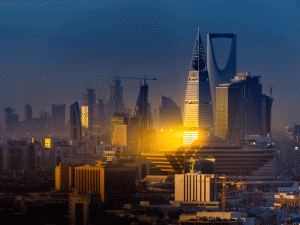
As the majority of the world’s economies struggle, there are still regions with growing economies and vast business potential. At the forefront of this pack are the GCC countries who are making award-winning progress
It’s a cruel set of circumstances that casts the nations of the Gulf Cooperation Council in such good health. With Europe struggling to implement austerity, the US economy at crawl pace and even China’s mighty growth hitting a few speed bumps, the Gul...
France is set to re-establish itself as an arms supplier to the new independent state of Libya, following a recent military contract between the two countries
In February, France signed a long-term contract with the Libyan government and agreed to refurbish Libya’s Mirage F1 fighters and also offer pilot training to the country's air force. French defence minister, Gerard Longuet has been reported as saying t...
Although a lawsuit has delayed substantial maneuvers, interested parties are moving into Congo
Mining company Eurasian Natural Resources Corp (LSE: ENRC), announced that it had reached a £804m settlement with Canadian company, First Quantum Minerals, over a disputed mine in the Democratic Peoples’ Republic of Congo. The settlement was announced ...
Reforms and resources open doors for investment in Zimbabwe’s growing property markets
For some time, Zimbabwe has been on the ‘no-go’ list as far as international investment is concerned, largely due to the country’s ongoing political instability, AIDS epidemic and a shrinking commercial farming sector in the wake of the governmentâ€...
New international communication links in 2012 will further support the expanding financial services industry
The Seychelles consists of 115 islands in the Indian Ocean, hosting a population of about 88,000. Being an archipelago, the country is small on land-mass – but it controls a significant area of exclusive economic zone in the sea, which the governmen...
European countries are scrambling to raise every last penny of funds through taxes. But some countries may have gone too far...
Though all business taxes in Belgium can be paid online with little effort and preparation, the rates are still sky-high at 57.7 percent, including a staggering 50.8 percent total rate on profits only in social security contributions.
In Belarus, a company spends up to 338 hours annually preparing for and paying ten different taxes and duties. The total tax rate has incredibly been lowered to 60.7 percent, from 117.5 percent in 2008.
A company in France pays seven different taxes and duties, the sum of which can amount to 65.7 percent of profits; though President François Hollande has announced a wave of business tax rate cuts coming up.
A business in Estonia pays 67.3 percent of profits in tax, 37.2 percent exclusively in social security contributions. The country has gone against the grain in Europe by raising businesses taxes from 48.6 percent in 2008 to the current rates.
While corporate income tax (IRES) in Italy is limited to 38 percent of taxable profit, a company operating in Italy can expect to pay 14 other taxes and duties, including social security contributions, bringing their total payable tax to 68.7 percent of profits, according to the World Bank.
Norway taxes motor fuels twice, with a road use tax and a CO2 emissions tax. Combined with strikes in the energy sector that have curbed output, the price of gas at a local pump has soared to $10.12 per gallon.
Though Turkey sits on the Suez Canal and neighbours many oil rich countries, the price of a gallon of average gas clocks in at $9.41 in Turkish pumps, because of a 60 percent share of taxes.Â
Like Turkey, Israel is surrounded by oil-rich neighbours, but drills very little itself. Gas prices are controlled by the government, so about half of the $9.28 per gallon goes to taxes.
There are few gas stations in Hong Kong, but the ones available charge up to 76 percent more per gallon than mainland China, where the government caps the cost of fuel. A gallon at the pumps will cost around $8.61 on the island.
Expensive labour costs make the Dutch petrol prices the dearest in Europe, at $8.26 per gallon; though the 57 percent tax add-ons don’t help.
8 February 2007
HSBC warns of subprime mortgage losses
2 April 2007
New Century goes bus
14 September 2007
Wholesale markets have dried up
17 March 2008
Rescue of Bear Stearns
7 September 2008
Rescue of Fannie Mae
15 September 2008
Lehman Brothers file for bankruptcy
3 October 2008
US congress approves $700bn bailout
14 February 2009
$787bn stimulus approved by congress
The effects of the current financial crisis are global and irrefutable. With the collapse of Lehman Brothers, the domino effect of irresponsible public monetary policies, huge levels of unsustainable debt, and a deregulated financial sector, has escalated to the point where no corner of the globe has been left untouched.
October 1973
Syria and Egypt launch an attack on Israel on Yom Kippur and set off a twenty day war;
1977
US President Carter creates Department of Energy, which develops the US strategic petroleum reserve
The Organisation of Petroleum Exporting Countries (OPEC) used their oil reserves as a weapon with the Arab Oil Embargo against those who supported Israel. By January 1974, world oil prices were four times higher than they were at the start of the crisis, especially in the US, and the shock led to a huge drop in the stock market with NYSE losing $97bn in just six weeks. The embargo lasted five months, and the effects are still seen today.
1922-1923
Hyperinflation
1923 – 1924
Stabilisation
The trouble began when Germany missed a repatriation payment, worth about one third of the German deficit in this period. Inflation was already high but by 1923 it was raging. Prices doubled within hours, and by late 1923, it cost 200bn marks to buy a single loaf of bread. People burned money as it was cheaper than buying firewood. Germany eventually regained control of its economy when it introduced the Rentenmark into circulation in 1923, and then the Reichmark in 1924.
1929-1933
The Great Crash
1934-1939
Recovery and Recession
After the decadence of the Roaring Twenties, the 1930s saw the biggest economic slump of all time. The stock market crashed on 29 October 1929, and optimism and decadent living tumbled along with the figures. The GDP fell from $103.6bn in 1929, to $66bn in 1934 and the subsequent years of recovery were the most dramatic in US history.
1907
Otto Heinze and his brother Augustus Heinze bought shares of United Copper.
The stock market was already cautious over the tight money supply, but the US was thrown into a depression after the stock market fell nearly 50 percent from its peak in 1906. The Heinze brothers thought they could influence market shares but ended up bankrupting lenders that provided the financing to buy the stock. A chain reaction left nine institutions bankrupt. By February 1908, the panic was over and the government created the Federal Reserve system, to prevent banks from exercising too much control over the economy.